
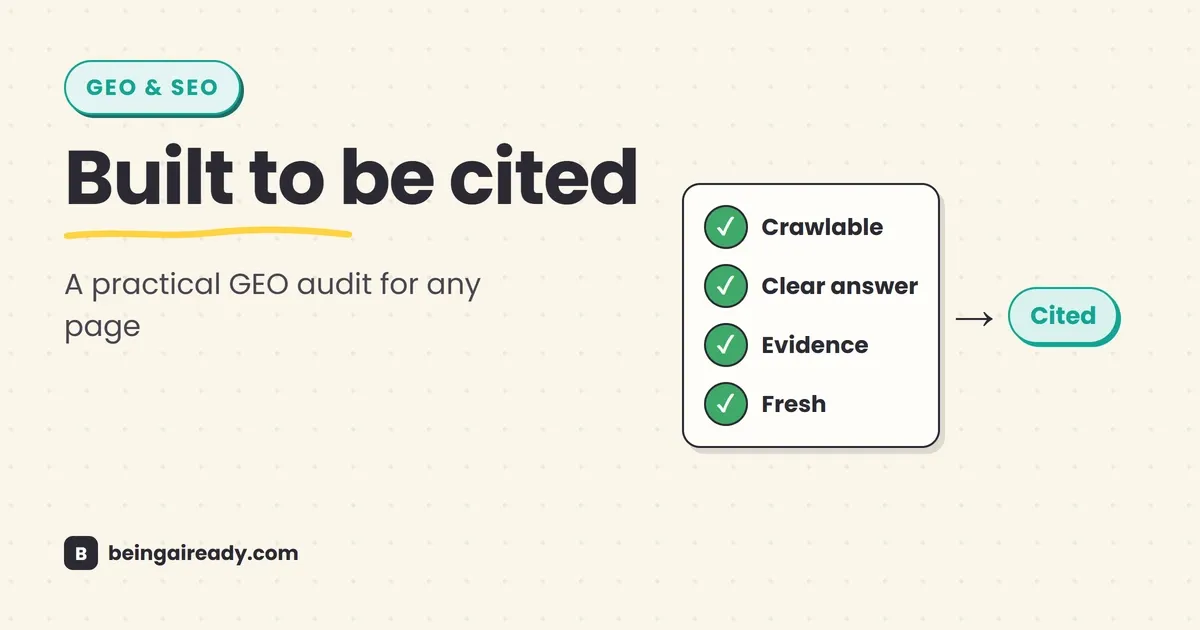
The GEO Checklist: Make Any Page AI-Citable
You wrote the best page on the topic. It ranks in the top three, it earns links, and a human who lands on it gets exactly what they came for. Then you ask an AI assistant the very question your page answers — and it quotes three other sites instead, or paraphrases your work and hands the credit to someone else.
A page can rank well in search and still be awkward to cite. It might bury its answer under a long introduction, make a useful claim without showing where the number came from, or describe a company, product, or method so vaguely that a retrieval system cannot tell which entity it means. And a page that is excellent for a human reader is worth nothing to the AI product you care about if the crawler feeding that product never gets in.
That is the practical problem Generative Engine Optimization, or GEO, is trying to solve. It is not about writing for a robot or inserting a magic file that forces an assistant to mention your brand. The useful work is more ordinary: making a page easy to find, interpret, verify, extract, and attribute without distorting what it says.
This checklist turns that idea into an audit you can use on a blog post, product page, comparison, report, service page, help article, or research page. It is deliberately strict about the difference between improving eligibility and guaranteeing a citation, because no honest checklist can promise the latter. AI search systems use different indexes, retrieval methods, ranking signals, and citation policies. Their answers can also change between runs. A 2026 ACL study comparing Google, OpenAI, and Perplexity systems found substantial differences in source diversity, retrieval behavior, and stability across platforms.
Quick answer: To make a page AI-citable, first make it technically eligible: indexable, snippet-eligible, fast enough to render, canonically clear, and accessible to the relevant search crawler. Then make its content easy to use: answer the main question early, write self-contained factual passages, use descriptive headings, clarify entities, add evidence and primary sources, identify the author, show meaningful publication and update dates, and keep structured data consistent with what readers can see. Finally, measure citations separately from mentions, traffic, and conversions. No item guarantees inclusion, but together they remove the most common reasons a good page is ignored or cited badly.
Here’s what you’ll walk away knowing:
- What “AI-citable” actually means, and why it is a chain of several decisions rather than a new ranking position.
- A detailed checklist covering technical access, page focus, answer structure, evidence, entities, schema, freshness, and page experience.
- Which popular GEO tactics are useful, which are optional, and which are mostly theater.
- How to audit a page in fifteen minutes, then improve it in the right order instead of rewriting everything at once.
- How to measure AI visibility without mistaking a one-off mention for a durable result.
What “AI-citable” means in practice
An AI answer usually does not begin by reading every page on the internet. Depending on the product and query, it may search an index, issue several related searches, retrieve passages from a small set of pages, evaluate those passages, compose an answer, and attach citations to some of the claims it used.
Google describes its AI search features as using retrieval-augmented generation and query fan-out, where the system issues related searches across subtopics before assembling a response. It also says a page must be indexed and eligible to appear with a snippet to qualify for inclusion in Google’s generative search features. OpenAI separates its search crawler, OAI-SearchBot, from GPTBot, which is associated with potential model training. Microsoft describes AI answer selection as working at the level of useful pieces of a page, not merely ordering complete pages in a traditional results list.
Those implementations are not identical, but they suggest a useful four-stage model:
| Stage | The system needs to do | What can go wrong on your page |
|---|---|---|
| Discover | Find and access the URL | Blocked crawler, orphan page, broken sitemap, slow or failed rendering |
| Retrieve | Match the page or passage to the query | Vague focus, weak internal linking, unclear title, missing subtopic coverage |
| Use | Extract a complete, relevant answer or piece of evidence | Answer buried in prose, missing context, key facts trapped in images, unsupported claims |
| Cite | Attribute the answer to a suitable source | Unclear author, ambiguous entity, weak evidence, stale page, conflicting versions |
A fifth stage happens after the citation: the user decides whether to click and what to do next. That matters because a citation with no useful referral traffic may still build awareness, while a less prominent citation might send a highly qualified visitor. GEO measurement has to keep visibility, influence, traffic, and business outcomes separate.
The original GEO paper presented at KDD 2024 helped formalize this area and showed that changes to how content was presented could alter visibility inside its experimental setup. That was important, but it was not evidence for one universal formula. Modern AI search is a moving, multi-platform retrieval problem, not a single algorithm you can reverse-engineer once.
Before the checklist: three rules that keep GEO honest
1. Eligibility is not selection
You can make a page perfectly crawlable, clearly written, properly marked up, and still not receive a citation. The system may prefer a primary source, a more specific passage, a better-known domain, a fresher page, or a different perspective — and for some prompts it will not search the web at all. This checklist exists to remove avoidable weaknesses; it cannot remove competition or platform discretion, and any honest account of GEO has to say so up front.
2. A citation is not proof that the answer used you well
An AI system may cite a page next to a sentence that only partly reflects it, combine your fact with another source’s interpretation, or list your page among supporting links without ever drawing on its distinctive evidence.
Measure citation selection and citation absorption separately:
- Selection: Was your URL cited or shown as a source?
- Absorption: Did the answer use your fact, phrasing, method, comparison, or conclusion accurately?
This distinction matters most for original research, product claims, and expert commentary, where a link in a source panel is not the same thing as your evidence actually shaping the answer.
3. The page still has to satisfy the person who clicks
A bad GEO strategy produces pages that look like answer fragments stapled together: forty headings, repetitive definitions, thin FAQ blocks, and no coherent argument. That may be easy to parse, but it is unpleasant to read and often adds little value.
Google’s current guidance on generative AI search is explicit that ordinary SEO foundations and people-first, non-commodity content remain central. It also rejects the idea that pages must be chopped into tiny chunks or rewritten in a special “AI language.” The strongest page is not the one most aggressively formatted for extraction. It is the one that remains useful when read as a whole and still contains passages that work when retrieved separately.
The GEO checklist
Use this as a page-level audit. A check means the item is genuinely true, not merely that a plugin reports no error.
Part 1: Make the page discoverable and eligible
An AI system cannot cite content it cannot access or retrieve. Technical SEO is not the glamorous part of GEO, but it is the part that makes everything else possible.
[ ] 1. The preferred URL returns a clean 200 response
The canonical page should load reliably for users and crawlers. Check for accidental redirect chains, soft 404s, intermittent server errors, bot challenges, geo-blocking, and security tools that serve different content to crawlers.
A technically “live” page that frequently returns 403, 429, or 5xx responses is not reliably discoverable. Inspect server logs rather than assuming a successful browser visit proves crawler access.
[ ] 2. The page is indexable
Confirm that the preferred URL is not blocked by:
- A
noindexrobots meta tag. - An
X-Robots-Tag: noindexHTTP header. - A CMS setting that excludes the page or content type.
- A canonical pointing to another URL.
- Authentication, a consent wall, or an interstitial that prevents access to the main content.
For Google’s AI features, the page must be indexed and eligible to appear in Search. A page that is intentionally excluded from search should not be expected to appear as a normal cited source in AI Overviews or AI Mode.
[ ] 3. The page is eligible to provide a useful snippet
Snippet controls matter more than many site owners realize. Google states that nosnippet and restrictive max-snippet settings can limit how content is used in AI Overviews and AI Mode. Review page-level robots directives and any data-nosnippet attributes around the main answer.
This does not mean every page should expose everything. It means snippet restrictions should be deliberate. Do not accidentally wrap the core definition, conclusion, price, or evidence in a component your template marks as unavailable for snippets.
[ ] 4. The relevant AI search crawler is allowed
Crawler policy should match your actual goal.
For ChatGPT search, OpenAI says sites should allow OAI-SearchBot and permit traffic from its published IP ranges. OpenAI also says OAI-SearchBot and GPTBot can be controlled independently, so a publisher can allow search visibility while disallowing potential training use.
A simplified policy may look like this:
User-agent: OAI-SearchBot
Allow: /

User-agent: GPTBot
Disallow: /
Do not copy that blindly into a production site. Check your existing rules, CDN, firewall, bot-management service, and legal policy. A permissive robots.txt file does not help if the infrastructure blocks the crawler before it reaches the page.
[ ] 5. The page appears in an XML sitemap
Include the canonical URL in a current XML sitemap. Reference the sitemap from robots.txt, submit it to the major webmaster tools you use, and remove dead, redirected, duplicate, or non-canonical URLs.
A sitemap is not a ranking boost. It is a reliable discovery and maintenance signal, particularly for large sites, new pages, and content that is not naturally linked from frequently crawled sections.
[ ] 6. Important updates are actively signaled
For sites where freshness matters, use IndexNow to notify participating search engines when a URL is added, updated, or removed. Microsoft specifically recommends it for keeping AI answers aligned with the current version of a page.
Still keep a sitemap. IndexNow is an update signal, not a replacement for clean crawl paths, internal links, or canonicalization.
[ ] 7. The main content is present in crawlable HTML
Do not make a crawler solve a puzzle to find the answer.
- Render the primary text server-side or ensure reliable JavaScript rendering.
- Put key facts in HTML, not only in an image, canvas, video, or downloadable PDF.
- Avoid loading essential sections only after a user interaction.
- Test the rendered page, not just the source code or CMS editor.
Microsoft advises against relying on PDFs for core information and against placing key facts only in images. PDFs and images can support a page, but the page should contain the essential claim, context, and summary in accessible HTML.
[ ] 8. The page has one clear canonical version
Duplicate and near-duplicate pages make it harder for search systems to choose the right URL and can split signals across versions.
Check for:
- Tracking parameters that create indexable copies.
- Printer, AMP, translated, or syndicated variants with inconsistent canonicals.
- HTTP/HTTPS and
www/non-wwwduplication. - Category and tag archives that repeat most of the article.
- Product variants that compete for the same intent without a clear parent-child structure.
Consolidate where possible. When duplicates must exist, use accurate canonicals, redirects, and hreflang rather than leaving the system to infer your preferred page.
[ ] 9. The page is internally linked from relevant content
An orphan page is difficult to discover and difficult to place in a topic.
Link to it from pages that explain the surrounding subject, using anchor text that describes the relationship. A page about AI citation measurement should naturally link from your broader guides to GEO and GEO versus SEO.
Internal links do two jobs: they help crawlers find the page, and they tell retrieval systems how the page fits into your site’s subject map.
[ ] 10. Access controls, paywalls, and consent layers are explicit
A paywalled page can still be discoverable, but the implementation needs to be clear. Use the appropriate paywall markup, expose enough accurate public information for discovery, and avoid showing crawlers content that users cannot access without explaining the restriction.
For lead-generation pages, do not hide the complete answer behind a form and expect the public teaser to be cited as if it contained the evidence. Publish a useful summary and make the gated asset the deeper layer.
Part 2: Give the page a precise job
Retrieval becomes easier when the page has a clear purpose. “Comprehensive” should mean complete for a defined question, not vaguely about everything in the category.
[ ] 11. One primary question or intent is obvious
Finish this sentence in one line:
This page helps [specific reader] answer [specific question] so they can [specific outcome].
If you cannot, the page may be trying to serve several unrelated intents. Split pages only when those intents genuinely need different answers, not to manufacture more URLs.
A focused page can still cover adjacent questions. The difference is that each section supports the main job rather than wandering into a new topic because a keyword tool suggested it.
[ ] 12. The title, description, H1, and introduction agree
These elements do not need to repeat the same phrase, but they should describe the same page.
A common failure looks like this:
- Title: “Best CRM Software for Small Businesses”
- H1: “The Complete Guide to Customer Relationships”
- Introduction: a general history of sales technology
The system has to infer whether the page is a product comparison, a definition, or a strategy guide. Make the scope explicit.
[ ] 13. The page names important entities unambiguously
Use the full name on first reference and add disambiguating context where needed.
Instead of:
Atlas supports agents.
Write:
OpenAI’s ChatGPT Atlas browser supports agentic interactions with websites.
Instead of:
The company increased the limit in May.
Write:
Microsoft added AI Performance reporting to Bing Webmaster Tools in February 2026.
Pronouns and shorthand are natural, but a passage that may be retrieved by itself should not force the system to guess who “they” or “it” refers to.
[ ] 14. The page covers the obvious follow-up questions
AI search systems often expand a query into related subqueries. A page about “best invoicing software for freelancers” may need to address price, payment collection, tax support, recurring invoices, mobile access, and who should not use each option.
Covering those follow-ups on one page can make it more useful, but only when they belong to the same decision. Do not create a padded section for every syntactic variation of the keyword. Google specifically warns against making separate content for every possible query variation and says its systems can understand relevance without exact wording.
[ ] 15. Important terms are defined in the page’s own context
Do not assume a retrieved passage will carry definitions from three sections earlier.
A good definition is brief and operational:
Citation absorption is the extent to which an AI answer actually uses a source’s facts, evidence, phrasing, or reasoning, rather than merely listing the source as a link.
Avoid circular definitions, dictionary filler, and definitions written only to target a “what is” query. Define the term because the reader needs it to understand the page.
[ ] 16. The page states its boundaries
Strong sources are clear about where their answer applies.
Examples:
- “This comparison covers tools available to individual users in India as of August 2026.”
- “The results apply to our test dataset and should not be treated as a universal benchmark.”
- “This is general information, not legal advice.”
Boundaries make a passage safer to quote because they reduce the chance that the claim will be reused too broadly.
Part 3: Make the answer easy to extract without flattening the writing
This is where GEO becomes visible on the page. The goal is not to write like a database. It is to make complete ideas easy to locate.
[ ] 17. The primary answer appears early
A reader should not have to scroll through six paragraphs of scene-setting to learn the page’s conclusion. Put a short answer, recommendation, or definition near the top, then earn the nuance below it.
The quick answer should be:
- Direct enough to stand alone.
- Qualified enough not to mislead.
- Specific enough to be useful.
- Consistent with the rest of the article.
Do not write a dramatic teaser that withholds the answer. That style may increase scrolling in some contexts; it also makes the page less efficient as a factual source.
[ ] 18. Headings describe the question or decision beneath them
Vague headings such as “Overview,” “More details,” and “What next?” waste a strong structural signal.
Prefer:
- “How does OAI-SearchBot differ from GPTBot?”
- “When should you update an existing page instead of publishing a new one?”
- “What makes a comparison table trustworthy?”
Descriptive headings help readers scan and help retrieval systems identify where a specific answer begins.
[ ] 19. Each important passage is self-contained
A self-contained passage makes sense when extracted from the page.
Weak:
This is why it matters so much.
Stronger:
Clear publication and modification dates matter because an AI system choosing between similar sources may need to identify which page reflects the current state of a fast-changing topic.
You do not need to repeat every noun in every sentence. Focus on the passages most likely to carry an answer, number, recommendation, or definition.
[ ] 20. One sentence does not carry five separate claims
Dense sentences are difficult to verify and easy to cite inaccurately. Separate claims that have different evidence, conditions, or timeframes.
Weak:
Tool A is the fastest, safest, cheapest, easiest, and most popular platform for small teams.
Stronger:
Tool A was the fastest option in our five-workflow test. It was not the cheapest: its entry plan cost $12 more per month than Tool B at the time of testing.
The stronger version is easier to evaluate and harder to distort.
[ ] 21. Lists are used for real sets, not decorative formatting
Use a list when the content is genuinely a sequence, checklist, group of requirements, or set of alternatives. Use prose when the idea depends on connection and explanation.
A page made entirely of bullets often loses reasoning and context. A page made entirely of long paragraphs hides steps and comparisons. The right format follows the information.
[ ] 22. Tables make comparisons explicit
Tables are particularly useful for:
- Product features and prices.
- Eligibility criteria.
- Before-and-after examples.
- Options with clear trade-offs.
- Research results with consistent units.
Give each column a precise label, define units, state the date of volatile figures, and explain the conclusion in prose. A table without interpretation is data storage, not an answer.
[ ] 23. Key answers are not hidden only in accordions or tabs
Expandable sections can improve a long page, but do not place the only version of a crucial answer inside an interaction that may not render consistently.
Use accordions for secondary detail. Keep the main conclusion, requirements, price, limitations, and evidence visible in the page’s primary HTML.
[ ] 24. Images, charts, and videos have a textual equivalent
A chart may carry the most valuable evidence on the page. Add:
- A descriptive title.
- Useful alt text.
- A caption that states what the chart shows.
- A nearby paragraph summarizing the conclusion and units.
- A link to the underlying data or method where possible.
The aim is not to describe every pixel. It is to make the chart’s factual contribution available even when the image is not interpreted correctly.
[ ] 25. FAQs answer real residual questions
An FAQ is useful when it resolves questions that do not fit naturally into the main narrative. It is not a dumping ground for twenty keyword variants.
Write each answer as a complete response, not “Yes, as explained above.” Keep it consistent with the visible article. Add FAQ structured data only when it is appropriate for the page and platform; schema does not turn weak questions into useful content.
Part 4: Give the system something worth citing
Formatting can make an answer easier to extract. Evidence makes it worth citing.
[ ] 26. Factual claims link to the best available source
Prefer the source closest to the fact:
- An official policy page for a platform rule.
- A regulatory filing for a company figure.
- A government dataset for a public statistic.
- The paper itself for a research finding.
- Your own documented test for a claim about your experiment.
Secondary reporting is useful for context and interpretation. It should not replace an accessible primary source when the primary source is what proves the claim.
[ ] 27. Sources are attached to the exact claims they support
A list of references at the bottom is better than nothing, but inline links make support easier to verify.
Avoid paragraphs containing several statistics followed by one link that supports only the final sentence. Do not cite a homepage when a specific documentation page exists. And never cite a source merely because it contains the same keyword.
A real URL that does not support the claim is still a bad citation. The practical verification method is simple: open the source and confirm the exact statement before publishing. Our guide to fact-checking AI answers applies equally well to human-written pages.
[ ] 28. The page contributes original value
The easiest page to replace is a summary of summaries.
Original value can be modest and still matter:
- A test you ran.
- A screenshot showing the current workflow.
- A worked example with real inputs and outputs.
- A dataset you cleaned and published.
- A decision framework built from practical experience.
- An expert interpretation that explains what common advice misses.
- A local, industry-specific, or audience-specific application.
Google’s generative search guidance emphasizes non-commodity, first-hand, expert-led content over material that merely recycles what is already available. Original evidence gives an AI answer a reason to cite your page rather than one of the dozens that repeat the same definitions.
[ ] 29. Original research explains its method
A number without a method is difficult to trust.
For a survey, test, benchmark, or analysis, state:
- What was measured.
- When it was measured.
- Sample size and selection method.
- Tools, versions, locations, and settings where relevant.
- How results were scored.
- Known limitations.
- Whether the underlying data is available.
This does not need to become a journal paper. It needs to give a careful reader enough information to understand what the result means and what it does not mean.
[ ] 30. Claims use measurable language
Replace unanchored adjectives with facts.
Weak:
Our platform offers lightning-fast, enterprise-grade performance.
Stronger:
In our published load test, the API’s median response time was 420 ms across 10,000 requests from the Mumbai region on 28 July 2026.
The stronger claim can be checked, compared, updated, and cited. The weaker one is advertising copy.
[ ] 31. Facts, interpretation, and opinion are distinguishable
Signal when you are moving from evidence to judgement:
- “The documentation states…”
- “Our test found…”
- “We think this trade-off is acceptable for…”
- “This suggests, but does not prove…”
AI answers often compress nuance. Clear labels reduce the chance that a recommendation will be restated as a universal fact.
[ ] 32. Contradictions and uncertainty are addressed
If credible sources disagree, say so and explain the source of the disagreement. Different dates, definitions, markets, test conditions, or legal jurisdictions often account for apparently conflicting numbers, and a trustworthy page makes that uncertainty legible instead of quietly hiding it.
[ ] 33. The author is identifiable and relevant
Show who created or reviewed the page and link the byline to a useful profile. The profile should explain the person’s relevant experience, role, or methodology rather than existing only as an SEO shell.
Google’s people-first content guidance strongly encourages accurate authorship information where readers would expect it, and its Article structured data guidance recommends identifying authors with a URL or sameAs property.
For organizational content, name the responsible team and describe the review process. “Admin” is not an author identity.
[ ] 34. Publication and modification dates are honest
Display the original publication date and the date of a meaningful update. Keep them consistent in visible text, structured data, sitemaps, and metadata.
Do not change the date because you fixed a typo or want an old page to look fresh. Google explicitly warns against changing dates without substantial updates. For volatile subjects, add a short note explaining what changed.
Part 5: Clarify entities and structured data
Structured data helps machines identify the page’s type and relationships. It is supporting infrastructure, not a substitute for the visible content.
[ ] 35. The page uses the most specific appropriate schema
Common examples include:
Article,NewsArticle, orBlogPostingfor editorial content.ProductandOfferfor products and commercial availability.Organization,LocalBusiness, or a more specific subtype for businesses.PersonorProfilePagefor author profiles.Datasetfor published data.HowTo,Recipe,Event, or other types when the page genuinely fits the definition and the search platform supports the experience.
Do not mark a sales page as a neutral review, add fake ratings, or apply several unrelated types because a schema plugin allows it.
[ ] 36. Structured data matches the visible page
Google’s structured data guidelines require markup to represent content visible to users. Check that names, prices, availability, authors, dates, images, ratings, and FAQs match the rendered page.
This matters beyond rich results. Conflicting machine-readable and visible facts create ambiguity about which version should be trusted.
[ ] 37. Article markup includes useful identity and freshness fields
A practical BlogPosting block might include:
{
  "@context": "https://schema.org",
  "@type": "BlogPosting",
  "headline": "The GEO Checklist: Make Any Page AI-Citable",
  "description": "A practical checklist for making pages easier for AI search systems to discover, verify, quote, and cite.",
  "datePublished": "2026-08-04T09:00:00+05:30",
  "dateModified": "2026-08-04T09:00:00+05:30",
  "author": {
    "@type": "Organization",
    "name": "Being AI Ready",
    "url": "https://example.com/about"
  },
  "publisher": {
    "@type": "Organization",
    "name": "Being AI Ready",
    "url": "https://example.com/"
  },
  "mainEntityOfPage": "https://example.com/blog/the-geo-checklist-make-any-page-ai-citable"
}
Replace the example URLs and fields with the real page. Validate the syntax and the platform-specific requirements, then inspect the rendered result after deployment.
[ ] 38. Important entities have consistent identities across the site
Use one canonical name for the organization, product, author, or methodology. Connect relevant profiles and official pages. Keep logos, contact details, addresses, and descriptions consistent.
For authors, link articles to a stable profile. For organizations, maintain a complete About page and accurate organization markup. For local businesses and products, keep first-party profiles and feeds current rather than relying only on prose pages.
Entity consistency does not mean repeating the same boilerplate everywhere. It means the web should not contain several conflicting versions of who you are and what you offer.
[ ] 39. Product and local facts are maintained in the systems built for them
For ecommerce and local queries, a blog post is not the only source of truth. Maintain:
- Product feeds, prices, availability, identifiers, shipping, and returns.
- Google Merchant Center data where relevant.
- Google Business Profile and Bing Places details.
- Opening hours, address, phone number, service area, and booking links.
Google’s guidance for generative search specifically points site owners toward Merchant Center and Business Profiles for product and local information. Feed quality and first-party listings may matter more than adding another paragraph to a category page.
Part 6: Keep the page current and internally consistent
Freshness is not a design element. It is the continued accuracy of the page.
[ ] 40. Volatile facts include a date or version
Prices, limits, model names, regulations, software instructions, office holders, availability, and benchmarks can age quickly. Attach the relevant date, location, version, plan, or jurisdiction to the claim.
“Starts at $20” is ambiguous.
“Acme Pro was listed at US$20 per user per month in the United States on 4 August 2026” is checkable and updateable.
[ ] 41. Updates change the substance, not just the timestamp
A meaningful refresh may involve:
- Rechecking every price and specification.
- Re-running a test on current versions.
- Replacing superseded screenshots.
- Adding new official guidance.
- Removing products or methods that no longer exist.
- Revising the recommendation because the market changed.
Keep a short update note for major revisions. This helps readers and reviewers understand why the page is current.
[ ] 42. Old claims, links, and examples are removed or labeled
A stale section can contaminate an otherwise current page. Check outbound links, quoted interface labels, screenshots, tables, legal references, and internal links.
When an old example remains historically useful, label the date rather than presenting it as the current state.
[ ] 43. Conflicting pages are consolidated
Sites often publish a new “2026 guide” while leaving older pages live with similar titles and contradictory advice. Decide which URL should own the topic. Update and redirect where practical; otherwise make the scope and canonical relationship clear.
One strong, maintained source usually creates a cleaner signal than a sequence of lightly refreshed annual pages competing with one another.
[ ] 44. The same fact is consistent across text, tables, schema, feeds, and media
AI systems may encounter several representations of the same entity or claim, and a product page that says “in stock,” schema that says OutOfStock, and an image showing an old price creates avoidable uncertainty — which is why factual consistency belongs in the publishing checklist, not in a final SEO pass.
Part 7: Make the page usable after the click
AI visibility is not valuable if the landing experience undermines trust or prevents the reader from completing the next step.
[ ] 45. The main content is easy to distinguish
Reduce clutter around the answer. Intrusive banners, autoplay video, excessive affiliate boxes, floating widgets, and repeated calls to action make it difficult to identify the page’s primary content.
Google includes page experience in its generative search guidance: pages should work across devices, load with reasonable latency, and make their main content easy to distinguish.
[ ] 46. The page works on mobile and under ordinary network conditions
Test the actual page on a phone, not only a desktop preview. Check layout shifts, sticky elements, broken tables, clipped code blocks, image weight, and delayed JavaScript.
A citation may send a user directly to the middle of a page or a specific heading. That destination should still make sense on a small screen.
[ ] 47. Accessibility supports both people and machine interpretation
Use semantic headings, meaningful link text, labeled forms, keyboard-accessible controls, alt text, captions, and appropriate ARIA attributes for interactive elements.
OpenAI’s publisher and developer guidance notes that accessible structure and descriptive ARIA roles help its browser agent understand interactive elements. Accessibility is not a GEO hack; it is good product design that also reduces ambiguity for automated systems.
[ ] 48. The page gives the reader a sensible next step
The next step should match the query:
- Download the underlying dataset.
- Try the calculator.
- Compare plans.
- Read the detailed method.
- Contact the right specialist.
- Subscribe for updates.
Do not let the only call to action be a generic “Book a demo” button when the visitor arrived for an informational answer. Earn the transition from evidence to conversion.
Part 8: Measure the result without fooling yourself
GEO is unusually easy to measure badly. Answers vary by platform, account state, location, time, prompt wording, and whether web search is triggered.
[ ] 49. You maintain a fixed prompt set
Create a small set of representative prompts for the page:
- The main question.
- Two or three natural paraphrases.
- A comparison query.
- A “best for” or recommendation query where relevant.
- A follow-up question that tests a distinctive fact on the page.
Record the prompt exactly. Do not change it after seeing a disappointing answer and then compare the new result as if it were the same test.
[ ] 50. You test more than one run and more than one platform
A single screenshot is anecdotal. Repeat each important test several times and record the date, platform, mode, location, and whether search was used.
The 2026 cross-platform research mentioned earlier found that generative search outputs vary across engines and over time. Treat visibility as a distribution, not a permanent rank.
[ ] 51. You record four outcomes separately
Use separate fields for:
| Metric | Question it answers |
|---|---|
| Mention | Did the answer name the brand, product, person, or idea? |
| Citation | Did it link to or list the page as a source? |
| Absorption | Did it accurately use the page’s distinctive information? |
| Referral/conversion | Did a user visit and take a valuable action? |
A brand mention without a citation can still matter. A citation without accurate absorption may be misleading. A click without conversion may expose a landing-page problem rather than a GEO problem.
[ ] 52. You use platform and first-party data where available
As of August 2026, useful sources include:
- Google Search Console’s generative AI performance reporting, where available for the property.
- Bing Webmaster Tools’ AI Performance reporting, including cited pages and grounding queries.
- Referral analytics. OpenAI says ChatGPT referral URLs include
utm_source=chatgpt.com. - Server logs for OAI-SearchBot and other relevant crawlers.
- Conversion and assisted-conversion data in your analytics stack.
No dashboard sees the whole market. Combine platform reporting with your own logs and outcomes.
[ ] 53. You compare against a baseline and a control
Before editing the page, record its current visibility for the prompt set. If possible, compare it with an unchanged page or a similar topic.
Then log the exact changes: title, section order, new original data, updated citations, schema, internal links, and technical fixes. Without a baseline and change log, every gain gets attributed to the latest rewrite even when the platform, competition, or query behavior changed independently.
[ ] 54. You optimize for business value, not citation count alone
A page cited for a broad informational query may produce little revenue. A page cited less often for a high-intent comparison may be much more valuable.
Track qualified visits, email signups, product usage, inquiries, sales, and assisted conversions. GEO is a distribution channel, not the business outcome itself.
A fifteen-minute GEO audit
You will not fully validate a page in fifteen minutes, but you can find the largest weaknesses quickly.
Minutes 0–3: Check eligibility
- Open the canonical URL in an incognito browser.
- Confirm the response is successful and the main content loads without interaction.
- Check
noindex, canonical, snippet controls, and crawler rules. - Confirm the URL is in the sitemap and internally linked.
Minutes 3–6: Check focus
- Read only the title, H1, introduction, and headings.
- Write the page’s primary question in one sentence.
- Mark any section that does not support that question.
- Note ambiguous entities, dates, markets, or versions.
Minutes 6–10: Check extractability
- Find the first direct answer.
- Copy the strongest paragraph into a blank document.
- Ask whether it still makes sense without the preceding paragraph.
- Check whether a list or table would make a real comparison clearer.
- Confirm that important facts are available in HTML.
Minutes 10–13: Check evidence
- Pick the five most consequential claims.
- Open every cited source.
- Confirm that each source supports the exact claim.
- Check author, date, method, and update notes.
- Mark vague superlatives and unsupported recommendations.
Minutes 13–15: Check measurement
- Add the URL to your GEO tracking sheet.
- Define three representative prompts.
- Record the current mention, citation, absorption, and traffic baseline.
- Choose the smallest set of changes likely to remove the largest weakness.
The BeingAiReady GEO scorecard
This is an editorial prioritization tool, not a published ranking model. Score each category from 0 to 5 based on the definitions below.
| Category | 0–1 | 2–3 | 4–5 |
|---|---|---|---|
| Access | Blocked, unstable, or not indexable | Accessible but with crawl, rendering, or duplication weaknesses | Clean access, indexing, canonicalization, sitemap, and crawler policy |
| Focus | Several unclear intents | Main intent exists but scope or entities are fuzzy | One clear job with well-covered follow-ups and boundaries |
| Extractability | Answer buried or dependent on surrounding text | Some useful headings and passages | Early answer, descriptive sections, self-contained claims, useful tables/lists |
| Evidence | Mostly unsupported or derivative | Credible sources but limited original value | Primary sources, transparent method, original evidence, calibrated claims |
| Identity | Author/entity unclear | Basic byline and schema | Strong author/entity profiles, consistent markup, dates, and first-party records |
| Freshness | Stale or contradictory | Mostly current with some weak sections | Meaningfully maintained, dated, consistent, and actively signaled |
| Experience | Difficult to read or use | Acceptable but cluttered or slow | Clear, accessible, mobile-friendly, and aligned with the visitor’s next step |
| Measurement | No tracking | Ad hoc screenshots or referral checks | Fixed prompts, repeated tests, platform data, baselines, and business outcomes |
Interpretation:
- 0–15: The page is not reliably eligible or trustworthy enough to prioritize for GEO.
- 16–25: The page can be found, but it gives an AI system several reasons to choose another source.
- 26–33: The page is citation-ready for its topic, though specific weak categories still limit it.
- 34–40: The page has strong foundations. Further gains are more likely to come from better original evidence, authority, distribution, and maintenance than from additional formatting.
Do not chase a perfect score. Fix categories scoring 0 or 1 before polishing categories already at 4.
A before-and-after example
Imagine a software company has this paragraph on a product page:
Before: Our next-generation platform makes support dramatically faster and gives teams everything they need to delight customers at scale. It integrates with leading tools and is trusted by modern businesses everywhere.
It is fluent but nearly impossible to cite. There is no clear product category, measurable fact, audience, date, integration list, or source.
A stronger version might be:
After: AcmeDesk is a customer-support platform for teams handling email and live-chat tickets. In our May 2026 test of 18,420 English-language tickets, its suggested replies reduced median first-draft time from 4 minutes 12 seconds to 1 minute 38 seconds. The test used AcmeDesk version 3.4 with human review enabled; it did not measure final resolution time or customer satisfaction. AcmeDesk currently has first-party integrations with Zendesk, Salesforce, Slack, and Microsoft Teams. Read the test method and anonymized results.
The second paragraph is not better because it sounds more technical. It is better because it answers several verification questions:
- What is the product?
- Who is it for?
- What changed?
- By how much?
- When was it tested?
- Under what conditions?
- What was not measured?
- Where can the evidence be checked?
That is the shape of citable writing: specific enough to use and bounded enough to use correctly.
A reusable content brief for an AI-citable page
Use this before drafting or refreshing a page.
# Page purpose

Primary reader:
Primary question:
Decision or outcome:
Geography / market:
Date or version scope:

# Direct answer

One-paragraph answer:
Main recommendation or conclusion:
Important qualification:

# Supporting questions

1.
2.
3.
4.

# Evidence

Primary sources:
Original data or experience:
Method:
Limitations:
Claims that require dates:
Claims that require legal / expert review:

# Entity clarity

Organization:
Product / service:
People / authors:
Terms that need definitions:
Potentially ambiguous names:

# Page structure

H1:
H2s:
Table or comparison needed:
Steps or checklist needed:
Images / charts and text equivalents:

# Technical publication

Canonical URL:
Indexing and snippet status:
OAI-SearchBot policy:
Sitemap:
IndexNow:
Structured data:
Internal links in:
Internal links out:

# Measurement

Prompt set:
Baseline date:
Platforms:
Mention / citation / absorption fields:
Referral and conversion goal:
Review date:
The brief forces the editorial, technical, and measurement work into one place. That matters because GEO fails when each team assumes another team handled the missing piece.
GEO myths that waste time
“We need an llms.txt file before AI systems can cite us”
There is no universal llms.txt standard that controls AI search visibility. Google explicitly says it does not use llms.txt or other special AI text files for Search, including its generative features. Some tools and agents may choose to read such a file, so it can be useful for a specific implementation. It is optional infrastructure, not a general ranking factor and not a replacement for the public site.
“Every paragraph should be exactly 40–60 words”
There is no evidence-based universal paragraph length for AI citation. Short passages can be easy to retrieve; longer passages can carry necessary context. Google says there is no required content “chunking” pattern or ideal page length for generative search.
Write paragraphs around complete ideas. Split when the subject changes, not when a word counter reaches a target.
“Adding FAQ schema makes us an answer source”
Schema can clarify page type and fields. It does not prove that the answer is correct, original, or relevant. A thin FAQ with inflated markup remains a thin FAQ.
“The AI will cite whoever ranks first in Google”
Traditional search visibility can affect discovery, but generative systems may issue multiple subqueries, use different indexes, retrieve lower-ranked passages, or choose sources based on the specific evidence needed, and the source set can differ from one platform and one run to the next. The point is not that SEO stopped mattering; it is that a single rank position is an incomplete model of AI visibility.
“More pages give us more chances to be cited”
More useful pages can increase coverage. More overlapping pages can create duplication, split authority, and leave the system unsure which version is current.
Publish a new page when the reader’s task, evidence, format, or intent is genuinely different. Otherwise improve the page that already owns the topic.
“We should repeat our brand name in every answer block”
Entity clarity is useful; forced repetition is not. Name the entity when a passage would otherwise be ambiguous. Use normal pronouns and variation when context is clear.
“Once we get cited, the work is finished”
AI answers are unstable, competitors update their evidence, and your own facts age. Citation monitoring is closer to rank tracking plus editorial quality control than to earning a permanent badge.
What to fix first
When a page fails the audit, work in this order:
- Access: indexing, crawler blocks, rendering, canonical, sitemap.
- Accuracy: stale facts, unsupported claims, contradictions.
- Focus: primary question, title/H1 alignment, entity clarity, boundaries.
- Answer structure: early answer, headings, self-contained passages, useful tables.
- Evidence: primary sources, original data, method, author credibility.
- Structured data: accurate schema matching the visible page.
- Experience: mobile usability, accessibility, clutter, next step.
- Measurement: prompts, baselines, repeated checks, conversion tracking.
This order prevents an expensive mistake: polishing prose and schema on a page that is blocked, duplicated, wrong, or strategically unfocused.
The bottom line
The phrase “make any page AI-citable” sounds like a formatting exercise, but it is really a publishing standard.
A citable page is technically available, topically precise, easy to quote without stripping away its meaning, and backed by evidence a careful reader can verify. It says who produced the information, when it was true, how the conclusion was reached, and where its limits are. It keeps those facts consistent across the visible page, structured data, feeds, images, and updates.
None of that is unique to AI. Good researchers, editors, librarians, journalists, and technical writers have always done it. AI search simply makes the cost of not doing it more visible. When an answer engine has to choose one passage from a crowded web, the page that removes ambiguity and supplies checkable value gives itself a better chance.
Start with one important page. Run the fifteen-minute audit. Fix the weakest category. Add something genuinely worth citing. Then measure what happens across several queries and several runs, without pretending one screenshot proves a strategy.
That is GEO without the theater: better access, clearer answers, stronger evidence, and more honest measurement.
Sources and further reading
- Google: Optimizing your website for generative AI features on Google Search
- Google: AI features and your website
- Google: Robots meta tags, snippet controls, and X-Robots-Tag
- Google: Creating helpful, reliable, people-first content
- Google: Article structured data
- OpenAI: Overview of OpenAI crawlers
- OpenAI: Publishers and developers FAQ
- Microsoft: Optimizing your content for inclusion in AI search answers
- Microsoft: AI Performance in Bing Webmaster Tools
- IndexNow: How the protocol works
- Princeton University: GEO — Generative Engine Optimization
- ACL 2026: Characterizing Web Search in the Age of Generative AI
Frequently asked questions
What does it mean for a page to be AI-citable?
An AI-citable page is easy for an AI search system to discover, retrieve, understand, verify, and attribute. It contains clear, self-contained answers, supports factual claims with evidence, identifies its author and update history, and is technically available to the crawlers or search indexes the system uses. Being AI-citable improves eligibility; it does not guarantee that any particular engine will cite the page.
Is GEO different from SEO?
GEO adds a new outcome to familiar SEO work: being selected and cited inside a generated answer, not only ranking as a blue link. The foundations still overlap heavily. Crawlability, indexing, relevance, authority, internal links, page quality, and accurate structured data continue to matter. GEO mainly changes how you structure evidence, answers, entities, and measurement around those foundations.
Do I need an llms.txt file to appear in AI answers?
No universal requirement exists. Google explicitly says it does not use llms.txt for Search or its generative AI features. Other services may choose to read the file, so maintaining one can be reasonable for a specific platform or workflow, but it is not a substitute for crawlable HTML, a clean technical setup, or useful content.
Does schema markup make a page more likely to be cited by AI?
Schema can help machines identify what a page and its entities represent, but it is not a citation switch. Use the most specific valid schema that matches the visible page, include useful properties such as author and dates, and keep the markup consistent with the content. Incorrect or inflated schema can create ambiguity rather than remove it.
How long should an AI-citable page be?
There is no preferred word count. A page should be long enough to answer the main question completely and short enough to remain focused. Some queries need a few hundred words; a technical comparison or original study may need several thousand. Useful structure and evidence matter more than manufacturing length or splitting every idea into tiny chunks.
How do I measure whether GEO is working?
Track several outcomes separately: whether your pages are crawlable and indexed, whether they appear as cited sources, whether the generated answer actually uses your information, whether users click through, and whether those visits convert. Use repeated tests across platforms, Search Console and Bing Webmaster Tools where available, referral analytics, server logs, and a fixed set of representative prompts.
Related articles
GEO vs SEO: What's Different and Why You Now Need Both
SEO earns rankings and clicks. GEO helps content get selected and cited in AI answers. Learn what differs, what overlaps, and why you need both.
What Is GEO (Generative Engine Optimization)? Complete 2026 Guide
Learn what Generative Engine Optimization is, how GEO differs from SEO and AEO, and how to improve visibility in ChatGPT, AI Overviews, Copilot, and Perplexity.
How to Show Up in Google AI Overviews
A practical 2026 guide to earning citations in Google AI Overviews through stronger SEO, original evidence, clear structure, and measurable improvements.