
What Is GEO (Generative Engine Optimization)? Complete 2026 Guide
Ask ChatGPT for the best CRM for a five-person agency and watch what it does. It runs a handful of searches, opens a dozen pages, compares their claims, and hands back a single paragraph naming two or three tools — usually with a couple of small citations off to the side that you may never click. You got your answer. Most of the pages that produced it got no visit at all.
That is a different arrangement from the one search ran on for years. You typed a query, the engine returned ten links, websites competed for a place near the top, and the page that won got the visit, the visitor saw the brand, and the publisher could measure the click. Generative search keeps the question and rewrites the middle of the journey: it may run several searches, retrieve a group of pages, compare their claims, and produce one synthesized answer, and the user gets most of what they need without opening every source. A page can matter enormously to that answer while receiving no click at all. It can rank well in conventional search and never be cited, or sit below the obvious results and become one of the sources the answer relies on.
That gap — between ranking and being used — is what Generative Engine Optimization is trying to solve.
Quick answer: Generative Engine Optimization (GEO) is the practice of improving the likelihood that your content will be discovered, retrieved, understood, cited, and used by AI-powered search systems such as Google AI Overviews and AI Mode, ChatGPT Search, Microsoft Copilot, and Perplexity. It does not replace SEO. It expands the job from ranking pages and winning clicks to building information that generative systems can confidently use in an answer — and that people still have a reason to visit, trust, and act on.
Here is what this guide covers:
- What GEO actually means, without the inflated claims now surrounding it.
- How a generative engine turns a question into a cited answer.
- The practical differences between GEO, SEO, AEO, and LLM optimization.
- What appears to influence AI visibility in 2026, and what is still unproven.
- A step-by-step GEO framework for content, technical SEO, authority, distribution, and measurement.
- How to optimize specifically for Google, ChatGPT Search, Copilot, and Perplexity.
- Which GEO metrics are worth tracking, including citations, answer influence, referrals, and conversions.
- A realistic 90-day plan for adding GEO to an existing SEO and content program.
What is GEO?
Generative Engine Optimization is the process of making digital content more discoverable and usable by systems that generate answers from multiple sources.
The term was formalized in a 2023 research paper titled GEO: Generative Engine Optimization. Its authors described a new optimization problem: conventional search engines place pages in a ranked list, while generative engines weave information and citations into a composed response. That makes visibility more complicated than a single ranking position.
A source can be:
- Retrieved but not cited.
- Cited but barely reflected in the answer.
- Used for a specific fact without receiving a prominent citation.
- Mentioned early and repeatedly.
- Used as the main evidence behind a recommendation.
- Clicked, ignored, or remembered without a click.
GEO is therefore broader than “ranking in ChatGPT.” It deals with the full path from technical access to business value:
- Discovery: Can the engine find the page?
- Eligibility: Can it crawl, index, render, and legally or technically use the content?
- Retrieval: Does the page appear relevant to the question or one of its sub-questions?
- Selection: Is it chosen over other possible sources?
- Citation: Is the page visibly attributed?
- Absorption: Does its information materially shape the generated answer?
- Action: Does the answer lead to a visit, branded search, signup, purchase, or other useful outcome?
That sequence matters because improving one stage does not guarantee the next. A crawler fix can make a page eligible without making it relevant. A highly cited page can generate little traffic. A page can influence an answer without being the citation a user notices.
A useful working definition is:
GEO is the discipline of creating and distributing information that generative systems can retrieve, verify, attribute, and confidently reuse — while preserving a compelling reason for the human reader to visit the original source.
Why GEO matters in 2026
GEO matters because generated answers are no longer a small experiment sitting beside traditional search. They are now part of the mainstream discovery layer across several major products.
Google has published dedicated guidance for websites appearing in generative search features, including AI Overviews and AI Mode. Its documentation explains that these experiences use retrieval-augmented generation and “query fan-out”: the system may turn one broad question into several related searches before assembling an answer. Google is also explicit that the foundation is still its Search index and core ranking systems. In its words, GEO and AEO work aimed at Google are still, fundamentally, SEO. Google’s 2026 optimization guide is unusually clear on this point.
OpenAI publishes a dedicated search crawler, OAI-SearchBot, and tells site owners that allowing it is important for inclusion in ChatGPT Search. Microsoft added an AI Performance report to Bing Webmaster Tools in February 2026, showing total citations, cited pages, grounding queries, and citation trends across Copilot, Bing AI summaries, and selected partner experiences. Perplexity also publishes separate user agents for search indexing and user-requested page visits.
The practical implication is not that ordinary search has disappeared. It is that one piece of content can now be evaluated in two connected markets:
- The market for rankings and clicks.
- The market for inclusion in generated answers.
They overlap, but they are not identical.
A traditional search result asks, “Which page should the user visit?” A generative engine asks something closer to, “Which information should be used, how should it be reconciled with other sources, and which references should support the answer?”
That changes the value of several things:
- A precise definition may be more reusable than a vague introductory paragraph.
- A first-party dataset may be more defensible than a polished summary of other articles.
- A comparison table may supply useful evidence for several sub-questions.
- A trusted third-party review may matter as much as the claims on your own product page.
- A page can create brand exposure even when the user does not click immediately.
It also makes measurement less tidy. Rankings remain useful, but they are no longer a complete account of visibility.
GEO is real. The certainty around it is not.
This is where much of the GEO industry gets more confident than the evidence allows. The original GEO paper reported visibility improvements of up to 40% in its experiments, with strategies such as adding relevant citations, quotations, and statistics performing well in some settings, and those findings mattered because they established that the presentation and evidential quality of a retrieved source can affect how it appears in a generated answer. What they did not show is that adding three statistics and two quotations will make a page organically discoverable in every commercial AI engine.
A 2026 critical review of 45 GEO studies makes the distinction clearly: the strongest evidence shows that a document already placed in the retrieval context can influence citation and answer use, while the evidence is much thinner for stable, cross-platform improvements in organic retrieval, long-term traffic, or conversions. Results also vary by engine, query wording, date, location, and whether the system searches the web at all. None of this is a reason to ignore GEO — it is a reason to treat it as an emerging optimization discipline rather than a solved ranking formula.
Three principles follow:
- Do not optimize for a single prompt result. Generated answers vary between runs and query phrasings.
- Separate eligibility, citation, and business impact. They are different outcomes.
- Prefer durable information quality over speculative tricks. The platforms themselves keep changing; a genuinely useful source retains value across them.
How generative engines work, in plain English
You do not need to understand model architecture to practice GEO, but you do need a rough picture of the pipeline. Otherwise, every tactic gets mixed into one vague idea of “AI visibility.”
1. The user asks a question
The query may look like a conventional search — “best CRM for a five-person agency” — or a longer request with context: “We are a five-person design agency, use Gmail, have a limited budget, and need a CRM that is simple enough for freelancers. What should we shortlist?” The second version carries more constraints, and those constraints can change which sources are useful.
2. The system may decide whether web search is needed
Some questions can be answered from the model’s existing knowledge. Others require current, local, niche, or verifiable information, so the product may activate search automatically, let the user select it, or use a retrieval system behind the scenes. When it runs no search, there is no fresh web retrieval for that particular answer — one reason GEO visibility is probabilistic rather than guaranteed.
3. The question may be expanded into sub-queries
A generative engine often needs more than one result set. Google’s documentation calls this query fan-out. A broad CRM question might be decomposed into searches for:
- CRM pricing for five users.
- Gmail integration quality.
- Freelancer access or guest seats.
- Setup complexity.
- Recent product changes.
- Reviews from agencies of a similar size.
This means a page does not need to match the original wording exactly to be useful; it may win precisely because it answers one of the hidden supporting questions unusually well.
4. Candidate pages are retrieved and ranked
The engine gathers a set of documents using search indexes, partner providers, proprietary crawlers, knowledge graphs, product feeds, business listings, and other sources. Conventional SEO signals still matter here: crawling, indexation, topical relevance, links, quality systems, freshness, page experience, and entity understanding.
This is the stage many GEO discussions skip, and it is the one that decides everything downstream: a beautifully formatted answer block counts for nothing if the page is never retrieved in the first place.
5. The system selects passages and evidence
The engine does not necessarily treat a page as one indivisible unit. It may identify passages containing a definition, price, comparison, process, caveat, statistic, quote, or product fact. Clear headings, coherent sections, descriptive labels, and self-contained explanations make the useful parts easier to identify — not because an AI demands tiny “chunks,” but because good information architecture reduces ambiguity for machines and people alike.
6. The model synthesizes an answer
The model combines what it retrieved with its instructions and existing knowledge. It may reconcile conflicting claims, compress several pages into one summary, choose examples, and decide what deserves emphasis.
At this point, being correct is not always sufficient. The information also needs to fit the user’s intent, be supported, and be easy to justify against competing sources.
7. Citations are attached
The interface may cite sources inline, place them beside a paragraph, group them at the end, or show them behind a link. Citation formats differ between engines and change over time.
A citation is useful, but it is not the whole outcome. A 2026 paper on citation selection and citation absorption found that platforms can differ in both the number of sources they cite and the degree to which those sources influence the final answer. Citation breadth and answer influence are separate things.
8. The user decides what to do next
The user may click a source, refine the question, remember a brand, compare alternatives elsewhere, or take an action directly inside an AI interface. This final stage is where GEO becomes marketing rather than an academic visibility exercise.
GEO vs SEO vs AEO vs LLMO
The terminology is messy because several labels emerged around the same shift.
| Discipline | Primary goal | Typical surface | Core question |
|---|---|---|---|
| SEO | Improve organic search visibility and traffic | Ranked search results, rich results, Discover, images, video | Will this page be crawled, indexed, ranked, and clicked? |
| AEO | Provide the clearest direct answer | Featured snippets, voice assistants, answer boxes | Can the system extract a concise answer to this question? |
| GEO | Improve inclusion and influence in generated answers | AI Overviews, AI Mode, ChatGPT Search, Copilot, Perplexity | Will this source be retrieved, cited, and used in the synthesis? |
| LLMO | Improve how a brand or entity is represented by language models | Model answers with or without live search | Does the model recognize and describe the entity accurately? |
In practice, a sensible team should not create four isolated workstreams. The overlap is much larger than the difference.
A technically sound page with a direct answer, original evidence, descriptive headings, credible authorship, strong links, accurate entity data, and relevant third-party mentions is useful across SEO, AEO, and GEO.
The differences appear mainly in measurement and emphasis:
- SEO has mature ranking, click, and conversion data.
- AEO emphasizes answer extraction.
- GEO adds multi-source retrieval, citations, answer influence, and prompt variability.
- LLMO may include model knowledge that is not tied to a live search result.
For BeingAiReady, the most practical view is simple: SEO gets you into the consideration set; GEO improves the chance that your information survives the synthesis.
What generative engines appear to reward
There is no universal GEO ranking factor list. Each engine has its own retrieval stack, providers, quality systems, model, citation interface, and update cycle. Still, official guidance and emerging research point to a set of recurring characteristics.
1. Strong relevance to the actual task
Keyword matching is not enough. The page needs to solve the problem implied by the query and its likely sub-questions.
A page titled “Best Project Management Software” may be broadly relevant. A page comparing project management tools specifically for a ten-person architecture studio, with pricing, guest access, document handling, and setup trade-offs, may be more useful for a constrained query.
This is why GEO research starts with prompt families, not one target phrase. The real unit of demand is often a task:
- Understand a concept.
- Compare alternatives.
- Decide what to buy.
- Troubleshoot a problem.
- Build a plan.
- Verify a claim.
- Calculate an outcome.
- Find a local or current fact.
2. Original, non-commodity information
Google’s 2026 guidance repeatedly distinguishes useful, first-hand material from commodity summaries. A page that restates the consensus in smoother language is easy to replace. A page with evidence only you can provide is not.
Examples include:
- Original survey data.
- Benchmarks from real usage.
- A documented experiment.
- Product specifications maintained by the manufacturer.
- First-hand photographs or video.
- A transparent pricing model.
- A case study with constraints and outcomes.
- An expert’s practical judgment, including where a method fails.
- A calculator, dataset, template, checklist, or interactive tool.
Generative systems have no shortage of generic prose. Distinctive evidence is scarcer.
3. Extractable evidence
A useful source contains information that can support a claim, not merely introduce a topic.
Evidence-rich elements include:
- Definitions with clear boundaries.
- Numbers with dates and units.
- Comparison criteria.
- Named examples.
- Step-by-step procedures.
- Advantages and limitations.
- Quotations with attribution.
- Tables that make relationships explicit.
- Statements linked to primary sources.
The original GEO paper found that citations, relevant quotations, and statistics could improve visibility in its experimental setting. Later research has also associated influential pages with structured explanations, definitions, numerical facts, comparisons, and procedures. Treat this as a quality principle, not a recipe for stuffing every paragraph with numbers.
4. Clear structure and low ambiguity
Good structure helps the engine understand what each section is about and helps a person verify the answer after clicking.
Useful patterns include:
- A plain-language definition near the top.
- Descriptive H2 and H3 headings.
- One main idea per section.
- Short summaries before deeper explanation.
- Tables for genuine comparisons.
- Ordered steps for processes.
- Visible dates on time-sensitive claims.
- Consistent names for products, companies, people, and concepts.
- Captions and alt text for meaningful images.
This does not mean every paragraph should be reduced to a tiny answer fragment. Google specifically says there is no requirement to “chunk” a page into small pieces for its generative features. Write the length and structure the subject requires.
5. Trustworthy sourcing and transparent authorship
Generative systems need grounds for choosing one claim over another. A page becomes easier to trust when readers and machines can see:
- Who wrote it.
- Why that person or organization is qualified.
- When it was published and updated.
- Which claims come from external evidence.
- Which claims come from first-hand testing or opinion.
- How corrections are handled.
- How the business can be contacted.
For high-stakes topics, primary sources and recognized institutions matter more. For product experience, first-hand testing may matter more. Trust is contextual.
6. Authority beyond your own website
What a brand says about itself is useful for first-party facts, but not always persuasive for recommendations. Independent sources help establish reputation, comparison, and consensus.
A 2025 study comparing AI search with traditional search reported a strong preference in its sample for authoritative third-party or “earned” media sources over brand-owned and social content. The authors also found meaningful differences between engines, languages, freshness, and query phrasings. The study is a preprint, so it should not be treated as a universal law, but it supports a practical observation: GEO includes digital PR, reviews, expert contributions, and reference-worthy distribution, not only on-page editing.
7. Freshness where freshness matters
A definition of photosynthesis does not need a monthly update. A software comparison, tax threshold, product price, medical recommendation, or regulatory guide might.
Useful freshness signals include:
- A visible “last updated” date.
- Specific dates beside claims.
- Removal of discontinued products.
- Updated screenshots and interfaces.
- Correct version numbers.
- Change logs for important revisions.
- Fast notification to search systems when content changes.
Microsoft recommends IndexNow to notify participating search engines when pages are added, updated, or removed. That can shorten the gap between publishing a change and having the current version available to retrieval systems.
8. Consistent entity information
An entity is a recognizable thing: a company, person, product, place, organization, or concept. Generative answers are easier to assemble when the facts about an entity are consistent across the web.
For a business, keep the following aligned:
- Official name and common brand name.
- Product names and descriptions.
- Founders and leadership.
- Location and service areas.
- Pricing and plan names.
- Social profiles.
- Contact information.
- Logos and images.
- Organization, Product, and LocalBusiness structured data where relevant.
When those facts contradict one another across the web, the resulting uncertainty is exactly what makes a source harder for a system to use with confidence.
The complete GEO framework
The most reliable way to implement GEO is to treat it as a system with four layers:
- Technical eligibility — can engines access and process the content?
- Information quality — is the page worth retrieving and quoting?
- Authority and distribution — do other sources support the entity and its claims?
- Measurement and iteration — can you tell which part of the system is improving?
The following playbook turns those layers into practical work.
Step 1: Define the business outcome before the prompt list
Do not begin with “How do we rank in ChatGPT?” Begin with the user decision you want to influence.
Examples:
- A software company wants to appear when teams compare tools.
- A consultancy wants to be recommended for a narrow service category.
- A publisher wants its original research cited.
- A local business wants accurate hours, location, and service details surfaced.
- An ecommerce brand wants its product specifications included in comparisons.
Then choose a primary outcome:
- Awareness.
- Citation authority.
- Qualified referral traffic.
- Leads.
- Purchases.
- Reduced support demand.
- More accurate brand representation.
A page can succeed at citation visibility and fail commercially. Deciding the outcome early prevents you from celebrating a metric that does not matter.
Step 2: Build a prompt and intent map
Traditional keyword research remains useful, but a GEO research set should include complete questions and realistic constraints.
Start with five sources:
- Search Console queries.
- Paid-search terms.
- Sales and support conversations.
- Community questions from forums, reviews, and social platforms.
- Questions people ask AI tools during a real buying or learning process.
Group them into prompt families rather than treating every variation as a separate page.
For a payroll software company, one family might be “choosing payroll software for a small business.” Sub-prompts could include:
- What does payroll software cost for ten employees?
- Which tools handle contractors and employees?
- What is easiest for a first-time employer?
- Which products support a specific country?
- What are the hidden fees?
- When is an accountant still needed?
A strong content asset may answer the whole family through one definitive guide plus supporting pages for country rules, pricing, integrations, and setup.
A simple prompt-mapping table
| Prompt family | User task | Important constraints | Best source type | Commercial next step |
|---|---|---|---|---|
| “What is X?” | Learn | Beginner knowledge, examples | Definitive explainer | Newsletter or related guide |
| “X vs Y” | Compare | Price, features, use case | Transparent comparison | Trial, demo, shortlist |
| “Best X for Y” | Decide | Persona, budget, location | Tested roundup or decision framework | Product page or consultation |
| “How to do X” | Complete a task | Tools, time, skill level | Step-by-step tutorial | Template, product, service |
| “Is X safe?” | Evaluate risk | Context, severity, alternatives | Evidence-led risk guide | Policy, checklist, professional help |
| “X pricing” | Budget | Seats, usage, contract term | Current pricing reference | Calculator, quote, purchase |
The mapping should reveal where you have a source and where the web has a gap.
Step 3: Audit whether the site is technically eligible
GEO cannot rescue a page that crawlers cannot access or search systems cannot process.
Check the fundamentals:
- Important pages return a successful HTTP status.
- Canonical tags point to the intended version.
- The content is indexable and not accidentally marked
noindex. - Robots.txt does not block essential search or AI-search crawlers.
- XML sitemaps contain canonical, current URLs.
- Important pages are linked internally.
- JavaScript-rendered content is available to crawlers.
- The main content is not hidden behind login, consent walls, or client-side interactions.
- The CDN or WAF is not returning 403 errors to legitimate bots.
- Page templates expose meaningful titles, headings, dates, authors, and body text.
- Mobile pages contain the same primary information.
For Google generative features, a page needs to be indexed and eligible to appear with a snippet in Google Search. Google says no special AI file or markup is required.
For ChatGPT Search, OpenAI recommends allowing OAI-SearchBot and its published IP ranges. OpenAI separates that choice from GPTBot, which is used for model training. A publisher can therefore allow search discovery while disallowing training. The current definitions and user-agent details are maintained in the official OpenAI crawler documentation.
For Perplexity, PerplexityBot is the search crawler intended to surface and link websites. Perplexity-User is used for user-requested visits and may not follow robots.txt in the same way because the fetch is initiated by a person. Perplexity documents both in its crawler guide.
Example robots.txt policy
The correct policy depends on your legal, commercial, and publishing choices. Make those choices explicitly rather than blocking every AI-related user agent by accident.
# Conventional search
User-agent: Googlebot
Allow: /

User-agent: Bingbot
Allow: /

# ChatGPT Search visibility
User-agent: OAI-SearchBot
Allow: /

# OpenAI model training: choose your own policy
User-agent: GPTBot
Disallow: /

# Perplexity search visibility
User-agent: PerplexityBot
Allow: /

Sitemap: https://example.com/sitemap.xml
Do not copy this blindly. Check your crawler policy, licensing position, security controls, and the current documentation for each platform.
Step 4: Create the best direct answer on the page
A comprehensive article should not make the reader dig through 600 words of scene-setting to find the definition.
Near the top, provide a self-contained answer that:
- Names the concept.
- Defines it in plain language.
- Distinguishes it from adjacent concepts.
- Explains why it matters.
- Avoids claims the rest of the article cannot support.
Then expand.
For a “what is” query, a useful opening often looks like this:
[Concept] is [clear category and definition]. It is used to [primary purpose]. Unlike [adjacent concept], it [important distinction]. In practice, it involves [three or four concrete components].
None of that is an AI trick; it is just considerate writing.
Step 5: Cover the full decision, not every keyword variation
Generative engines may fan one query into several supporting searches. This rewards coherent topic coverage, but it does not justify hundreds of thin pages targeting minor wording changes.
Build content around the user’s complete decision:
- Definition.
- How it works.
- Who it is for.
- When it is useful.
- When it is not.
- Alternatives.
- Cost.
- Risks.
- Setup.
- Examples.
- Evaluation criteria.
- Common mistakes.
- Next action.
The exact sections depend on the task. A medical guide should lead with safety and primary evidence. A product comparison needs current pricing and transparent testing. A technical tutorial needs versioned code and failure modes.
Google explicitly warns against producing separate pages for every possible fan-out query merely to manipulate visibility — depth is not the same as page count.
Step 6: Add evidence only your page can supply
This is the most important part of a durable GEO strategy, and it comes down to a single question. Ask: What can this page prove that a competent model could not generate from generic web knowledge?
Possible answers:
- We tested six products using the same dataset.
- We surveyed 300 customers and publish the methodology.
- We maintain the official specification.
- We have seven years of anonymized benchmark data.
- We show the exact workflow and screenshots.
- We publish the calculation and assumptions.
- We explain a failed implementation and what changed.
- We provide downloadable source data.
- We interviewed the person responsible for the decision.
First-party information gives other websites a reason to cite you and generative engines a reason to preserve your contribution rather than flatten it into generic advice.
What counts as useful evidence?
| Weak | Stronger |
|---|---|
| “Most teams save time with automation.” | “Across 42 client workflows, the median manual time fell from 18 minutes to 6 minutes; methodology and task definitions are shown below.” |
| “Tool A is easy to use.” | “Three first-time users completed setup in 14, 19, and 23 minutes; the two failures occurred at the domain-verification step.” |
| “GEO is becoming important.” | “Google, Microsoft, OpenAI, and Perplexity now publish site-owner guidance or reporting for AI search visibility; links and dates are provided.” |
| “This method improves conversions.” | “The test ran for six weeks, changed one element, and increased completed trials from 4.1% to 4.8%; traffic mix remained stable.” |
The stronger version is not automatically true — it is stronger because it can be checked.
Step 7: Cite primary and authoritative sources
External citations do two jobs:
- They let the reader verify your claims.
- They show the evidence chain an answer system can use.
Prefer the source closest to the fact:
- Official documentation for product behavior.
- Government or regulatory databases for law and statistics.
- Original research papers for study findings.
- Company filings for financial facts.
- Standards bodies for technical standards.
- First-hand reporting for events and quotations.
Avoid citation theatre: adding links that look scholarly but do not support the sentence. This is particularly important in GEO because the page may be used as an intermediate source in another generated answer. A weak citation chain can amplify an error.
BeingAiReady already has a detailed guide to fact-checking AI answers. The same discipline applies to GEO content: isolate claims, weigh their risk, and verify the important ones independently.
Step 8: Make relationships explicit
Models and readers both benefit when the page says how concepts relate instead of expecting them to infer it.
Useful structures include:
- “X is a type of Y.”
- “X differs from Y because…”
- “Use X when…, but use Y when…”
- “The process has four stages…”
- “The result depends on A, B, and C.”
- “This number applies to the 2026 plan, not the free tier.”
Tables are especially useful for comparisons when the rows use consistent criteria. A poor table simply repeats marketing copy. A good table makes trade-offs visible.
Example: vague versus reusable writing
Vague:
GEO improves online visibility by making content better for AI.
More useful:
GEO improves visibility in generated answers by addressing four separate stages: crawler access, retrieval relevance, citation eligibility, and answer usefulness. A page can pass one stage and fail the next, so GEO performance should not be reduced to a single “AI ranking.”
The second version gives the engine concepts and relationships it can use accurately.
Step 9: Build entity trust across the site
A strong article cannot compensate indefinitely for a site that gives no clear account of who is publishing it.
Create or improve:
- About page.
- Author pages.
- Editorial policy.
- Correction policy.
- Contact information.
- Organization details.
- Product documentation.
- Pricing pages.
- Methodology pages.
- Sources and disclosure standards.
Connect these pages with internal links. Use consistent names and descriptions. Add supported structured data where it accurately reflects visible content.
For an article, relevant markup may include Article, BreadcrumbList, Organization, and Person. For a product, Product and offer data may be appropriate. For a local business, use LocalBusiness and maintain Google Business Profile and Bing Places information.
There is no special universal “GEO schema.” Google’s guidance says structured data is not required for its generative features, although valid, relevant schema remains useful for conventional search understanding and rich-result eligibility. The Google structured data gallery remains the sensible reference.
Step 10: Earn citations and corroboration elsewhere
Generative search draws from the web, not only your site. A complete GEO strategy therefore includes the sources surrounding your brand and topic.
Practical routes include:
- Publishing original research journalists and analysts can cite.
- Contributing expert commentary to relevant publications.
- Maintaining accurate listings in trusted directories.
- Encouraging substantive customer reviews on appropriate platforms.
- Appearing in industry comparisons based on real merit.
- Publishing open data, templates, or tools.
- Speaking at events that create transcripts and coverage.
- Collaborating with credible experts.
- Correcting inaccurate third-party profiles.
- Making press and product information easy to verify.
This should not become a campaign for fake mentions, manufactured reviews, or mass-produced guest posts. Google explicitly warns against inauthentic mention-seeking, and the underlying problem is straightforward: weak corroboration is not durable authority.
A useful question is: Which sources would a careful buyer consult before believing our claim? Your distribution plan should make sure those sources have something accurate and worthwhile to work with.
Step 11: Preserve a reason to click
If the generated answer can reproduce the entire value of the page, the page may earn a citation without earning a visit.
This does not mean hiding the answer. It means making the original source more useful than the summary.
Good click reasons include:
- Full dataset.
- Interactive calculator.
- Downloadable template.
- Detailed methodology.
- Product configurator.
- Current availability or inventory.
- Personalized recommendation.
- Original images or video.
- Complete comparison matrix.
- Source documents.
- Community or expert discussion.
- A next step the AI interface cannot complete.
The page should answer the immediate question generously and offer deeper utility naturally.
Step 12: Keep important pages current and consolidated
A common content-marketing problem is having four aging pages compete to answer the same question. That dilutes links, creates conflicting facts, and makes it harder for any system to identify the canonical source.
For each important prompt family:
- Choose the primary page.
- Merge overlapping content where useful.
- Redirect obsolete pages.
- Update dates only when the substance changed.
- Remove unsupported claims.
- Add new evidence and examples.
- Refresh internal links.
- Re-submit or notify search systems where appropriate.
A smaller set of maintained reference pages is usually more valuable than a large archive of near-duplicates.
Platform-specific GEO in 2026
Current as of August 4, 2026: Crawler names, reporting features, and publisher controls change frequently. Treat this section as a dated implementation reference and verify each provider’s documentation before changing access rules.
The core strategy transfers across engines, but the technical controls and reporting differ.
GEO for Google AI Overviews and AI Mode
Google’s position is the least mysterious: generative features are built on Search. Its official guidance says standard SEO practices remain relevant because the systems use the Search index, core ranking and quality systems, retrieval-augmented generation, and query fan-out.
A common source of confusion is Google-Extended. It is a product token for controlling certain uses in Gemini Apps and Vertex AI, not the crawler control for Google Search. Blocking Google-Extended does not remove an otherwise eligible page from AI Overviews or AI Mode; ordinary Google Search crawling and snippet controls remain the relevant mechanisms. Google maintains the distinction in its official crawler documentation.
What to prioritize for Google
- Indexability and snippet eligibility.
- Helpful, original, non-commodity content.
- Clear site architecture and internal linking.
- Crawlable HTML and accessible JavaScript content.
- Relevant images and video.
- Accurate product feeds and business information.
- Good page experience.
- Fresh, non-duplicative pages.
- Valid structured data for supported search features.
What not to overvalue
Google’s 2026 documentation specifically says you do not need:
- An
llms.txtfile for Google Search. - Special AI-only markup.
- Artificially tiny content chunks.
- A separate page for every long-tail variation.
- Rewrites that sound unnatural but are supposedly “for AI.”
- Manufactured brand mentions.
- Excessive structured data unrelated to visible content.
Measuring Google generative-search visibility
Google says site owners can use the Generative AI performance report in Search Console to understand discovery through generative features. Use it alongside ordinary Search Console data, not as a replacement. The useful questions are:
- Which pages appear in generative experiences?
- Which topics produce impressions and visits?
- Do AI-sourced visits behave differently?
- Are cited or surfaced pages converting?
- Is the same content also strengthening normal organic visibility?
Google’s preferred-source feature can also let users choose publications they value, which may increase visibility and add a preferred badge in some surfaces. This is an audience relationship signal rather than a substitute for quality.
GEO for ChatGPT Search
OpenAI says any public website can appear in ChatGPT Search, but there is no guaranteed placement. Inclusion depends on reliable, relevant information and technical access.
ChatGPT Search technical controls
OpenAI currently distinguishes three relevant user agents:
| User agent | Purpose | Practical implication |
|---|---|---|
| OAI-SearchBot | Surfaces sites in ChatGPT search features | Allow it if you want content eligible for search answers and snippets. |
| GPTBot | Crawls content that may be used for model training | Set a separate allow or disallow policy based on your publishing choice. |
| ChatGPT-User | Visits pages for specific user-initiated actions | It is not the automatic search crawler, and robots.txt may not apply in the same way. |
OpenAI says changes to OAI-SearchBot rules can take roughly 24 hours to be reflected. Also check that your host, WAF, or CDN permits traffic from OpenAI’s published IP ranges; an allowed robots.txt rule does not help if the firewall returns a 403.
ChatGPT Search content priorities
There is no published ChatGPT ranking formula. Focus on:
- Accurate answers to realistic questions.
- Current facts with visible dates.
- Primary evidence and transparent sourcing.
- Distinctive expertise or data.
- Clear entity names and product details.
- Strong third-party corroboration.
- Pages that remain useful after a generated summary.
Measuring ChatGPT Search visibility
OpenAI’s publisher FAQ says referral links from ChatGPT include utm_source=chatgpt.com, making inbound sessions identifiable in analytics. Track:
- Sessions and conversions from ChatGPT.
- Landing pages receiving those visits.
- Prompt families where your site is cited.
- Brand mentions with and without links.
- Which claims are attributed correctly.
- Whether the answer uses your evidence or merely lists the URL.
GEO for Microsoft Copilot and Bing
Microsoft currently offers the most explicit native GEO reporting through Bing Webmaster Tools’ AI Performance public preview.
The report includes:
- Total citations.
- Average cited pages.
- Grounding queries used to retrieve the content.
- URL-level citation activity.
- Visibility trends over time.
Microsoft is careful to note that citation count does not reveal placement, importance, or the role a page played in an individual answer. That distinction is important: one citation can support the central recommendation, while ten citations can sit behind peripheral facts.
What to prioritize for Bing and Copilot
- Bing indexation and crawl health.
- Clear headings, tables, and FAQ sections where they genuinely help.
- Claims supported with examples and data.
- Fresh, accurate versions of important pages.
- Consistent facts across text, images, and video.
- IndexNow for faster update notification.
- Accurate Bing Places data for local businesses.
Use grounding queries to expand or improve content only when they reveal a genuine user need. Do not produce a new thin page for every phrase in the report.
GEO for Perplexity
Perplexity is built around sourced answers, so citation visibility is central to its interface.
Perplexity technical controls
Perplexity documents:
- PerplexityBot for surfacing and linking sites in search results.
- Perplexity-User for page visits triggered by user questions.
If PerplexityBot is allowed in robots.txt but the site still does not appear, inspect WAF, CDN, bot-management, and IP allowlisting rules.
Perplexity content priorities
The same fundamentals apply, with particular attention to:
- Clear answers and evidence.
- Current sources.
- Pages with definitions, comparisons, procedures, and data.
- Original information worth attributing.
- Correctly rendered text without login or script barriers.
Because Perplexity often displays several sources, raw citation count can look encouraging. Still measure whether your source supports the main answer and whether people visit it.
What about Claude, Gemini, and other assistants?
The market changes too quickly for a permanent crawler table to remain accurate without maintenance. Some assistants use their own search indexes, some depend on partners, some perform user-requested fetching, and some mix approaches.
The durable approach is:
- Check the provider’s current publisher or crawler documentation.
- Inspect server logs for actual user agents and response codes.
- Decide separately how you feel about search visibility, user-requested access, and model training.
- Avoid assuming one robots.txt rule controls all uses.
- Re-audit quarterly because names, products, and policies change.
How to write GEO-friendly content without sounding robotic
The worst GEO writing has the same problem as the worst SEO writing: it lets an imagined machine reader ruin the experience for the actual one.
A better approach is to make the content answerable, evidential, and navigable.
Use an answer-first structure
Give the main answer early, then explain the reasoning, exceptions, examples, and next steps. This helps a hurried reader and creates a clear passage for retrieval.
Write headings that carry meaning
“Benefits” is weaker than “Where GEO adds value beyond conventional SEO.”
“Challenges” is weaker than “Why a page can be cited without receiving traffic.”
A reader scanning the headings should understand the argument.
State the conditions around a claim
Instead of:
Adding statistics increases AI visibility.
Write:
In the original GEO experiments, adding relevant statistics improved some visibility measures, but the effect varied by domain and did not establish a universal organic-ranking rule for commercial engines.
That second sentence runs longer because reality is longer, and it is more useful for exactly that reason.
Use examples that expose the decision
Do not merely say “be specific.” Show what specific changes:
- “Best accounting software” is broad.
- “Best accounting software for a UK consultant with VAT, two currencies, and no payroll” contains a real decision.
Keep language natural
You do not need to repeat the exact keyword in every heading. Modern retrieval systems understand related concepts and synonyms. Use the language a knowledgeable person would use to explain the subject clearly.
Include limitations
Limitations create trust because they help the reader know when the advice stops applying. They also give generative systems material for balanced answers.
For example:
- This benchmark used a small sample.
- The pricing applies to annual billing.
- The workflow requires administrator access.
- The method is suitable for low-risk drafts, not legal advice.
- The study measured citation visibility, not sales.
Content formats that work well for GEO
No format wins automatically, but some formats naturally contain the evidence and structure generated answers need.
Definitive explainers
Best for concept queries. Include a direct definition, how it works, comparisons, examples, limitations, and FAQs.
Original research and benchmark reports
Best for earning third-party citations and contributing facts that cannot be replaced by generic summaries. Publish methodology, sample limitations, dates, and downloadable data where possible.
Transparent comparisons
Best for decision queries. State testing criteria, disclose relationships, show current pricing dates, and explain which option suits which situation.
Product and technical documentation
Best for exact facts, setup instructions, integrations, specifications, errors, and version-specific behavior. Documentation should be crawlable, internally linked, and updated when the product changes.
Calculators and interactive tools
Best when the user needs a personalized result. Include a readable explanation of formulas and assumptions so the page remains understandable to search systems and accessible to people who cannot use the interface.
Case studies
Best for first-hand evidence. Include the starting situation, constraints, intervention, timeline, result, and what did not work. Avoid turning every customer story into an implausibly perfect outcome.
Statistics pages
Best when maintained carefully. Link every number to its source, include the year, avoid mixing incompatible definitions, and add interpretation rather than compiling disconnected facts.
Glossaries and knowledge hubs
Best for entity and topic coverage when each entry is genuinely useful and connected to deeper material. Thin, mass-generated definitions create little value.
FAQs
Best for real follow-up questions. They are not a magic ranking format. A useful FAQ answers something that did not fit naturally in the main flow and does not repeat the same paragraph with different wording.
GEO for small websites and new brands
Large sites have an obvious advantage in links, recognition, publishing capacity, and historical data. That does not make GEO pointless for smaller sites. It changes the strategy.
A new site is unlikely to become the default source for “best laptop” by publishing another generic roundup. It can become a valuable source for a narrower question where it has genuine knowledge.
Small-site advantages include:
- Narrow subject expertise.
- Faster updates.
- Direct access to customers.
- First-hand implementation experience.
- Willingness to publish detailed methods.
- Better coverage of overlooked niches.
- A strong founder or practitioner voice.
A practical small-site strategy:
- Choose one narrow audience and task.
- Publish one reference-quality guide.
- Add a tool, template, dataset, or test that competitors do not have.
- Create supporting documentation around the decision.
- Earn a small number of relevant third-party references.
- Update the core pages consistently.
- Measure qualified outcomes, not vanity citation counts.
For a small business starting from scratch, this should sit inside a broader, sensible AI and digital strategy rather than become a separate expensive program. The BeingAiReady small-business starter guide covers that wider foundation.
Measuring GEO: the metrics that matter
GEO measurement is difficult because generated answers are dynamic. The same question can produce different sources across engines, dates, locations, accounts, and paraphrases. A useful system therefore combines platform data, analytics, repeated testing, and human review.
1. Technical eligibility
Track:
- Crawl access by user agent.
- HTTP status codes.
- Blocked requests in WAF or CDN logs.
- Indexation status.
- Sitemap freshness.
- Rendering problems.
- Canonical and noindex errors.
This answers: Can the systems reach and process the page?
2. Retrieval and citation visibility
Track:
- Number of prompts that cite your domain.
- Number of unique cited URLs.
- Citation frequency by topic.
- Citation position or prominence where visible.
- Engine-specific share of voice.
- Competitors most frequently cited beside you.
This answers: Are you being selected as a source?
A simple share-of-citation metric is:
Citation share of voice = Prompts citing your domain / Total tracked promptsDo not treat one run as a stable measurement. Use repeated runs and several natural paraphrases.
3. Citation absorption or answer influence
A citation can be decorative. Review whether the answer actually uses your page’s distinctive material.
Score examples:
- 0 — Absent: not cited and no visible use.
- 1 — Listed: cited among sources but not connected to a specific claim.
- 2 — Supporting: supplies a minor fact or example.
- 3 — Material: supports a major section or recommendation.
- 4 — Defining: the answer adopts your definition, framework, data, or structure.
This answers: Did the page shape the answer?
The scoring is subjective, so define it clearly and review a sample manually.
4. Referral traffic
Track sessions from:
chatgpt.comand its UTM source.- Perplexity referral domains.
- Bing and Copilot surfaces where visible.
- Google generative-search reporting and landing pages.
- Other assistant referrals discovered in analytics.
Compare:
- Engagement.
- New versus returning visitors.
- Landing-page conversion.
- Assisted conversion.
- Pages viewed after arrival.
- Signup or purchase quality.
AI referral volume may be small while intent is high, or large while the visits are informational. Let the data decide.
5. Brand demand and representation
Generated answers can influence people without a direct click. Track:
- Branded search volume.
- Direct traffic.
- Mentions in sales calls.
- “How did you hear about us?” responses.
- Accuracy of brand descriptions.
- Frequency of inclusion in shortlists.
- Sentiment and common claims repeated about the brand.
This answers: Is AI discovery changing consideration?
6. Business outcomes
Ultimately track:
- Qualified leads.
- Trials.
- Purchases.
- Subscription starts.
- Revenue.
- Pipeline influenced.
- Support deflection.
- Customer acquisition cost where attribution is credible.
A GEO report that ends at “citations increased” is incomplete.
How to build a reliable GEO tracking set
A practical tracking set does not need thousands of prompts. It needs consistency.
Start with 30–100 prompts across:
- Core commercial decisions.
- Concept and category questions.
- Brand-versus-competitor comparisons.
- Problem-solving queries.
- High-value customer constraints.
- Current or local questions where relevant.
For each prompt, create two or three natural paraphrases. Test across the engines that matter to your audience. Record:
- Date and location.
- Product and mode used.
- Whether web search was active.
- Exact prompt.
- Domains cited.
- URLs cited.
- Main recommendation.
- Whether your distinctive claims were used.
- Visible errors.
- Referral or conversion data downstream.
Review trends monthly or quarterly. Daily checking encourages overreaction to normal variation.
A practical GEO dashboard
| Layer | Metric | Source | Review cadence |
|---|---|---|---|
| Access | Bot success rate, 403/429 errors | Server, CDN, WAF logs | Weekly |
| Indexation | Indexed canonical pages | Search Console, Bing Webmaster Tools | Weekly |
| Visibility | Citation share of voice | Engine testing, Bing AI Performance | Monthly |
| Influence | Material-use score | Manual answer review | Monthly |
| Traffic | AI referral sessions | Web analytics | Monthly |
| Quality | Engagement and conversion rate | Analytics and CRM | Monthly |
| Brand | Shortlist and branded-demand signals | Surveys, CRM, search data | Quarterly |
| Value | Pipeline or revenue influenced | CRM and attribution model | Quarterly |
Common GEO mistakes
Mistake 1: Treating GEO as keyword stuffing for chatbots
Repeating “generative engine optimization” 27 times does not create unique value. It makes the article worse.
Mistake 2: Publishing machine-readable summaries instead of better pages
Files such as llms.txt may have niche uses, but they are not a substitute for indexable pages, sound architecture, clear content, and evidence. Google says it ignores llms.txt for Search visibility.
Mistake 3: Measuring only whether the brand was mentioned
A mention can be inaccurate, incidental, or commercially irrelevant. Measure the source, claim, prominence, and user outcome.
Mistake 4: Testing one exact prompt
Minor wording changes can alter retrieval and citations. Use a family of prompts and repeated runs.
Mistake 5: Mistaking correlation for a GEO tactic
If cited pages often have tables, that does not mean adding a table causes citation. The pages may be cited because they contain better comparative information, with the table simply being the natural format.
Mistake 6: Creating unsupported “original statistics”
A precise-looking number without methodology is worse than no number. It can be copied into generated answers and become harder to correct.
Mistake 7: Ignoring ordinary SEO
Most generative search systems still depend heavily on search indexes and retrieval infrastructure. Blocking crawlers, creating orphan pages, duplicating URLs, or neglecting links will limit GEO before the writing style matters.
Mistake 8: Optimizing away the human voice
Flat, repetitive, over-structured prose is easy to summarize and easy to replace. Distinctive judgment, specific examples, and honest caveats make the source worth remembering.
Mistake 9: Forgetting the click
A page that surrenders all of its value in a two-sentence summary may win citations and lose the business. Give the user a deeper reason to visit.
Mistake 10: Buying a dashboard before fixing the content
GEO tools can help monitor prompts and citations. They cannot manufacture expertise, original evidence, crawlability, or trust. Tooling is most useful after the fundamentals exist.
GEO myths, corrected
| Myth | More accurate view |
|---|---|
| “SEO is dead.” | SEO remains the retrieval and indexation foundation for major generative search experiences. |
| “There is one AI ranking.” | Visibility varies by engine, mode, query wording, date, location, and generation. |
| “FAQs guarantee citations.” | FAQs help only when they answer real questions with useful information. |
| “Schema makes an LLM cite you.” | Relevant schema can improve entity understanding and search features, but there is no citation guarantee or universal GEO schema. |
| “llms.txt is the new sitemap.” | Google does not use it for Search; other adoption remains uneven. XML sitemaps and crawlable pages still matter. |
| “Longer content wins.” | Length helps only when it adds relevant coverage, evidence, or utility. |
| “More mentions always improve GEO.” | Credible, relevant, earned references matter more than manufactured volume. |
| “A citation equals a conversion.” | Citation, influence, traffic, and revenue are separate stages. |
| “The original paper proved a 40% traffic increase.” | It reported visibility gains in specific experiments, not a universal increase in organic traffic or sales. |
| “You should write only for AI.” | The safest strategy is to write for people in a form that machines can accurately interpret. |
A 90-day GEO implementation plan
GEO should be added to an existing content and search workflow, not launched as an isolated project with a new acronym on every meeting agenda.
Days 1–30: Establish the baseline
Week 1: Choose the scope
- Select one product, audience, or topic cluster.
- Define the business outcome.
- Identify 30–50 high-value prompts.
- Group them into intent families.
- Record the main competing sources.
Week 2: Audit access and indexation
- Review robots.txt and crawler policies.
- Check OAI-SearchBot, PerplexityBot, Googlebot, and Bingbot access.
- Inspect WAF and CDN logs for 403 and 429 errors.
- Verify canonical tags, noindex rules, sitemaps, and rendering.
- Confirm analytics can identify AI referrals.
Week 3: Audit the information
For each important page, ask:
- Is the answer clear near the top?
- Is the page current?
- Does it contain original evidence?
- Are claims linked to primary sources?
- Are limitations stated?
- Is the author and publisher identifiable?
- Does the page offer something worth clicking for?
Week 4: Create the first measurement set
- Run the prompt set across relevant engines.
- Repeat important prompts with paraphrases.
- Record cited domains and URLs.
- Score material answer use.
- Capture current referral and conversion baselines.
Days 31–60: Improve the highest-value sources
Choose three to five pages rather than rewriting the entire site.
For each page:
- Strengthen the opening definition or recommendation.
- Add missing decision criteria.
- Replace generic claims with evidence.
- Add current dates and version details.
- Improve headings and comparison structures.
- Link to primary sources.
- Add author, methodology, and disclosure information.
- Create a deeper click reason: tool, data, template, or full comparison.
- Consolidate overlapping pages.
- Improve internal links from relevant authority pages.
At the same time, identify one first-party asset worth promoting externally: a benchmark, dataset, expert analysis, or useful tool.
Days 61–90: Build authority and iterate
- Pitch or distribute the first-party asset to relevant publications and communities.
- Correct inaccurate directory, profile, and product information.
- Encourage legitimate customer reviews where appropriate.
- Re-run the prompt set.
- Compare citation share, answer use, traffic, and conversions.
- Review which competitors appear and why.
- Update pages based on genuine gaps, not every observed phrase.
- Document what changed so later results can be interpreted.
At day 90, decide whether to expand the program. The decision should depend on evidence of useful visibility or customer impact, not on the novelty of the channel.
A GEO content brief template
Use this brief for an article, comparison, landing page, or reference guide.
# GEO Content Brief

## Business goal
What action or decision should this content influence?

## Primary audience
Who is asking, and what do they already know?

## Prompt family
What broad task connects the target questions?

## Core questions
-
-
-

## Important constraints
Budget, location, industry, company size, skill level, date, product version, risk.

## Direct answer
Write the clearest 2–4 sentence answer before drafting the article.

## Unique contribution
What original data, experience, method, tool, image, or judgment can only this source provide?

## Evidence
List the primary sources and first-party evidence supporting major claims.

## Required sections
Definition, process, comparison, limitations, examples, next step.

## Entity facts
Names, products, people, prices, dates, locations, and relationships that must remain consistent.

## Click reason
What useful value remains on the original page after an AI summary?

## Internal links
Which existing pages establish context or authority?

## Update triggers
Which facts will make this page stale, and who owns the update?

## Measurement
Citation visibility, answer influence, referrals, assisted conversions, and business outcome.
A practical GEO checklist
Technical
- Important pages are crawlable and indexable.
- Canonicals, redirects, and status codes are correct.
- XML sitemaps contain current canonical URLs.
- Critical content renders without interaction or login.
- WAF and CDN rules allow intended search crawlers.
- OAI-SearchBot and PerplexityBot policies are explicit.
- Training-crawler policies are decided separately.
- Server logs are retained for crawler analysis.
- Analytics identifies AI referral sources.
Content
- A direct, accurate answer appears near the top.
- The page covers the user’s complete task.
- Claims include dates, units, and conditions.
- Primary sources support important facts.
- The page contains original evidence or judgment.
- Headings describe the actual content.
- Comparisons use consistent criteria.
- Limitations and failure cases are visible.
- Images, tables, and video add information.
- The original page offers a reason to click.
Trust and authority
- Author identity and qualifications are clear.
- About, contact, editorial, and correction pages exist.
- Product and organization facts are consistent.
- Relevant structured data matches visible content.
- Third-party profiles and listings are accurate.
- Reviews and mentions are legitimate and relevant.
- Original assets are distributed to likely reference sources.
Measurement
- Prompt families reflect real customer demand.
- Several paraphrases are tested.
- Results are collected across relevant engines.
- Citation and answer influence are measured separately.
- AI referral traffic and conversions are tracked.
- Branded demand and sales-call mentions are reviewed.
- Changes are logged before re-testing.
- Monthly trends matter more than single-run fluctuations.
The future of GEO
GEO will probably become less distinct as a label and more embedded in normal search, content, product, and brand work.
The direction is visible already:
- Search engines are publishing generative-search guidance inside their SEO documentation.
- Webmaster tools are adding AI citation reports.
- Search and model-training controls are becoming separate publisher choices.
- Product feeds, business profiles, structured entity data, and live availability are feeding conversational experiences.
- AI agents are beginning to do more than summarize: compare, configure, book, and buy.
That last change matters. When an AI system can take an action, websites need to be not only understandable but operable. Accurate product data, accessible interfaces, stable forms, clear policies, and machine-readable transaction details may become part of discoverability. Google’s guidance now points site owners toward agent-friendly design and emerging commerce protocols, although this area is still early.
The temptation will be to respond with another layer of hacks. The more durable response is to make the website a better source of truth and a better place to complete the task.
The bottom line
GEO is not a replacement for SEO, and it is not a shortcut around authority. It is the practical response to a different kind of search result: one that retrieves several sources, composes an answer, and decides how much of each source survives into the final response.
The work begins with familiar foundations — crawlability, indexation, relevance, links, page quality, accurate entities, and useful content. It becomes GEO when you also design for evidence, attribution, answer influence, prompt variability, and the possibility that the user learns about you before they ever click. The best GEO strategy in 2026 is not to make your content sound more like an AI answer; it is to make it a source an AI answer would be irresponsible to ignore: clear, original, current, verifiable, and genuinely useful.
And then make the original page worth visiting anyway.
Frequently asked questions
What is Generative Engine Optimization in simple terms?
Generative Engine Optimization, or GEO, is the practice of making your content easier for AI-powered search systems to find, understand, trust, cite, and use in generated answers. It builds on SEO rather than replacing it: your pages still need to be crawlable, indexable, relevant, useful, and authoritative, but success is measured across citations, mentions, answer influence, referral traffic, and conversions rather than rankings alone.
Is GEO replacing SEO?
No. GEO is best treated as an extension of SEO. Google explicitly says its generative search features are rooted in core Search ranking and quality systems. Traditional SEO remains essential for crawling, indexing, relevance, authority, page experience, and traffic. GEO adds a second question: after a page is retrieved, is its information clear, distinctive, credible, and useful enough to be included in the generated answer?
What is the difference between GEO, SEO, and AEO?
SEO improves visibility in traditional search results. AEO focuses on concise answers that can appear in featured snippets, voice assistants, and other answer surfaces. GEO focuses on generative systems that retrieve several sources and synthesize a new response. In practice the three overlap heavily, so a strong strategy usually combines technical SEO, helpful answer-first content, original evidence, clear structure, and external authority.
How do I optimize content for ChatGPT Search?
Make the site publicly accessible, allow OpenAI's OAI-SearchBot in robots.txt, avoid blocking its published IP ranges in your firewall or CDN, and publish accurate, well-structured content that directly answers the query. OpenAI separates OAI-SearchBot, which is used for search visibility, from GPTBot, which is used for model training, so publishers can allow search discovery while choosing a different policy for training.
Does schema markup help GEO?
Relevant structured data can help search systems understand entities and can make pages eligible for rich results, but there is no universal GEO schema and Google says structured data is not required for its generative search features. Use supported schema only where it accurately represents visible page content, such as Product, Organization, Article, LocalBusiness, or Breadcrumb markup.
Do I need an llms.txt file for GEO?
Not for Google Search. Google's 2026 guidance says it does not use llms.txt for ranking or inclusion in AI Overviews or AI Mode. Some other services may choose to use similar files, so maintaining one is optional, but it should not distract from crawlability, indexation, useful content, first-party evidence, sound internal linking, and accurate structured data.
How long does GEO take to work?
There is no fixed timeline because GEO has several stages: crawling, indexing, retrieval, citation, answer use, and user action. Technical fixes may be reflected quickly, while authority-building, earned media, and topical coverage can take months. Measure progress as a portfolio of signals rather than expecting a single prompt to start citing your page on a predictable date.
How can I measure GEO performance?
Track AI citations and cited pages, referral sessions from AI platforms, share of voice across a stable prompt set, which claims or passages are used in answers, assisted conversions, branded search growth, and the performance of cited landing pages. Bing Webmaster Tools provides AI citation reporting, OpenAI adds a chatgpt.com UTM source to referral links, and Google Search Console provides reporting for generative AI visibility in Google Search.
Can small websites compete in generative search?
Yes, particularly on narrow topics where they have first-hand experience, original data, a useful tool, better documentation, or a clearer answer than larger sites. Small sites are unlikely to win by publishing generic summaries at scale. They have a better chance by becoming the most specific and defensible source for a smaller set of questions.
What is the biggest GEO mistake?
The biggest mistake is treating GEO as a formatting hack. Headings, FAQs, tables, and concise definitions help only when the underlying information is worth retrieving. A page that is easy to extract but generic, inaccurate, or unsupported gives an AI system little reason to choose it over stronger sources.
Related articles
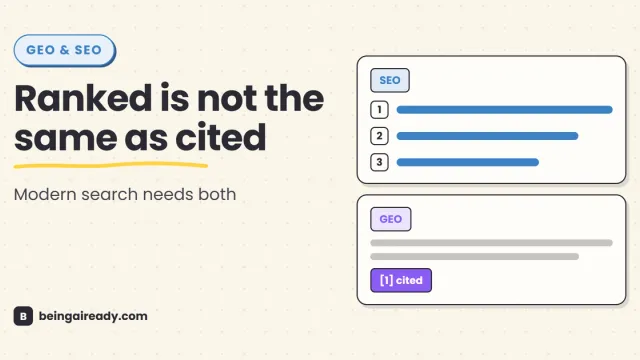
GEO vs SEO: What's Different and Why You Now Need Both
SEO earns rankings and clicks. GEO helps content get selected and cited in AI answers. Learn what differs, what overlaps, and why you need both.
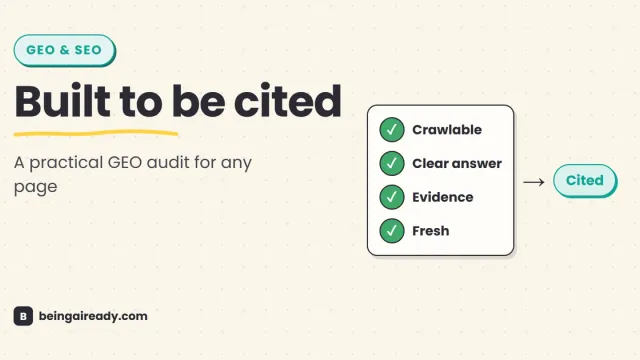
The GEO Checklist: Make Any Page AI-Citable
A practical, evidence-based GEO checklist for making any page easier for AI search systems to discover, understand, verify, quote, and cite.
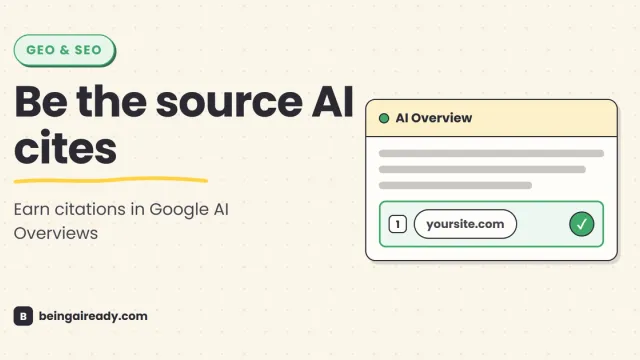
How to Show Up in Google AI Overviews
A practical 2026 guide to earning citations in Google AI Overviews through stronger SEO, original evidence, clear structure, and measurable improvements.