
GEO vs SEO: What's Different and Why You Now Need Both
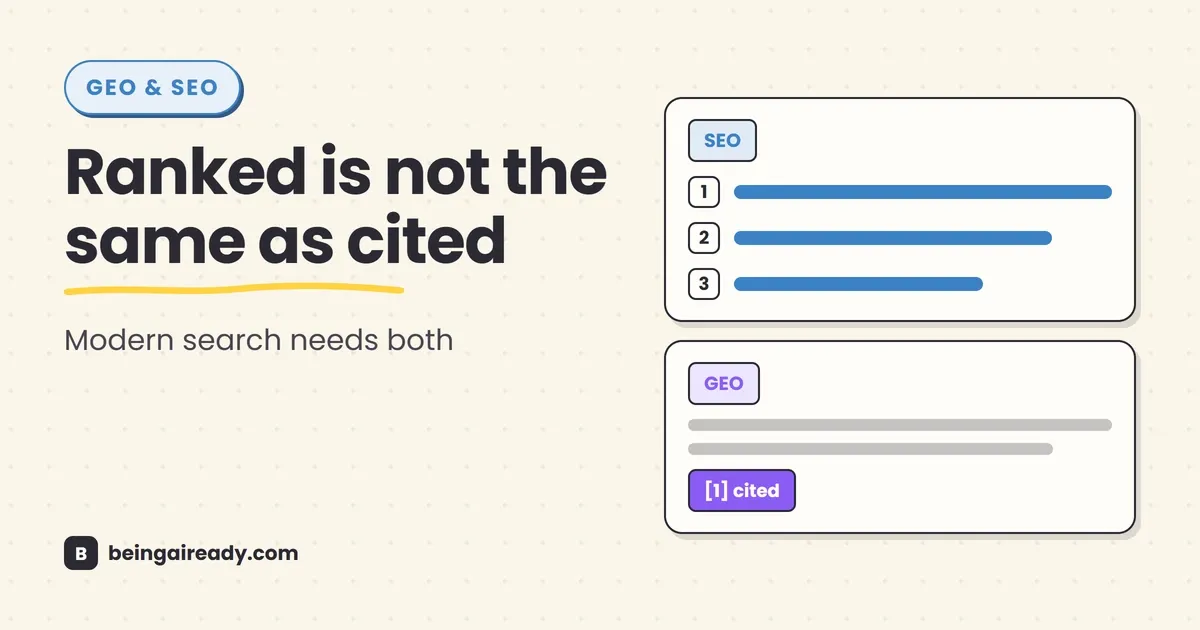
You rank first on Google for a question your business ought to own. Then, out of curiosity, you type that same question into ChatGPT — and your page is nowhere in the answer. The model paraphrases a competitor’s definition, cites two sources you have never heard of, and sends the reader on their way without ever mentioning you. Nothing is broken. Your ranking is intact. You have just run into the gap this article is about: being ranked and being cited are no longer the same thing.
For most of search’s history there was really only one bargain. A person typed a query, the engine ranked a list of pages, and the sites near the top won most of the attention. That bargain has not disappeared, but it is no longer the only one — a growing share of searches now produces an answer before it produces a visit: a Google AI Overview, an AI Mode response, a ChatGPT search answer, a Microsoft Copilot summary, or a Perplexity response assembled from several sources. The user may still click, or may get enough from the generated answer to keep going without ever opening a page.
This is why generative engine optimization, usually shortened to GEO, has entered the marketing vocabulary. SEO tries to make a page visible in search results. GEO tries to make information visible inside the answer itself.
The distinction is real, but it is easy to exaggerate. GEO is not a clean break from SEO, and it does not come with a secret set of AI-only tricks. Google now says directly that its generative search features are built on its core Search ranking and quality systems, and that the familiar foundations of SEO still apply. Microsoft, meanwhile, uses the GEO label more explicitly and has added reporting for citations in AI answers.
The practical conclusion is not that SEO is over. It is that ranking is no longer the whole job.
Quick answer: SEO helps your pages get crawled, indexed, ranked, and clicked in traditional search results. GEO helps your information get retrieved, understood, selected, cited, and used in AI-generated answers. They overlap heavily because AI search still depends on search indexes, technical accessibility, relevance, authority, and useful content. But they optimize for different immediate outcomes: SEO mainly competes for a position and a visit; GEO competes for inclusion and influence inside a synthesized answer. In 2026, the sensible strategy is to keep doing good SEO and add a GEO layer to the pages, topics, and claims that matter most.
Here’s what you’ll walk away knowing:
- What SEO and GEO each mean without the marketing fog.
- Where they genuinely differ, and where the distinction is mostly artificial.
- Why strong rankings do not guarantee citation in an AI answer.
- Which SEO practices still carry over unchanged.
- What to add to your content, technical setup, and measurement.
- A practical framework for building one strategy that serves both.
SEO and GEO, in plain English
Search engine optimization (SEO) is the work of improving a website’s visibility in search engines. In practical terms, that means helping a search engine discover a page, understand what it is about, judge it useful and trustworthy, and show it for relevant searches.
The visible output is normally a search result: a title, description, URL, image, product result, local listing, featured snippet, video, or another search feature. The user then decides whether to click.
Generative engine optimization (GEO) is the work of improving the likelihood that your content, facts, products, expertise, or brand will be selected and used by a generative answer system.
The visible output is different. Instead of merely listing your page, the system may:
- cite it as a supporting source;
- paraphrase one of its claims;
- use its data in a comparison;
- mention the brand in a recommendation;
- pull a definition or process into the answer;
- send the user to the page for detail or action.
The term came into wider use after researchers introduced a formal GEO framework in late 2023. Their original paper tested ways of increasing source visibility in generated responses and reported gains of up to 40% in its experimental setting. That number is useful as evidence that wording and evidence can affect citation behavior, but it has often been repeated too broadly. A 2026 critical review of GEO research makes an important distinction: improving the treatment of a source that has already been retrieved is not the same as proving durable gains in organic discoverability, traffic, or revenue across real platforms.
That distinction matters. GEO is still young, the systems are mostly black boxes, and their answers can vary between runs. Anyone promising a guaranteed “AI ranking” is borrowing certainty from a much more mature discipline and applying it where it does not yet belong.
The simplest way to understand the difference
SEO asks:
Can this page win a visible place in the search results for this query?
GEO asks:
Can this source provide the exact information an AI system wants to use in its answer?
Those questions overlap, but they are not identical. A traditional search engine can rank a broad, authoritative page because it is the best destination for a user. A generative system may instead need one precise paragraph that supports one part of a much larger answer. It might retrieve several pages, compare their claims, use one source for a definition, another for current data, and a third for a real-world example.
The page is still important, but the useful unit is increasingly the claim, passage, table, definition, specification, or piece of evidence inside the page.
GEO vs SEO: the practical comparison
| Area | SEO | GEO |
|---|---|---|
| Primary goal | Rank prominently and earn qualified visits | Be retrieved, cited, summarized, mentioned, or recommended in generated answers |
| Typical interface | Search results page with links and features | Synthesized answer with citations, follow-up questions, and sometimes actions |
| Main unit of competition | Page, result, listing, image, video, product, or local profile | Source, passage, claim, fact, entity, table, product detail, or experience |
| User behavior | Scans options and chooses a result | Reads a combined answer and may click only for depth, proof, or action |
| Query pattern | Often short or keyword-shaped, though increasingly conversational | Frequently longer, contextual, comparative, and followed by refinements |
| Core systems | Crawling, indexing, ranking, result presentation | Search activation, retrieval, reranking, context selection, generation, and citation |
| Content emphasis | Relevance, intent satisfaction, quality, authority, usability | The same foundations, plus extractable answers, evidence, specificity, and clear attribution |
| Authority signals | Links, reputation, topical depth, expert trust, brand demand | Many of the same signals, plus corroboration and whether a claim is safe to reuse |
| Technical emphasis | Crawlability, indexability, internal links, rendering, speed, structured data | The same, plus access for relevant AI search crawlers and machine-readable factual consistency |
| Success metrics | Rankings, impressions, CTR, organic sessions, conversions | Citations, answer inclusion, cited pages, brand mentions, AI referrals, assisted conversions |
| Main uncertainty | Rankings move and result layouts change | Retrieval and citations can change across prompts, platforms, locations, and repeated runs |
The table makes the disciplines look tidier than they are. In reality, modern SEO already includes intent, entities, featured snippets, structured content, brand reputation, and direct answers. GEO mostly extends those ideas into a system where the machine composes the result rather than simply ordering links.
Why SEO still matters to GEO
The easiest mistake is to imagine that an AI answer engine bypasses search and simply “knows” the web. Current systems often use retrieval-augmented generation, or RAG: they search an index or fetch current sources, select relevant material, and give that material to a language model as evidence for the response.
Google describes this explicitly. Its generative Search features use core ranking systems to retrieve relevant pages, and may use query fan-out: one complex question triggers several related searches across subtopics. A question about choosing business software, for example, might lead the system to search separately for pricing, integrations, limitations, security, user suitability, and recent product changes. All of which makes old-fashioned SEO work rather more important than the GEO label sometimes suggests.
Your page still needs to be discoverable
An AI system cannot cite a current page it cannot find or access. Indexing, sitemaps, internal links, canonicalization, rendering, server reliability, and sensible site architecture remain basic entry requirements.
For Google AI Overviews and AI Mode, a page must be indexed and eligible to appear in Google Search with a snippet. Google says there are no extra technical requirements beyond the Search foundations.
Other platforms have their own search crawlers. OpenAI says sites that opt out of OAI-SearchBot will not appear as sources in ChatGPT search answers, apart from possible navigational links. Perplexity similarly recommends allowing PerplexityBot and its published IP ranges if a site wants to appear in Perplexity search results. None of this is exotic GEO work; it is crawl management with a longer list of legitimate user agents.
Authority does not reset when the interface changes
AI systems need to decide which sources are reliable enough to support an answer. They may use different retrieval and selection methods, but they do not suddenly stop caring about reputation, expertise, corroboration, links, or whether a source has a history of publishing accurate material.
A recognized medical body has an advantage on health questions. A manufacturer has an advantage on its own specifications. A publication with original testing has an advantage on product experience. A local business with complete, consistent details has an advantage on queries about availability and location. Traditional SEO helps build that authority over time, and GEO cannot manufacture it with formatting.
Search demand still reveals what people need
Keyword research remains useful, even when people ask AI tools longer questions. Search data exposes recurring problems, wording, comparison criteria, misconceptions, and stages of intent.
The adjustment is to stop treating each keyword as an isolated target. A generative system may break a query into several related needs, so the better planning unit is often a topic and decision journey:
- What is it?
- How does it work?
- Is it suitable for me?
- What does it cost?
- How does it compare?
- What are the risks?
- What should I do next?
A strong content cluster can answer those separately and connect them. A strong page can answer several of them where that makes sense. Both are useful to SEO; both give generative systems better material to retrieve.
Where GEO is genuinely different
If the foundations are shared, what actually changes? Four things matter most: the shape of the query, the selection process, the role of citations, and the meaning of success.
1. The query can become a research brief
Traditional search queries are often compressed: “best CRM small business” or “GEO vs SEO”. People know the search engine expects keywords, so they trim the question.
In an AI interface, they are more likely to describe the whole situation:
“I run a five-person consulting firm, mostly use Google Workspace, do not have a full-time salesperson, and need a CRM that is simple enough to maintain. Compare three options under $100 a month and explain what I would give up with each.”
That prompt contains a category, budget, company size, existing stack, operational constraint, comparison request, and concern about trade-offs. One page may not address all of it. The engine can search several subquestions and compose a response.
For content teams, this shifts research from keyword matching toward scenario coverage. You still need the category page. You also need the practical details that help a system answer the more specific version.
2. The machine selects before the user does
In conventional search, the engine ranks results and the human evaluates them. In generative search, the system performs more of the evaluation first. It decides which sources enter the context, which claims are useful, how much attention each source receives, and which citations appear.
That means visibility can be lost at several stages:
- Search or retrieval never activates.
- The page is not in the relevant index.
- The page is retrieved but reranked out.
- The page enters the model context but contributes nothing to the answer.
- Its information is used but the page is not cited prominently.
- The page is cited, but the user does not click.
- The user clicks, but the page does not convert or retain them.
SEO reporting traditionally concentrates on the later part of this chain: impressions, rankings, clicks, sessions, and outcomes. GEO requires a wider mental model because the brand may influence an answer without receiving a visit.
3. Being quotable and being useful become more valuable
A generated answer has to turn source material into sentences. Content that makes a clear, supportable claim is easier to use than content that circles the point for five paragraphs.
This does not mean every paragraph should become a robotic snippet. It means the important parts should be unambiguous:
- define the term directly;
- state the conclusion before the caveats;
- put numbers beside their units, dates, and sources;
- explain methodology where a comparison depends on it;
- distinguish fact from opinion;
- use headings that describe the actual question being answered;
- keep product, price, and policy details current;
- show who produced the information and why they are qualified.
The original GEO study found that citations, quotations, and statistics could improve visibility within its test environment. More recent work is less enthusiastic about universal formatting recipes, but it still points toward relevance, evidence, specificity, and completeness as more defensible levers than superficial rewriting.
4. A citation can matter even without a click
This is the hardest change for marketers, because most analytics systems are built around visits. A user can encounter your brand, recommendation, statistic, or point of view inside an answer and never open your website. That exposure may still shape a later decision: the user might search the brand by name, return directly, mention it to a colleague, or select it when comparing vendors days later. None of that is a reason to pretend every invisible mention has commercial value — only to admit that last-click analytics sees less of the journey than it used to.
The click itself is also becoming less reliable as the only score. In a March 2025 browsing study, Pew Research Center found that people clicked a traditional result in 8% of visits when an AI summary appeared, compared with 15% when it did not, and a link inside the AI summary received a click in only 1% of visits. Those numbers are not a universal forecast for every query or industry, but they do show why a strategy built only around winning the click is becoming incomplete.
Nor does the evidence justify moving the entire budget to AI referrals. A 2026 study in Marketing Science analyzed first-party data from 973 ecommerce websites. ChatGPT referral traffic showed better conversion rates and revenue per session than paid social, but lower performance than the other traditional channels studied, and its overall volume remained modest. AI search is a real acquisition channel; it is not yet a broad substitute for search, email, direct traffic, or other established routes to market.
A better model: discovery, influence, and destination
The cleanest way to combine SEO and GEO is to separate three jobs your content performs.
1. Discovery: can the system find you?
This is the traditional foundation:
- crawlable pages;
- sensible information architecture;
- internal links;
- XML sitemaps;
- correct canonical tags;
- indexable text;
- fast and stable delivery;
- appropriate structured data;
- accessible product, business, author, and organization details.
Discovery serves search engines, AI retrieval systems, and users navigating the site.
2. Influence: can the system use you?
This is where the GEO lens adds the most:
- direct answers to real questions;
- clear factual statements;
- original data or experience;
- cited primary sources;
- comparison criteria and methodology;
- current dates and version details;
- explicit limitations and trade-offs;
- a consistent brand and author identity;
- enough context to prevent a claim being misread.
Influence is not only about citation. A page can shape the answer by supplying the evidence, framing, terminology, or recommendation logic.
3. Destination: is there a reason to visit you?
This is what AI cannot fully replace, and it is where a great deal of thin informational content has become vulnerable.
A page should offer something beyond the summary:
- a tool or calculator;
- a downloadable template;
- original research;
- an interactive comparison;
- detailed screenshots;
- a complete tutorial;
- firsthand testing;
- a community or expert opinion;
- a product trial;
- a quote, booking, purchase, or other next action.
If the generated answer can reproduce the entire value of the page in six sentences, the problem is not only GEO — the page may simply not be a strong destination.
What a combined SEO and GEO workflow looks like
You do not need two separate teams creating two versions of the same content. Use one workflow with additional checks.
Step 1: Choose topics by business value, not AI novelty
Start where you would start with sensible SEO: the questions that affect awareness, evaluation, purchase, onboarding, support, retention, or trust.
Prioritize topics where your organization has something real to add:
- proprietary data;
- firsthand experience;
- expert judgment;
- product knowledge;
- customer patterns;
- a useful tool;
- a defensible point of view.
Generic topics are easy for AI to summarize because they are already abundant. The most durable content gives the system something it could not have produced from common knowledge alone.
Step 2: Map the query and its likely fan-out
For each important topic, identify the main question and the related questions a person or AI system may ask next.
For “GEO vs SEO”, the fan-out includes:
- definitions of GEO and SEO;
- whether GEO replaces SEO;
- how AI search retrieves sources;
- differences in content optimization;
- technical crawler access;
- measurement and tools;
- examples;
- implementation priorities;
- common myths.
This list becomes the brief — more useful than building a page around one exact keyword phrase and padding it to a target word count.
Step 3: Write the quick answer before the long explanation
A good article should work at several depths.
The opening gives the answer to someone who needs orientation. The comparison table helps a reader decide what is different. The deeper sections explain mechanisms, exceptions, and implementation.
This layered structure serves humans first. It also gives retrieval systems several clean passages that can support different versions of the question.
Step 4: Add evidence the answer can safely reuse
For every important claim, ask:
- Is it a fact, an inference, an opinion, or a recommendation?
- Is there a date attached where the fact can change?
- Is the source primary where possible?
- Does the linked source actually support the sentence?
- Can the reader understand the method behind the number?
- Have we included the limitation that changes how it should be interpreted?
Evidence is not decoration: it reduces the risk that an AI system reuses the claim incorrectly, and it gives human readers a reason to trust the page.
Step 5: Make entities unmistakable
AI systems do not only retrieve documents; they also try to understand entities and relationships: the company, product, author, location, category, feature, price, and reputation involved.
Keep core information consistent across the site and the wider web:
- organization name and description;
- author names and expertise;
- product names and versions;
- service locations;
- contact details;
- pricing and availability;
- social and directory profiles;
Organization,Person,Product,Article,LocalBusiness, and other relevant structured data.
Structured data is not a special GEO switch. Google explicitly says there is no unique AI schema. It remains useful because it reduces ambiguity and can support rich search results.
Step 6: Build a page that deserves the post-answer click
Assume the reader already has the short answer. What still makes your page worth opening?
For this article, it might be the comparison table, workflow, implementation plan, measurement framework, or specific technical guidance. For a product page, it may be live inventory, a configurator, transparent pricing, or customer evidence. For research, it may be the dataset and methodology.
The more value that survives summarization, the more resilient the page becomes.
Step 7: Publish, connect, and maintain
A page with no internal links and no place in the site architecture is harder for both people and machines to interpret.
Connect it to:
- a parent topic page;
- related guides;
- product or service pages where relevant;
- original research or methodology;
- author pages;
- glossary definitions;
- useful next steps.
Then set an update cadence based on how quickly the facts change. A definition may need occasional review. A software comparison, pricing page, policy guide, or 2026 market article needs much more active maintenance.
A practical optimization checklist
Technical and discovery
- Confirm the page is indexable and returns a healthy status code.
- Check rendering and ensure important content appears in the HTML or is reliably rendered.
- Add the page to a clear internal-link structure and relevant sitemap.
- Use canonical tags deliberately and reduce unnecessary duplication.
- Keep page titles, headings, and metadata descriptive rather than sensational.
- Use relevant structured data and make sure it matches visible content.
- Review robots.txt, CDN, and firewall rules for the search crawlers you intentionally want to allow.
- Maintain Google Search Console and Bing Webmaster Tools access.
Content and evidence
- Answer the primary question early.
- Use descriptive headings based on real subquestions.
- Include clear definitions for ambiguous terms.
- Add a comparison table where the decision is genuinely comparative.
- Support important factual claims with primary or strong independent sources.
- Attach dates, units, locations, product versions, and conditions to changing facts.
- Add firsthand evidence, original analysis, or expert judgment.
- Explain limitations instead of burying them.
- Remove generic filler that contributes no new information.
- Keep key claims consistent across related pages.
Brand and trust
- Show a real author and relevant expertise.
- Maintain a clear About page and editorial or review policy where appropriate.
- Make the organization, product, and contact details consistent.
- Earn genuine mentions through useful work, not manufactured citation campaigns.
- Correct inaccurate third-party listings and outdated product information.
- Build branded demand through newsletters, communities, social distribution, partnerships, and useful tools.
Conversion and retention
- Give the visitor a reason to continue beyond the answer.
- Offer a relevant next step rather than a generic pop-up.
- Capture email permission where the content supports an ongoing relationship.
- Connect informational pages to tools, demos, products, or services without forcing the fit.
- Measure qualified outcomes, not just raw sessions.
How to measure SEO and GEO together
Measurement is where the difference becomes most visible.
SEO metrics remain essential
Track:
- organic impressions;
- average position and result type;
- click-through rate;
- organic sessions;
- landing-page engagement;
- leads, sales, sign-ups, and assisted conversions;
- branded and non-branded query growth;
- crawl and index health.
These show whether your site is discoverable and whether search demand becomes business value.
Add GEO visibility metrics
Track:
- whether the brand appears in generated answers;
- whether the site is cited;
- which pages are cited;
- citation frequency across a fixed prompt set;
- share of cited sources among relevant competitors;
- the wording and position of the citation;
- whether your claim is actually reflected in the answer;
- referrals from ChatGPT, Perplexity, Copilot, Gemini, and other identifiable sources;
- conversion and engagement quality from those referrals;
- changes in direct and branded search demand after visibility grows.
Do not run one prompt once and call it a benchmark. Generative answers vary. Use a representative set of prompts, test paraphrases, repeat them, record the date and location where relevant, and separate “mentioned” from “cited” and “cited” from “used accurately”.
The reporting is improving, slowly
As of August 2026, the platforms are beginning to expose better data.
Google introduced dedicated Generative AI performance reports in Search Console in June 2026, showing impressions, pages, countries, devices, and trends for visibility in AI features. The initial rollout was limited to a subset of sites, so not every property will have it yet.
Bing’s AI Performance reporting, launched in public preview in February 2026, includes total citations, cited pages, sample grounding queries, page-level citation activity, and visibility trends across Microsoft AI experiences.
OpenAI says publishers allowing OAI-SearchBot can track ChatGPT referral traffic in normal analytics tools. That helps with visits, but it does not reveal every answer in which a source influenced the response without a click. This is progress, then, not a complete attribution system.
What not to do
A new label creates a market for old shortcuts. Most are a distraction.
Do not publish hundreds of near-duplicate question pages
Creating one page for every tiny prompt variation is the AI-search version of obsolete keyword-page SEO. Modern systems understand semantic similarity, and Google’s spam policies can treat scaled, low-value publishing as abuse. Cover the topic properly, and split pages only when the user need, intent, or depth genuinely justifies it.
Do not rewrite everything into tiny “AI chunks”
Clear sections help readers and retrieval, but artificially chopping prose into fragments does not create authority, and Google explicitly says there is no requirement to chunk content for its generative Search features. Use the length and structure the subject needs.
Do not treat llms.txt as a magic file
Google says it does not use llms.txt for Search, including its generative AI features. Creating one may be harmless and some tools may use similar conventions, but it is not a substitute for indexability, content quality, or crawler access.
Do not buy fake mentions
There is a sensible idea beneath the hype: brands that are consistently discussed and corroborated across credible sources are easier to understand and trust. The shortcut version — manufactured mentions, low-quality guest posts, synthetic reviews, and mass forum seeding — creates noise rather than durable authority. Earn references instead by publishing useful work, data, tools, opinions, or products worth discussing.
Do not confuse a citation with revenue
A citation is an intermediate signal. It may build awareness, trust, or referral traffic; it may also generate nothing measurable. So connect GEO reporting to real outcomes: qualified visits, branded demand, leads, trial starts, sales, retention, or whatever matters to the business.
Do not abandon SEO for prompt tracking
Prompt tracking tools can be useful, but the market is immature and no third-party platform has complete access to the ranking, retrieval, or generation systems inside Google, OpenAI, Microsoft, or Perplexity. Use them as sampling instruments, not as a new single source of truth.
A worked example: upgrading one article for SEO and GEO
Imagine a software company has an article titled “Best Project Management Tools for Small Teams.” It ranks on page two and receives little traffic.
The original article contains ten product summaries, each assembled from the vendor’s marketing page. There is no stated testing method, no clear definition of “small team,” no pricing date, no comparison table, and no explanation of which tool suits which operating style.
A conventional SEO update might improve the title, search intent, internal links, headings, freshness, and keyword coverage. That is useful, but it still leaves the article as commodity content.
A combined SEO and GEO update would go further:
- Define the audience: teams of two to twenty people, limited administration, and no dedicated operations manager.
- State the selection method: which products were tested, for how long, and against which tasks.
- Put the recommendation summary near the top.
- Add a comparison table with current pricing, key limits, best use case, and major trade-off.
- Include firsthand screenshots and the specific workflows tested.
- Separate verified product facts from editorial judgment.
- Link pricing and security claims to the vendor’s current documentation.
- Add decision sections such as “best for client work,” “best for teams living in Microsoft 365,” and “best when simplicity matters more than customization.”
- Explain when a spreadsheet is still enough and when software becomes worthwhile.
- Add a calculator or downloadable evaluation checklist.
The SEO result is a more relevant, authoritative destination. The GEO result is a page containing clear facts, comparisons, evidence, and scenario-specific recommendations that an answer engine can use.
The same work improves both because the underlying goal is the same: make the page genuinely more useful and easier to understand.
A 90-day plan for adding GEO without derailing SEO
Days 1–15: establish the baseline
Choose 20 to 50 commercially important questions, including category, comparison, problem, trust, and product queries.
Record:
- current organic rankings and traffic;
- whether AI features appear in Google;
- which domains are cited in ChatGPT, Copilot, Perplexity, and other relevant tools;
- whether your brand is mentioned, cited, or absent;
- which pages receive identifiable AI referrals;
- current branded search and direct traffic.
This is not a perfect measurement system. It is a starting point you can repeat.
Days 16–30: fix the foundations
Resolve crawl, index, rendering, duplication, canonical, sitemap, and internal-link issues on the priority section of the site.
Review crawler access deliberately. Do not blindly allow every bot, but make sure the search services you want to participate in are not being blocked by robots.txt, a CDN, or a firewall rule you forgot existed.
Days 31–60: upgrade the pages that already matter
Start with pages that already rank, convert, attract links, or support important sales conversations.
Add:
- a direct answer;
- clearer structure;
- current facts;
- stronger sourcing;
- original evidence;
- better comparisons;
- limitations and trade-offs;
- author and methodology details;
- a useful next action.
Do not begin by publishing fifty new pages. Improving an established page is usually a better test because it already has some authority and performance history.
Days 61–90: build assets AI cannot cheaply imitate
Create one or two genuinely distinctive resources:
- original research;
- a benchmark;
- a calculator;
- a template;
- a database;
- expert interviews;
- real implementation examples;
- a transparent testing program.
Then repeat the prompt benchmark, review search performance, inspect AI referrals, and compare business outcomes. Keep what moved. Drop what merely looked fashionable.
So, do you really need both?
Yes, but perhaps not in the way the phrase suggests.
You do not need an SEO team and a separate GEO team fighting over headings. You need a single discovery strategy that recognizes two realities:
- People still use search results, click links, compare pages, and act on websites.
- AI systems increasingly mediate that journey by selecting and composing information before the click.
SEO remains the foundation because it makes your site discoverable, legible, reputable, and useful. GEO adds a new optimization target: make your best information easy to retrieve, safe to reuse, worth citing, and attached to a brand people can recognize.
The best work tends to look remarkably ordinary. Publish something specific. Support it. Structure it clearly. Keep it current. Build a real reputation. Give the visitor more value than the summary could provide.
The interface is changing. The standard for useful information is not.
The bottom line
SEO is about earning visibility in search. GEO is about earning a place in the answer.
The two are different enough to require new measurement, content checks, and technical awareness. They are not different enough to justify abandoning the fundamentals.
Keep the SEO machinery: crawling, indexing, architecture, relevance, links, authority, page experience, and conversion. Add the GEO layer: precise answers, extractable evidence, original information, entity clarity, crawler access, citation monitoring, and a reason for the user to visit after the summary.
Do both, and you are not betting the business on one interface. You are making the organization easier to find, understand, trust, and choose — whether the journey begins with ten blue links or one generated answer.
Frequently asked questions
Is GEO replacing SEO?
No. GEO depends heavily on the same foundations as SEO: crawlability, indexing, relevance, authority, useful content, and a technically sound website. The difference is the immediate outcome. SEO aims to earn visibility and clicks in search results; GEO aims to make your information eligible to be retrieved, cited, summarized, or recommended inside an AI-generated answer.
What is the main difference between GEO and SEO?
SEO usually optimizes a page to rank for a query. GEO optimizes information so an AI system can find the right passage, understand it, trust it, and use it in a generated response. SEO competes for positions in a results page; GEO competes for inclusion and influence inside an answer.
Can content rank well on Google but never appear in AI answers?
Yes. AI systems may retrieve a different mix of sources, combine several related searches, prefer a more specific passage, or choose pages with clearer evidence for a particular claim. A strong organic ranking helps, especially within Google, but it does not guarantee that the page will be cited or used in a generated answer.
Do I need a separate GEO content strategy?
Usually not. Most teams need one search and content strategy with two sets of outcomes. Keep the SEO foundations, then make priority content easier to retrieve and cite by adding direct answers, clear headings, original evidence, precise definitions, useful comparisons, expert context, source links, and regular updates.
Does llms.txt improve GEO rankings?
There is no general evidence that an llms.txt file improves AI visibility. Google explicitly says it does not use llms.txt for Search or its generative AI features. Other systems may choose to support similar files in the future, but crawler access, indexability, content quality, and evidence are more important than treating a new file as a ranking shortcut.
How do you measure GEO performance?
Track citations, cited pages, answer inclusion, brand mentions, visibility across representative prompts, AI referral traffic, assisted conversions, and changes in branded search. Use repeated tests because AI answers vary. Google and Bing have also begun adding dedicated generative-AI visibility reports to their webmaster tools, although availability and coverage still vary.
Related articles
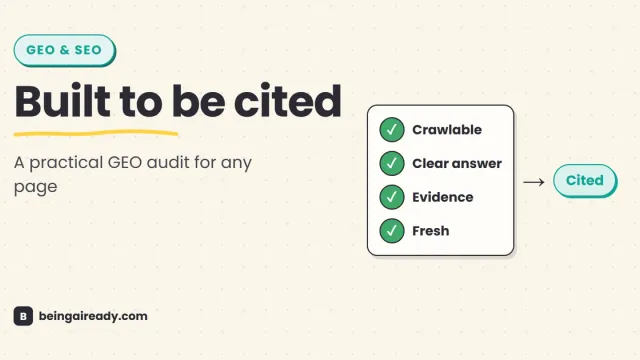
The GEO Checklist: Make Any Page AI-Citable
A practical, evidence-based GEO checklist for making any page easier for AI search systems to discover, understand, verify, quote, and cite.
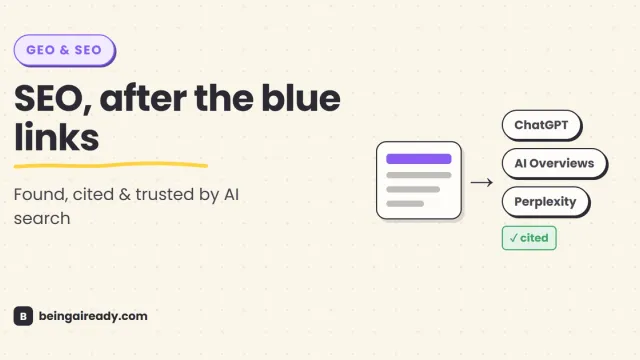
What Is GEO (Generative Engine Optimization)? Complete 2026 Guide
Learn what Generative Engine Optimization is, how GEO differs from SEO and AEO, and how to improve visibility in ChatGPT, AI Overviews, Copilot, and Perplexity.
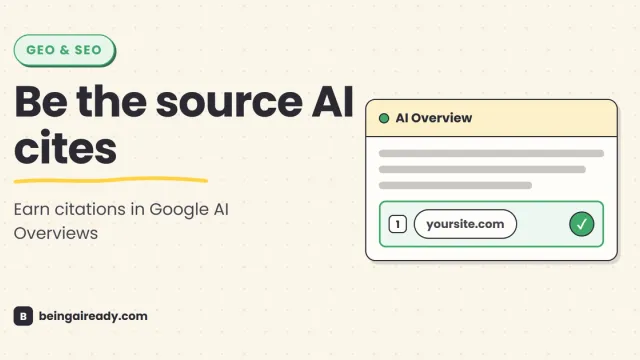
How to Show Up in Google AI Overviews
A practical 2026 guide to earning citations in Google AI Overviews through stronger SEO, original evidence, clear structure, and measurable improvements.