
Scite
An AI platform that shows how a paper has actually been cited by later research — supporting, contrasting, or merely mentioning a claim — to judge evidence beyond citation counts.
Visit website (opens in a new tab)Independent editorial listing. Features, pricing, and privacy terms can change; confirm details on the vendor site before buying or rolling out a tool.
What it does
Scite analyzes how scientific papers have been cited by later research and classifies each citation as supporting, contrasting, or simply mentioning the original claim — giving researchers a more meaningful signal than a raw citation count. Its browser extension overlays this Smart Citation data directly on Google Scholar, PubMed, and journal pages, and its Reference Check feature audits a manuscript’s citations for retractions before submission, making it a strong complement to literature-discovery tools like Consensus or Elicit.
Ideal users
- Academic researchers and PhD students verifying claims before citing them
- Journal editors and peer reviewers checking a manuscript's citation integrity
- Institutions wanting citation and author-level analytics
- Fact-checkers or writers verifying scientific claims made in other sources
Who should avoid it
- You need general web search or literature discovery from scratch — pair it with a discovery tool instead of using it alone for first-pass search
- You're a casual user unwilling to pay — the free tier is quite limited
- You need document synthesis or writing support rather than citation verification
Key features
- Smart Citations that classify 1.6B+ citation statements as Supporting, Contrasting, or Mentioning
- AI Research Assistant that generates evidence-backed answers with citations
- Browser extension that overlays Smart Citation data on Google Scholar, PubMed, and journal websites
- Reference Check that audits a manuscript's citations for retractions before submission
- Custom dashboards for journal-, author-, and institution-level citation analytics
- An index of 280M+ articles, preprints, books, patents, and datasets
Pros / Cons
Pros
- Goes beyond raw citation counts to show whether later research actually supports or contradicts a paper's claims
- Browser extension makes it easy to check citation context while reading elsewhere
- Reference Check is a genuinely useful pre-submission manuscript audit
- Large citation-statement database with real publisher partnerships
Cons
- Free tier is quite restrictive — limited daily searches and no access to full citation-statement text
- Best used alongside a discovery tool like Consensus or Elicit rather than as a standalone literature-search engine
- Institutional or enterprise pricing can be significant for organization-wide access
- Citation classifications are automated and should be spot-checked for high-stakes claims
Pricing
Free — $20/month (Individual; ~$12/month billed annually)
Team is $30/user/month; Enterprise and institutional pricing is custom, typically $5,000–$25,000/year depending on organization size.
Typical workflows
- A researcher drafting a paper checks whether a key claim they're about to cite has actually been supported or contradicted by later studies, using Smart Citations instead of relying on raw citation counts.
- Before submission, an author runs Reference Check to confirm none of their cited papers carry retraction or correction notices.
Integrations
- Chrome, Firefox, and Safari browser extensions
- Overlays on Google Scholar, PubMed, and journal websites
- Publisher partnerships (30+)
Privacy & security notes
Citation classifications are generated algorithmically from the citing text's context — treat them as a strong signal, not a definitive verdict, and read the actual citing passage for claims that matter in a publication or clinical decision.
Frequently asked questions
How is Scite different from a citation count?
Instead of just counting how many times a paper was cited, Scite classifies each citation as Supporting, Contrasting, or Mentioning the original claim, and shows the actual citing text.
Can Scite help me find new papers on a topic?
It's better used for verifying and contextualizing citations you already have than for first-pass literature discovery — pair it with Consensus or Elicit for initial search.
What is Reference Check?
A feature that audits a manuscript's cited papers for retractions or editorial notices before submission, helping avoid citing compromised research.
Is the free plan usable?
Only for very light use — it caps daily searches and doesn't show full citation-statement text, which is the tool's main value; most serious users need Individual or Team.
Best alternatives
Elicit
FreeAn AI research assistant built specifically for academic literature search, summarization, and systematic review workflows across a large database of scholarly papers.
Consensus
FreeAn AI-powered academic search engine that synthesizes findings across peer-reviewed papers and visually summarizes whether the evidence supports a given claim.
Related tutorials
How to Choose the Right AI Tool: A Buyer's Framework
A calm, no-hype framework for choosing the right AI tool for any task: define the job, judge the real criteria, run a cheap trial, and avoid costly switching.
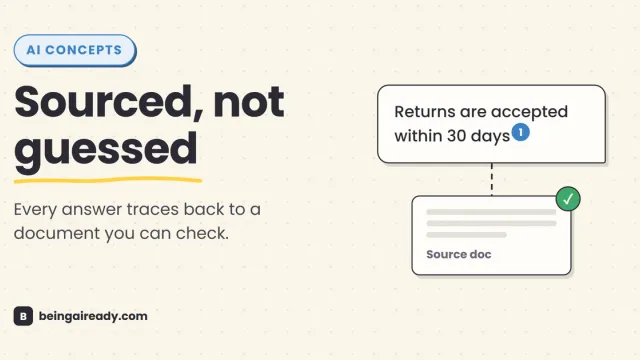
What Is RAG? Retrieval-Augmented Generation in Plain English
RAG is why some AI tools give a straight, sourced answer while others just guess with confidence. Here's what it is and how it works — without the jargon.
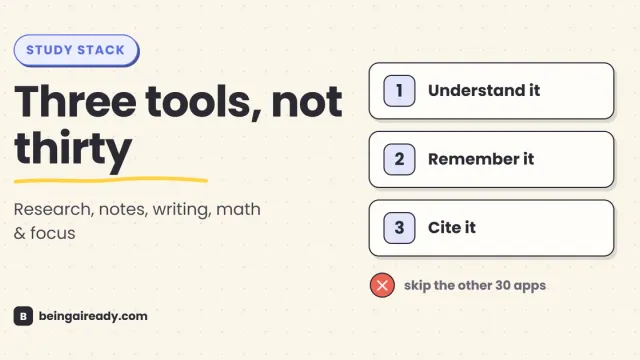
33 Best AI Tools for Students in 2026 (Practical Guide)
The best AI tools for students in 2026, explained simply: research, notes, PDFs, citations, writing, math, slides, coding and focus.