
Consensus
An AI-powered academic search engine that synthesizes findings across peer-reviewed papers and visually summarizes whether the evidence supports a given claim.
Visit website (opens in a new tab)Independent editorial listing. Features, pricing, and privacy terms can change; confirm details on the vendor site before buying or rolling out a tool.
What it does
Consensus is an academic search engine that lets users ask plain-language research questions and get back a synthesis of what peer-reviewed literature says, anchored by its signature Consensus Meter — a visualization based on the top-ranked papers on that question. It draws on a large index of scientific papers and offers a specialized Medical Mode for clinical guideline-backed queries, making it well suited to fast, evidence-based research questions rather than deep systematic-review data extraction.
Ideal users
- Students and academics doing evidence-based literature searches
- Clinicians and medical researchers via its Medical Mode
- Journalists or writers fact-checking scientific claims
- Anyone who wants a quick read on what the evidence says on a research question
Who should avoid it
- You need large-scale systematic-review screening and extraction across thousands of papers — Elicit is stronger here
- You need general, non-academic web search
- You need to go beyond a high-level synthesis into deep methodological critique yourself
Key features
- Consensus Meter — a visual yes/no/possibly synthesis across the top papers on a question
- Deep Search that automates search strategy across up to 1,000 papers
- Medical Mode filtering to roughly 50,000 clinical guidelines plus 8 million articles from top medical journals
- Study Snapshots — AI-generated summaries of individual papers
- An index of 220M+ papers with 170+ university library partnerships
Pros / Cons
Pros
- Consensus Meter gives a fast, intuitive read on scientific agreement for a claim
- Medical Mode is a strong fit for clinicians needing guideline-backed answers
- Large, reputable academic corpus
- Usable free tier for casual academic lookups
Cons
- Consensus Meter simplifies nuanced findings into a simplified view — real disagreement or methodological caveats can get flattened
- Less suited than Elicit for large-scale systematic-review data extraction
- Deep Search and Pro-tier pricing details vary across sources
- Not a general web search tool
Pricing
Free — ~$12/month (Pro, billed annually)
Pro is $12/month billed annually ($144/year), or $20/month billed monthly. A higher Deep tier is $45/month and adds around 200 Deep Searches/month on top of Pro. Student (~40%) and clinician (~25%) discounts are available.
Typical workflows
- A user types a yes/no research question and gets a Consensus Meter summarizing the balance of evidence across top papers, plus links and snapshots of the underlying studies.
- A clinician switches to Medical Mode to get guideline-backed answers filtered to trusted clinical sources rather than the full general academic corpus.
Integrations
- API access (by application)
- University library partnerships (170+)
Privacy & security notes
The Consensus Meter is a simplified visualization of a complex evidence base — always read the underlying Study Snapshots and, for important decisions, the original papers, since a summarized rating can mask methodological weaknesses or conflicting study designs.
Frequently asked questions
What is the Consensus Meter?
A visual summary of how the top-ranked papers on a topic answer a specific research question, weighted by citation count and study design.
Is Consensus good for medical research specifically?
Yes — its Medical Mode filters to clinical guidelines and top medical-journal articles for evidence-based clinical questions.
How is Consensus different from Elicit?
Consensus emphasizes a fast, visual synthesis of what the evidence says, while Elicit is built more for structured, large-scale data extraction and systematic review workflows.
Can I trust the Consensus Meter as a final answer?
No — treat it as a starting point; the underlying papers and their methodology should still be reviewed for anything used in serious research or publication.
Best alternatives
Elicit
FreeAn AI research assistant built specifically for academic literature search, summarization, and systematic review workflows across a large database of scholarly papers.
Scite
FreeAn AI platform that shows how a paper has actually been cited by later research — supporting, contrasting, or merely mentioning a claim — to judge evidence beyond citation counts.
Related tutorials
How to Choose the Right AI Tool: A Buyer's Framework
A calm, no-hype framework for choosing the right AI tool for any task: define the job, judge the real criteria, run a cheap trial, and avoid costly switching.
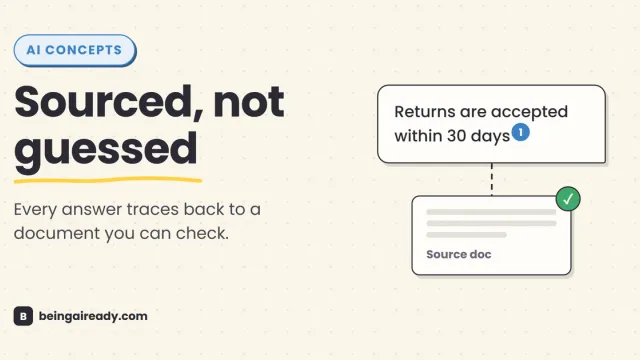
What Is RAG? Retrieval-Augmented Generation in Plain English
RAG is why some AI tools give a straight, sourced answer while others just guess with confidence. Here's what it is and how it works — without the jargon.
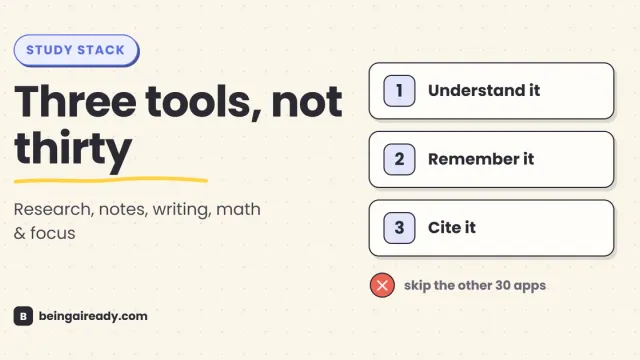
33 Best AI Tools for Students in 2026 (Practical Guide)
The best AI tools for students in 2026, explained simply: research, notes, PDFs, citations, writing, math, slides, coding and focus.