
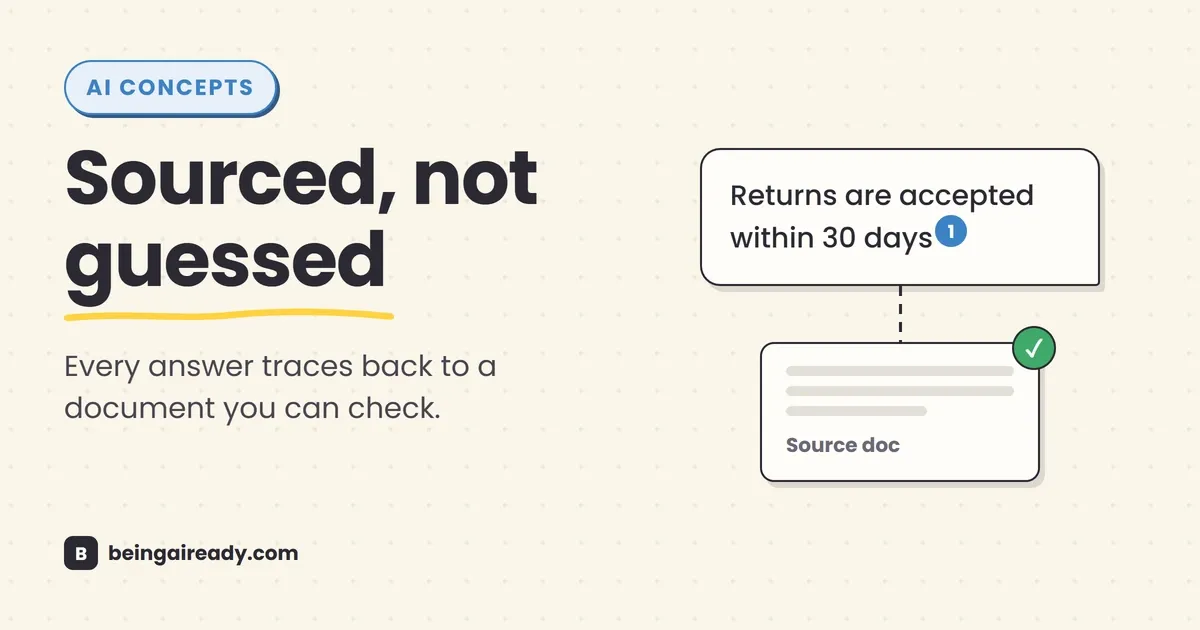
What Is RAG? Retrieval-Augmented Generation in Plain English
A few months ago, someone asked an AI chatbot on a retailer’s website about its return policy. The bot answered instantly, sounded completely sure of itself, and was completely wrong. It quoted a policy that never existed.
That’s not a random glitch. It’s what happens when you ask a language model something it was never actually taught, and instead of saying “I don’t know,” it decides to guess.
RAG is the fix for that exact problem. Short for Retrieval-Augmented Generation, it’s the quiet piece of engineering behind a growing number of AI tools that stopped bluffing and started citing their sources. If you’ve ever used an AI search engine that shows you the links it pulled its answer from, or a chatbot that seems to actually know your company’s policies, you’ve already seen RAG at work. You just didn’t know that’s what it was called.
This guide breaks down what RAG actually is, how it works underneath the buzzword, where it genuinely helps, and where it still falls short. No technical background required.
Quick answer: RAG (Retrieval-Augmented Generation) is a method that lets an AI model search for relevant, up-to-date information before it writes a response, instead of relying only on what it memorized during training. It pairs a search step with a writing step, so the final answer is grounded in real sources instead of the model’s memory alone.
Here’s what you’ll walk away knowing:
- RAG doesn’t make an AI model smarter. It gives the model something to read before it answers.
- It’s the main technology behind AI tools that cite sources, chatbots that actually know your company’s data, and “chat with your PDF” apps.
- It cuts down on hallucinations. It does not eliminate them, and anyone who tells you otherwise is oversimplifying.
- It’s usually far cheaper and faster to set up than retraining a model from scratch.
What Is RAG, Exactly?
Break the term into its three parts and it stops sounding intimidating.
Retrieval means searching for relevant information. Think of it as a smarter version of hitting Ctrl+F across an entire library, except it searches for meaning rather than exact word matches.
Augmented means that information gets added to what the AI is working with. It gets attached to your question before the model starts writing anything.
Generation is just the AI producing an answer in natural, readable language, based on everything it now has in front of it.
Put it together and the whole idea is: the AI searches, then it writes. That’s really it.
Researchers at Meta, then still called Facebook AI Research, coined the term in a 2020 paper that combined a language model’s built-in knowledge with a live, external memory it could pull from at the moment someone asked it a question. It’s one of those ideas that sounds obvious in hindsight and still ended up reshaping how most serious AI products get built.
The Problem RAG Was Built to Solve
To understand why RAG matters, you have to understand what a plain language model is actually bad at. Not “bad” in the sense of unintelligent. Bad in the sense of blind to anything outside its training data.
Your AI Has an Expiration Date
Every large language model is trained on a fixed snapshot of data, up to a certain cutoff date. After training finishes, the model doesn’t quietly keep reading the news. It stays frozen at that point.
Ask it about something that happened after that cutoff and it either tells you plainly that it doesn’t know, or it tries to answer anyway using whatever it remembers that seems close enough. Neither option is great if you actually need current information.
It’s Never Seen Your Business
A general-purpose AI model was trained on public data: books, articles, forums, code, websites. It was never shown your company’s internal wiki, your product catalog, your HR policies, or last quarter’s sales figures. There’s no version of training where that data was included, because the model provider never had access to it.
So when a customer asks a support bot a question that depends on your actual policies, a plain language model is guessing based on what similar companies in its training data tend to do. That’s a reasonable guess. It’s also not your policy.
Guessing With Confidence
This is the part that causes the most damage: when a language model doesn’t know something, it usually doesn’t say so. It fills the gap with something that sounds plausible. This is what people in AI call a hallucination, and the word is well chosen. The output isn’t random noise. It’s a confident, coherent, well-structured answer that happens to be false.
This isn’t a hypothetical risk. In February 2023, Google demoed its AI chatbot Bard (later folded into Gemini) and it stated, incorrectly, that the James Webb Space Telescope took the first-ever pictures of a planet outside our solar system. That single factual error, surfaced publicly and picked apart almost immediately, contributed to roughly $100 billion being wiped off Google’s market value in a single day. One wrong sentence, said with total confidence, and a nine-figure stock swing followed.
That’s the risk RAG was built to reduce.
Think of It Like an Open-Book Exam
Here’s the analogy that tends to make this click for people, and it holds up better than most AI comparisons do.
A plain language model answering your question is like a genuinely smart student sitting a closed-book exam. They can only use what they’ve memorized. If the material was covered before their studying stopped, they’ll probably get it right. If it wasn’t, they either admit it or, more often, write something that sounds correct and hope for partial credit.
RAG turns that into an open-book exam. Same student. Same intelligence. The only thing that changed is they’re now allowed to flip through the textbook before answering.
Two things are worth noticing here, because they’re easy to miss. First, the student didn’t get smarter. Retrieval doesn’t improve reasoning ability, it improves access to facts. Second, an open-book exam still requires a decent student. If you hand a mediocre student the wrong textbook, or the right textbook opened to the wrong page, you’re going to get a bad answer anyway. Keep that in mind. It matters more than most explainers admit, and we’ll come back to it.
How RAG Actually Works, Step by Step
Strip away the terminology and RAG runs on three steps that happen in roughly half a second, every time you send a message.
Step 1: Retrieve
The moment you ask a question, the system searches a knowledge source for content related to it. That source could be a folder of company documents, a product database, a legal archive, or the live web.
This search isn’t a simple keyword match. Most RAG systems convert both your question and the stored documents into something called embeddings, which are essentially numerical representations of meaning. You don’t need to understand the math behind that. Just know that it lets the system find passages that are conceptually related to your question, even if they don’t share a single word with it.
Step 2: Augment
Whatever passages come back from that search get attached to your original question. This combined package, your question plus the retrieved material, becomes the actual input the AI model sees. The model isn’t just being asked your question anymore. It’s being handed your question along with the specific “pages” it needs to answer it correctly.
Step 3: Generate
Now the model does what it’s always done best: it writes. Except this time, instead of pulling purely from memory, it’s writing a response grounded in the material it was just handed. A well-built RAG system will also point back to which passages it used, so you, the user, can go check the source yourself.
A Concrete Example
Let’s make this less abstract. Say you ask a company’s support bot: “Can I return this item after 45 days?”
Without RAG, the model has no idea what this specific company’s return window is. It might answer based on a generic 30-day policy it’s seen a thousand times in training data, which may or may not match reality.
With RAG, here’s roughly what happens: the system searches the company’s actual returns policy documentation, finds the relevant paragraph (say, a 60-day window for unopened items), attaches that paragraph to your question, and the model writes a reply based specifically on what it just read. Something like: “Yes, our return window is 60 days for unopened items. Since you’re within that window, you’re covered.” It can even link you to the exact policy page.
Same model. Same underlying intelligence. Completely different answer, because it was given the right thing to read first.
RAG vs. Fine-Tuning vs. Prompt Engineering: What’s the Difference?
This is one of the most common points of confusion, so it’s worth clearing up directly. All three are ways to get better, more specific answers out of an AI model, and people use the terms almost interchangeably even though they’re solving different problems.
| RAG | Fine-tuning | Prompt engineering | |
|---|---|---|---|
| What actually changes | Nothing about the model. Only what it’s allowed to read before answering | The model’s internal parameters, through additional training | Nothing. Just the wording of your instructions |
| Best for | Current facts, private or proprietary data, answers you can trace to a source | Teaching a model a specific tone, format, or specialized skill | Getting more out of a model you’re already using |
| Typical cost | Low to moderate, mainly the work of building a retrieval system | High: it requires compute, curated training data, and technical expertise | Free to very low |
| How current is the information | As current as the data source you connect it to | Frozen the moment training finishes | Whatever facts you paste in yourself |
| Can you trace an answer back to a source | Usually, yes | No | No |
If you’re trying to remember which is which, here’s a shortcut: fine-tuning changes how the model thinks. RAG changes what the model gets to see. Prompt engineering just changes how you ask.
Most production AI products, including many you’ve probably used, combine all three. RAG for grounding answers in real data, a bit of fine-tuning for tone and behavior, and careful prompt design to tie it together.
Where You’ve Already Used RAG Without Knowing It
RAG isn’t some future technology. It’s already running quietly behind tools you’ve probably used this month.
- Customer support chatbots that answer from a company’s actual help center articles instead of generic training data
- “Chat with your PDF” tools that let you upload a document and ask questions about its specific contents
- AI-powered search engines that show you a synthesized answer along with the sources it pulled from, letting you verify the claim yourself
- Internal assistants used by law firms, hospitals, and financial firms to search case files, medical guidelines, or compliance documents without exposing that private data to the open internet
- Coding assistants that pull up documentation for the specific library or framework you’re working in, rather than relying on outdated training data
None of these tools are doing anything mystical. They’re all running some version of the same three-step retrieve, augment, generate loop.
What RAG Doesn’t Fix (Let’s Be Honest About the Limits)
This is the part most explainer content skips, mostly because “it fixes everything” makes for a cleaner pitch. It’s also not true, and if you’re evaluating an AI product that claims to run on RAG, this is exactly what you should be asking about.
The retrieval step can fail quietly. If the search pulls the wrong documents, or outdated ones, or only partial context, the model will still write a confident answer. It just won’t be a correct one. Retrieval quality is the single biggest factor in whether a RAG system is actually reliable, and it’s the part that’s hardest to get right.
RAG reduces hallucinations. It doesn’t remove them. A model can still misread retrieved text, blend two sources together incorrectly, or fill a small gap with something plausible-sounding. Grounding an answer in real documents lowers the odds of a made-up answer considerably. It doesn’t guarantee accuracy. For a closer look at why hallucination happens in the first place and how to catch one, see our breakdown of AI hallucinations.
It adds moving parts. A plain language model is one system. A RAG system is a search engine bolted onto a language model, and that search engine needs to be built, indexed, updated, and maintained. Someone has to keep the underlying documents current, or the “up to date” advantage quietly disappears.
It doesn’t improve reasoning. Going back to the exam analogy: an open-book exam still requires the student to understand the material well enough to apply it correctly. RAG gives an AI more facts to work with. It doesn’t make the underlying model better at logic, math, or judgment calls.
There’s a real cost and speed tradeoff. Searching a knowledge base and then generating a response takes more time and computing power than just generating a response from memory. For most everyday uses this difference is invisible. At scale, it adds up.
None of this makes RAG a bad idea. It makes it a genuinely useful engineering pattern with real limits, which is a much more honest way to think about it than the “solves hallucinations” framing you’ll see in a lot of marketing copy.
Why This Actually Matters, Even If You’re Not Building AI
You don’t need to build a RAG system to benefit from understanding this concept. A few practical takeaways:
If you’re evaluating an AI vendor or tool for your business, “powered by AI” tells you almost nothing. “Powered by RAG, connected to your own documentation” tells you a lot. It’s a reasonable, informed question to ask in a sales call.
If you’re using an AI chatbot for research, knowing whether it’s retrieval-based changes how much you should trust an answer without double-checking it. A tool that shows its sources is giving you something you can verify. A tool that doesn’t is asking you to take its word for it.
If you manage a team that’s rolling out an internal AI assistant, understanding RAG helps you ask the right implementation questions: how current is the underlying data, how often is it refreshed, and what happens when the retrieval step comes up empty.
Understanding RAG doesn’t just make you sound informed at the next meeting where someone throws the term around. It changes how carefully you should trust what an AI tool tells you, which is a genuinely useful thing to calibrate correctly.
The Bottom Line
RAG doesn’t make an AI model smarter. It makes it honest, current, and able to point to where its answer actually came from. That’s a smaller claim than the hype usually suggests, and it’s also the reason RAG has held up as one of the more genuinely useful ideas in applied AI rather than fading out as a buzzword.
Next time you see an AI tool that shows its sources, or a chatbot that seems to actually understand a company’s specific policies, you’ll know exactly what’s happening behind the scenes. It went and checked, before it opened its mouth.
That’s the whole point of BeingAiReady: fewer buzzwords, more of this. If this helped, stick around, there’s more where it came from.
Frequently asked questions
Is RAG the same as fine-tuning?
No. Fine-tuning retrains the model itself, which changes its internal parameters permanently and requires significant compute and data. RAG leaves the model completely untouched and only changes what information it's given to read before answering. RAG is generally faster, cheaper, and easier to keep current than fine-tuning.
Does RAG completely stop AI hallucinations?
No, and be skeptical of anyone who claims it does. RAG grounds answers in retrieved documents, which significantly lowers the rate of made-up information. But the model can still misinterpret retrieved text or the retrieval step can pull irrelevant or outdated material, both of which can still produce an incorrect answer.
Is ChatGPT a RAG system?
It depends on how it's being used. When ChatGPT browses the web or searches uploaded files to answer your question, it's using a form of retrieval-augmented generation. When it's answering purely from what it learned during training, without looking anything up, it isn't. Many modern AI assistants switch between both modes depending on the question.
Do I need to understand vector databases or embeddings to understand RAG?
Not really. Those are the technical tools that make the retrieval step possible, but for a working understanding of RAG, you just need to know that the system searches for meaning, not exact keywords, and pulls back the most relevant material before the AI writes its answer.
Is RAG only useful for large companies with big datasets?
No. RAG scales down fine. A small business can connect a chatbot to a single folder of FAQ documents and get real value from it. The core idea, retrieve relevant information before answering, works whether your knowledge base is ten pages or ten million.
What's the difference between RAG and just pasting a document into a chatbot myself?
Functionally, they're built on the same underlying idea: give the model something specific to read before it answers. The difference is scale and automation. Pasting a document works fine for one file and one conversation. RAG automates that process across a huge collection of documents, automatically finding the relevant few pages out of thousands, every time someone asks a new question.
Related articles
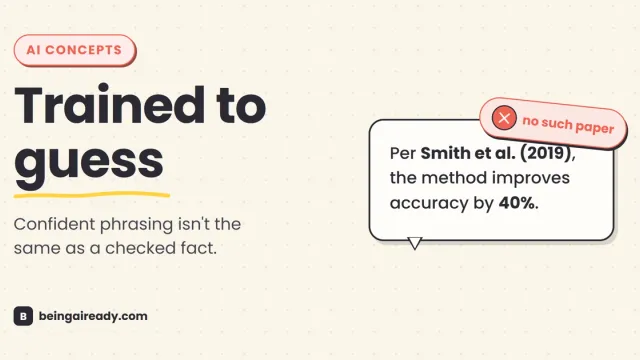
AI Hallucinations: Why AI Confidently Makes Things Up
AI hallucinations aren't random glitches. New research shows they're a predictable result of how models are trained and scored, and how to catch one.
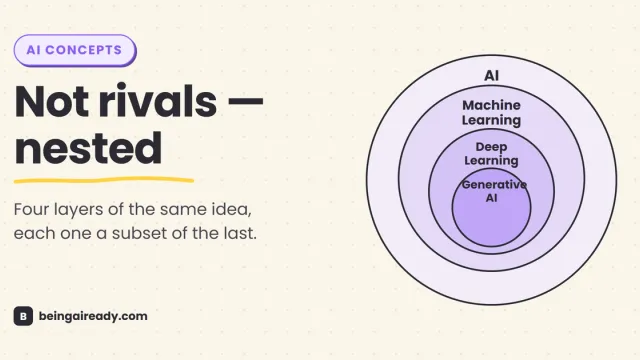
AI vs Machine Learning vs Deep Learning vs Generative AI
AI, machine learning, deep learning, and generative AI aren't rival technologies, they're nested layers. The plain-English map, with real history and examples.
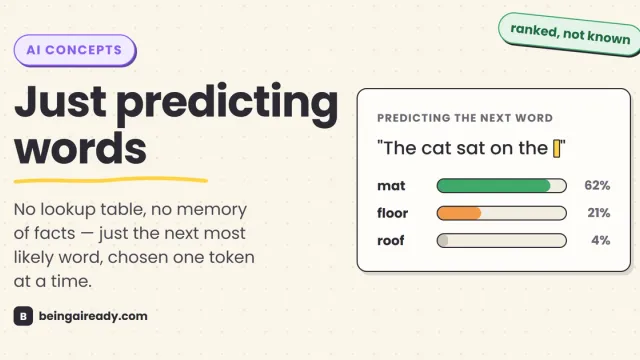
How Large Language Models Actually Work (Without the Math)
Large language models don't know facts, they predict the next likely word. Here's what's actually happening inside ChatGPT and Claude, no math required.