
ChatGPT vs Claude vs Gemini vs Perplexity vs DeepSeek (2026)
Ask five people which AI assistant is best and, this year, you will get five confident, sincerely held, mutually contradictory answers. That didn’t used to be true. Eighteen months ago “which AI chatbot” mostly meant “have you tried ChatGPT yet” — one product, one obvious default, one gap so wide between it and everything else that comparison was barely a real question. That gap has closed. OpenAI’s ChatGPT still has by far the largest audience, but Sensor Tower’s tracking has its share of AI-assistant usage sliding from over 50% in January 2026 to 46.4% by May, as Google’s Gemini and Anthropic’s Claude picked up the difference.
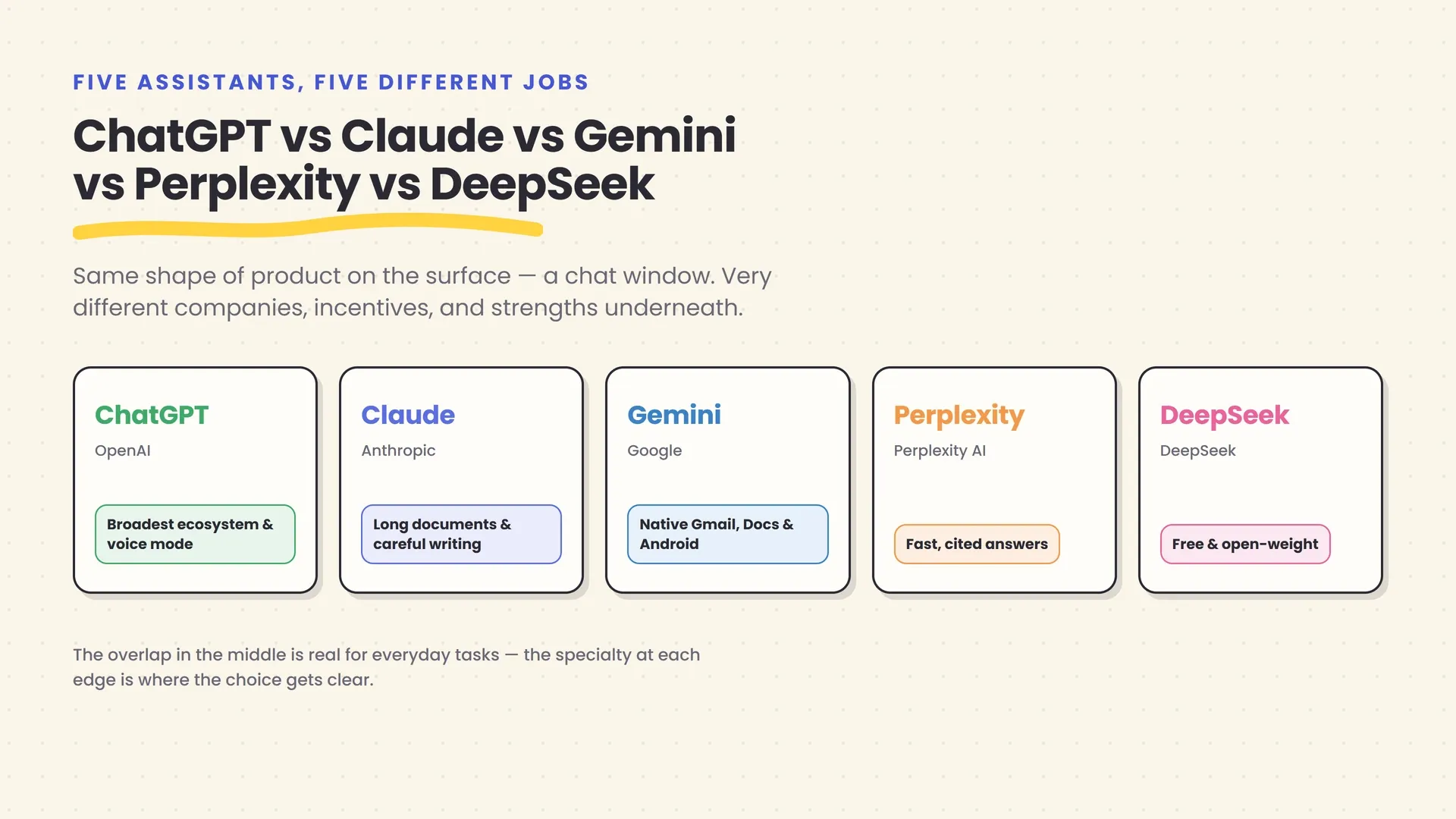
That’s the real story behind this comparison, and it’s worth saying plainly before the tables and pros-and-cons lists start: there is no longer one obviously correct answer, because there’s no longer one obviously best product. There are five reasonably close products built by five organizations with different businesses, different incentives, and different ideas about what an AI assistant is even for. A search company built one to keep you inside Search and Workspace. A safety-focused research lab built one to be trusted with your longest, most complicated documents. An answer-engine startup built one that treats every reply as a claim that needs a citation. A Chinese lab released one for free and open-sourced the weights behind it, because its business model isn’t the consumer chat app at all. None of that is marketing copy — it’s the actual shape of the decision, and it’s why “which one is best” is the wrong question. “Which one is built for what I actually need to do” is the one with a real answer.
This article exists to answer that second question properly, tool by tool and task by task, rather than crowning a winner and moving on. It’s written for the reader who has read three “best AI in 2026” roundups already, come away with three different answers, and would like one comparison that admits the honest complexity instead of resolving it into a single confident recommendation it can’t actually back up.
Quick answer: For most everyday drafting, brainstorming, and general Q&A, ChatGPT and Gemini are close enough that either is a fine default — pick Gemini if you already live in Gmail and Docs, ChatGPT if you don’t. Reach for Claude specifically when you’re working through a long document, contract, or codebase where careful, structured reasoning matters more than speed. Reach for Perplexity when you want a fast, cited answer to a factual question rather than a conversation. Reach for DeepSeek when cost is the deciding factor and the material isn’t sensitive — it’s genuinely free with no paid tier, but your data is processed on servers in China. None of these are exclusive choices; most confident users end up running two.
Here’s what this guide covers:
- What each of the five is actually optimized for, in one sentence, before the detail.
- A side-by-side comparison table you can scan in under a minute.
- What you’ll really pay, tier by tier, and where the free plans genuinely hold up.
- A task-by-task recommendation — coding, research, writing, spreadsheets, and more — instead of one verdict for every use case.
- How each one handles your data, and where the real privacy trade-offs are, including DeepSeek’s China-based hosting.
- Why the flagship models have converged so much in raw capability, and what that means for how you should actually be choosing.
The five, at a glance
Before the individual reviews, here’s the comparison that matters most: what each tool is built by, what it’s known for, and where it falls short. Every fact below is drawn from current vendor pricing pages and our own tool directory, verified as of July 2026 — pricing on all five has changed at least once already this year, so treat this as a snapshot, not a permanent price list.
| ChatGPT | Claude | Gemini | Perplexity | DeepSeek | |
|---|---|---|---|---|---|
| Made by | OpenAI | Anthropic | Perplexity AI | DeepSeek (China) | |
| Best known for | Broadest ecosystem, most polished voice mode | Long-document reasoning, careful writing | Native Gmail/Docs/Android integration | Fast, cited answers to factual questions | Free, full-featured, open-weight |
| Free tier | Yes, limited messages, older default model | Yes, limited daily messages | Yes, generous for casual use | Yes, unlimited basic search | Yes — no paid tier at all |
| Entry paid tier | Plus, $20/month | Pro, $20/month ($17/month annual) | Google AI Plus, $7.99/month | Pro, $20/month | None — free or pay-per-token API |
| Context window | Roughly 128K tokens on the default model | Up to 1M tokens on paid plans | Up to 1M tokens (Gemini 3 Pro) | Not the differentiator — grounded in live search instead | Up to 1M tokens |
| Biggest limitation | Fluent but unverified answers without a citation habit | No dedicated voice mode as of mid-2026 | Pricing tiers have shifted repeatedly through 2026 | Not built for systematic literature review | Data processed on servers in China |
Two things jump out. First, on paper, the top four are closer in raw capability than the marketing suggests — independent benchmark trackers put the leading models within a handful of points of each other on hard reasoning tests, a trend covered in more depth later in this guide. Second, the real differentiation isn’t in the chat window at all; it’s in what each tool is wired into, and what each company needs the product to do for its business.
ChatGPT: the one nobody has to think twice about
ChatGPT is OpenAI’s general-purpose assistant, and its defining advantage isn’t a specific capability — it’s reach. Sensor Tower’s tracking puts it at over 1.1 billion monthly active users, dwarfing every other name on this list, and that scale shows up as a genuinely larger ecosystem: the largest library of third-party Custom GPTs, the most mature plugin and API surface, and — as of a voice-focused model update in early July 2026 — the most developed voice mode of the five, with a full version for paying users and a lighter “mini” version on the free tier.
Day to day, ChatGPT runs on GPT-5.5 Instant as its default conversational model, with a more capable reasoning-tier family (OpenAI has been naming these Sol, Terra, and Luna, trading power for speed) available to paid plans for harder tasks. Don’t memorize those names — model names on all five of these products change every few months, and what matters practically is simpler: ChatGPT has a fast default and a slower, more careful option, and knowing that toggle exists matters more than knowing what it’s currently called.
Where it’s genuinely ahead: breadth. If you need one tool that drafts emails, brainstorms, writes and reviews code, generates a quick image, and talks back to you in the car, ChatGPT does more of that inside one subscription than any competitor. Where it falls short: it’s the same fluent-but-not-infallible risk every model on this list carries, and its context window — around 128K tokens on the default model — is smaller than Claude’s or Gemini’s largest, so a very long document is more likely to need chunking. OpenAI’s default policy also trains on Free, Plus, and Pro conversation content unless you opt out in settings, worth knowing before you paste anything sensitive.
Claude: the one for long documents and careful writing
Claude is Anthropic’s assistant, and it has built a specific, credible reputation: it’s the one people reach for when a document is long, a piece of writing needs to be careful rather than fast, or a task benefits from a model that reasons in visible, structured steps. Anthropic’s current lineup centers on Claude Opus for the hardest reasoning and agentic work, alongside the faster Sonnet line for everyday use — Claude Sonnet 5 became generally available in mid-2026, extending a model family Anthropic has kept unusually stable in tone and behavior release over release.
The feature that actually changes how people work is Claude’s Projects feature: a persistent workspace where you upload reference documents once — a style guide, a contract, last quarter’s numbers — and every subsequent conversation in that Project can draw on them automatically, up to a context window of 1 million tokens on paid plans. That’s large enough to hold a genuinely long report or a substantial codebase in one pass, without the repeated re-uploading that makes a plain chat window tedious for recurring work.
Where it’s genuinely ahead: synthesis and structure. Feed it a messy 200-page report or a folder of transcripts and Claude tends to produce a more organized, more carefully hedged summary than a faster model rushing to an answer. Where it falls short: it has no dedicated voice mode as of mid-2026 — text and a lighter mobile app only — and it doesn’t search the live web as capably or by default the way Perplexity or Gemini do, so it’s a weaker fit for “what happened today” questions.
Gemini: the one already living in your inbox
Gemini is Google’s assistant, and its real differentiator has nothing to do with the chat window — it’s how much of the rest of your digital life it can already see. For anyone on Google Workspace or an Android phone, Gemini is built directly into Gmail, Docs, Sheets, Slides, and the phone’s system layer, so drafting a reply or summarizing a spreadsheet happens without switching apps at all. That’s a structural advantage a standalone assistant can’t easily replicate, because it isn’t about model quality — it’s about which company also owns your email.
Google shipped Gemini 3 as a genuine step up from the prior generation, combining the multimodal reach of Gemini 1 and the agentic tool-use of Gemini 2 into one model, and Gemini 3 Pro ships with a 1-million-token context window matching Claude’s largest tier. A Deep Think mode adds slower, multi-hypothesis reasoning for genuinely hard problems, in the same spirit as the “thinking model” toggle every serious competitor now offers.
Where it’s genuinely ahead: ecosystem integration and real-time grounding — Gemini’s answers can draw on live Google Search results in a way a purely conversational model can’t, and its multimodal input (photos, screenshots, live camera via Gemini Live) is strong across the board. Where it falls short: its pricing tiers have been restructured more than once through 2026, which makes it genuinely harder to know what a given plan includes without checking the current page directly, and its third-party plugin ecosystem remains smaller than ChatGPT’s.
Perplexity: built to search and cite, not just chat
Perplexity is a different kind of product entirely, and it’s worth understanding that distinction before comparing it feature-for-feature with the other four. It pairs a language model with live web retrieval and returns a synthesized, cited answer instead of either a chat reply or a page of blue links — closer to a research assistant that shows its work than a general conversational partner. Its Comet browser, which launched as a costly early-access product, is now free across iOS, Android, Mac, and Windows, and extends the same idea into agentic, in-browser research tasks.
Paid Perplexity plans go further than most competitors on one specific axis: model choice. Rather than being locked to one company’s models, Pro and Max subscribers can pick from several underlying frontier models in the same interface, alongside a Deep Research mode that runs a multi-step process across many sources and returns a structured report rather than a single answer.
Where it’s genuinely ahead: trustworthy-feeling answers to factual, current questions, with citations you can actually click through and check — a real advantage for journalism, fact-checking, or any research where “where did this come from” matters as much as the answer itself. Where it falls short: citations are traceable but not infallible — the synthesized text can still overstate or misread what a source actually says, so treat a citation as a starting point for verification, not a guarantee, a caveat covered in full in our guide to fact-checking AI answers. It’s also not built for the kind of structured, screening-and-extraction workflow a systematic literature review needs — Elicit or Consensus fit that job better.
DeepSeek: free, capable, and hosted in China
DeepSeek is the outlier on this list in a way that’s easy to undersell: it’s a fully-featured AI chat assistant from the Chinese AI lab of the same name, and as of mid-2026 it has no paid consumer tier at all — not a limited free trial gating a subscription, but a genuinely free web, desktop, and mobile app with web search and file uploads included. That’s possible because DeepSeek’s business isn’t primarily the consumer chat app; it’s a research lab that also sells inexpensive API access and releases open-weight models developers can self-host, which is a fundamentally different economic model from the other four.
DeepSeek’s V4 release, which shipped in April 2026 under an MIT license, ships in two sizes — a larger V4-Pro and a lighter V4-Flash — both defaulting to a 1-million-token context window. On hard coding benchmarks, V4-Pro’s scores sit competitively with several Western frontier models released around the same time, at API pricing that undercuts them by a wide margin: V4-Pro runs at roughly $0.435 per million input tokens and $0.87 per million output tokens, a fraction of what comparable-tier competitors charge developers.
Where it’s genuinely ahead: cost, full stop. There’s no other tool on this list where “free” means the actual product rather than a stripped-down teaser, and its API pricing makes it a serious option for developers running high volume. Where it falls short, and this is the real trade-off: conversations and uploaded files are stored on servers in China and subject to Chinese data-access laws, with no regional hosting alternative offered. For casual, non-sensitive use that’s a minor consideration; for client data, proprietary business information, or anything regulated, it’s a genuine reason to look elsewhere or use DeepSeek’s open-weight models self-hosted instead.
Voice, images, and files: the multimodal picture
Text-in, text-out was the whole story for these products a few years ago; it isn’t anymore, and the differences here are practical rather than cosmetic. All five now accept images, screenshots, and document uploads directly in the chat window — a genuinely underused trick across all of them is pasting a screenshot of a confusing error message or a spreadsheet formula instead of typing out a description, which every one of the five can now read natively.
Voice is where the gap is widest. ChatGPT’s voice mode, refreshed again with a dedicated model in early July 2026, is the most developed of the five — natural turn-taking, interruption handling, and a full version for paying users alongside a lighter one on the free tier. Gemini Live covers similar ground with tight Android integration. Perplexity offers voice through its Comet mobile apps for quick spoken queries. Claude has no dedicated voice mode as of mid-2026 — text and a lighter mobile app only — and DeepSeek’s consumer apps are text-first as well, which is worth knowing if talking to your assistant is something you’d actually use daily rather than occasionally.
On generating new images rather than reading them, ChatGPT is the only one of the five with native image generation built directly into the same chat window, alongside its code interpreter for data analysis. Google offers separate, capable image-generation models elsewhere in its ecosystem, but that’s a distinct product from the core Gemini chat experience. Claude, Perplexity, and DeepSeek are all built to understand and reason over images, documents, and files you provide, rather than to create new visual work from a prompt — for that job, a dedicated image generator is still the better fit than any general chat assistant.
Which one for your actual task
Abstract comparison only goes so far. Here’s the same decision run against the tasks people actually bring to these tools — the fastest way to cut through five options is to match the job in front of you to the column that was built for it.
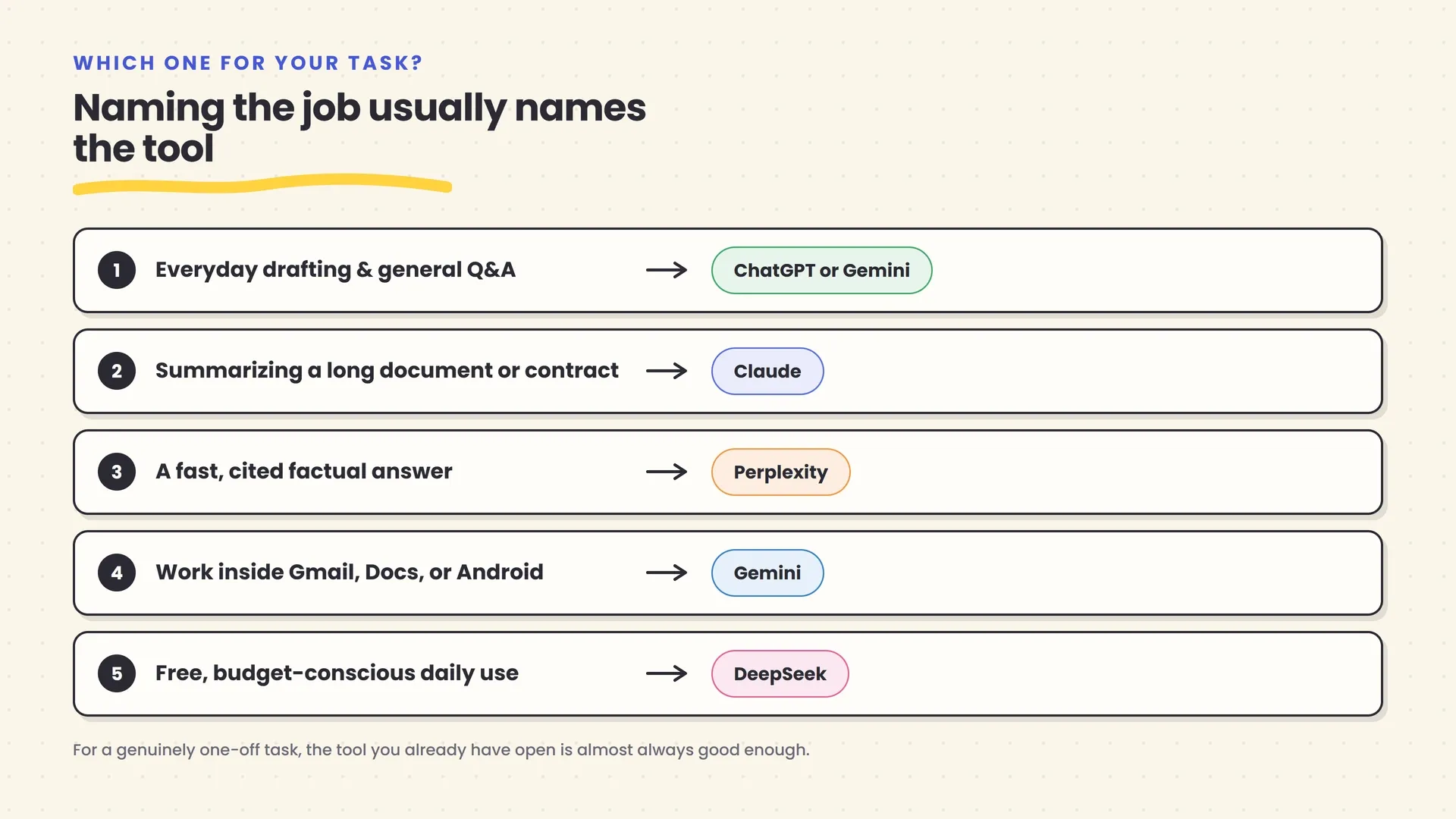
- Everyday drafting, brainstorming, and general Q&A → ChatGPT or Gemini. Both are strong generalists; default to whichever one you already have installed, and let Gemini’s Workspace integration break the tie if you’re a heavy Gmail or Docs user.
- Summarizing or synthesizing a long document, contract, or transcript → Claude. Its Projects feature and large context window are specifically suited to holding a lot of source material in view at once, more so than starting a fresh chat each time.
- A factual question you want answered fast, with sources you can check → Perplexity. It’s the only one of the five built around citation-first answers as the default behavior rather than an add-on.
- Writing or debugging code inside your own workflow → any of the four Western tools handle this well through dedicated coding modes or IDE integrations, but check our AI coding assistants directory for tools purpose-built to live inside your editor; DeepSeek’s API is worth a look specifically for cost-sensitive, high-volume use.
- Work tied to Gmail, Docs, Sheets, or an Android phone → Gemini, because the integration is native rather than bolted on.
- A budget-conscious personal assistant with no subscription → DeepSeek, as long as nothing sensitive is going into it.
- Anything involving client data, health information, or material under NDA → check the vendor’s current data-training and residency policy before any of the five, and default to a paid business/enterprise tier with explicit data protections rather than a free consumer account. We’ve covered this in more depth separately.
What you’ll actually pay
Every one of these five has a usable free tier, which makes the paid decision less urgent than the pricing pages want it to feel. Here’s the honest entry-level comparison, current as of July 2026 — pricing across this category changes often enough that it’s worth a final check on the vendor’s own page before you commit.
| Free tier | Entry paid tier | Top individual tier | |
|---|---|---|---|
| ChatGPT | Limited messages, older model | Plus — $20/month | Pro — $100–200/month |
| Claude | Limited daily messages | Pro — $20/month ($17/month billed annually) | Max — $100 or $200/month |
| Gemini | Generous for casual use | Google AI Plus — $7.99/month | Google AI Ultra — roughly $100–200/month |
| Perplexity | Unlimited basic search, limited Pro Search/Deep Research | Pro — $20/month | Max — $200/month |
| DeepSeek | Full-featured, no caps on core chat | None — API billed per token | N/A (developers pay per token) |
A few things worth noticing in that table rather than skipping past. Gemini’s entry paid tier, at $7.99/month, is meaningfully cheaper than the roughly-$20/month that ChatGPT, Claude, and Perplexity all converge on for their first paid step — which is a real number if you’re weighing options purely on cost and don’t need Claude’s document handling or Perplexity’s citations specifically. DeepSeek isn’t in this race at all: for the consumer chat product, there’s simply no tier to buy, which is either the whole appeal or the reason to be cautious, depending on what you’re using it for.
None of these prices are static. Gemini’s tier structure alone has shifted more than once through 2026, and every vendor here treats pricing as a lever they pull often — so build the habit of checking the current page rather than trusting a number you read six months ago, on this article or anywhere else.
Where your data actually goes
Pricing is the visible trade-off; data handling is the one that matters more and gets checked less. All five of these companies process what you type, and the policies genuinely differ in ways worth knowing before you paste something you’d regret sharing.
- ChatGPT trains on Free, Plus, and Pro conversation content by default; you can opt out in Settings → Data Controls, though that only affects future conversations. Business, Enterprise, Edu, and API usage don’t train on your data by default.
- Claude doesn’t independently search or retain a public index of your material — its research accuracy depends entirely on what you upload, and Enterprise plans carry stronger data controls than the consumer tier.
- Gemini’s free and individual paid tiers may have conversations reviewed by human raters to improve Google’s models, unless you turn off Gemini Apps Activity in your Google Account — which also deletes your stored history. Workspace and Enterprise integrations use a separate policy that doesn’t train on organizational data without permission.
- Perplexity’s citations are generally traceable to real source pages, but Enterprise-grade compliance certifications and stronger retention controls require the paid Enterprise tier, not the consumer plans.
- DeepSeek stores conversations and uploaded files on servers in China, governed by Chinese data-access law, with no alternative regional hosting offered and no fixed retention period beyond “as long as necessary.”
The practical rule that applies across all five: match the sensitivity of what you’re sharing to the tier and vendor you’d actually trust with it. A brainstorm or a first draft is low-stakes anywhere. Client data, health information, financials, or anything under NDA deserves a business or enterprise tier with an explicit data-processing agreement — or, for DeepSeek specifically, a self-hosted deployment of the open-weight model rather than the hosted chat app. For the fuller version of this reasoning, our guide to using AI at work without creating problems goes deeper.
Why the top models have converged — and why price hasn’t
Here’s the pattern underneath all five reviews above, and it’s worth naming directly because it explains why this comparison reads less decisively than the ones from two years ago. On hard, PhD-level science questions (the GPQA Diamond benchmark, a common stand-in for genuine reasoning strength), independent trackers now put the leading closed models from OpenAI, Anthropic, and Google within a handful of points of one another — a gap that used to be ten or twenty points wide has narrowed close to a rounding error. DeepSeek’s open-weight models have followed the same curve from below: on hard coding benchmarks like SWE-bench, V4-Pro now scores competitively with several Western models from the same period, at a small fraction of the price. Exact benchmark scores shift with every release, so treat the direction of the trend as the durable fact here, not any single number.
That convergence is the honest reason “which model is smartest” has become a less useful question than it was. Model quality at the frontier has stopped being the reliable differentiator it once was, and price has moved to fill the gap instead — DeepSeek’s open-weight pricing runs at a fraction of the cost of the most expensive flagship output pricing for work in the same capability tier. The decision that’s left, once raw intelligence stops discriminating between options, is exactly the one this guide has been making throughout: not “which model reasons best” but “which company’s product is actually built around the job I need done, and which one I trust with what I’m putting into it.”
That’s not a reason to stop paying attention to model quality entirely — the gap does still show up on the genuinely hardest problems, and it’s part of why Claude and Gemini both ship a slower “thinking” mode alongside their fast default. It’s a reason to stop treating a leaderboard score as the deciding factor for ordinary work, where the five tools compared here are close enough that ecosystem, cost, and data handling do more of the real deciding.
It’s also worth naming why this happened, because it isn’t an accident of timing. Training frontier-scale models has become expensive enough, and the base techniques well-understood enough across labs, that the biggest remaining gains increasingly come from the same handful of ideas — more careful post-training, longer reasoning chains before an answer, bigger and cleaner data — applied by every serious lab at once, including ones openly publishing their weights. When the underlying technique diffuses that fast, a durable capability lead gets harder to hold onto, and the competition shifts to the things that don’t diffuse as easily: distribution, integration, trust, and price.
Agent modes: when you want it to act, not just answer
Every product on this list has spent 2026 pushing past the chat window toward something that does multi-step work with less supervision — reading files, browsing, filling in forms, and completing a task across several steps rather than answering one question at a time. It’s worth a separate look here because it’s the one area where the five genuinely diverge in maturity rather than converging like their core chat quality has.
ChatGPT’s Agent mode and Claude’s Cowork are the most direct comparison: both let the assistant take a goal, break it into steps, use tools (a browser, a code sandbox, connected apps) to work through them, and check back in at decision points rather than after every single action. Gemini’s agentic features lean on the same underlying idea but benefit from native access to Google’s own apps, so a Gemini agent can act inside Gmail or Calendar without the connector setup a third-party tool needs. Perplexity’s approach comes at this from the browser side: Comet’s assistant can navigate and act across live web pages directly, which suits research-and-purchase tasks — comparing options across several sites, filling in a form — better than a pure chat interface ever could.
DeepSeek doesn’t ship a named consumer agent feature the way the other four do, and that’s consistent with its whole model: it’s a foundation, not a finished agent product. Its open-weight releases and inexpensive API are exactly what a lot of the third-party agent frameworks and coding agents in our AI agents directory build on top of, when a developer wants agentic behavior without paying frontier-model prices for every step.
None of this is essential for most everyday use yet — for drafting, summarizing, and answering questions, the plain chat interface on any of the five still does the job. But it’s the clearest signal of where all five companies are actually pointing their research effort, and it’s covered in full, including the real risks of giving a model less supervision, in our guide to what AI agents are.
Can you just use more than one?
Yes, and in practice, most people who use these tools seriously end up doing exactly that rather than picking one and closing the other four tabs forever. None of the five lock in enough of your data or workflow to make switching between them costly, which is unusual for software and worth taking advantage of.
A sensible small stack looks something like this: one general-purpose default for daily work — ChatGPT or Gemini, chosen by ecosystem fit — plus Claude kept on hand specifically for the days a document runs long, Perplexity for the moments you want a cited answer rather than a conversation, and DeepSeek’s free tier or cheap API in reserve for high-volume or budget-constrained work. That’s not indecision; it’s matching four genuinely different strengths to the four genuinely different situations that call for them, which is the same logic our buyer’s framework for choosing any AI tool argues for more generally: define the job first, and let the tool follow from that, rather than defending a single brand loyalty across every task you have.
The one discipline worth keeping regardless of how many you run: don’t let the number of tools become an excuse to skip verification on any of them. Every model on this list is still capable of a fluent, confident, wrong answer, and running the same question past a second tool occasionally — not obsessively, just occasionally, on anything with a real consequence — remains one of the cheapest checks available. Our guide to why AI hallucinates covers the mechanics and the fuller verification habit in detail.
The bottom line
There’s no single winner among ChatGPT, Claude, Gemini, Perplexity, and DeepSeek in mid-2026, and that’s a genuinely different situation from eighteen months ago, not a hedge. The flagship models have converged enough in raw capability that the real decision has shifted to fit: ChatGPT for reach and polish, Claude for long documents and careful reasoning, Gemini for Google integration, Perplexity for cited factual answers, DeepSeek for cost. Most people don’t need to choose exactly one — they need to know which of the five to reach for on a given afternoon, and default to the one that matches their actual workflow the rest of the time.
If you’re still narrowing down a single daily default, start with whichever one already fits how you work — the ecosystem you’re already in, or the specific task you do most often — rather than the one that wins the most benchmark headlines this month, since by the time you read the next comparison article, those headlines will likely have shifted again. For the deeper habits that separate a beginner account from a confident one on whichever tool you pick, our guide to using ChatGPT, Claude, and Gemini well is the natural next stop — and if you want to browse the full landscape of specialized tools beyond these five general-purpose assistants, the AI chat assistants directory is where that comparison continues.
Frequently asked questions
Which of these five AI assistants is simply the best?
None of them, outright — and by mid-2026 their flagship models score within a few points of each other on most hard benchmarks, so raw capability rarely decides it anymore. ChatGPT wins on reach and ecosystem, Claude on long-document reasoning, Gemini on Google integration, Perplexity on cited answers, and DeepSeek on price. Pick by matching your actual task to that list, not by chasing a leaderboard.
Is it safe to use DeepSeek given it's based in China?
It depends what you're putting into it. DeepSeek's hosted chat and API store data on servers in China, subject to Chinese data-access laws, which is a real consideration for sensitive, proprietary, or regulated information. For casual drafting, brainstorming, or coding help with nothing confidential in it, that risk is minor; for client data, unreleased business information, or anything under NDA, use a different tool or DeepSeek's self-hosted open-weight models instead.
Can I use more than one of these at the same time?
Yes, and most regular users end up doing exactly that. A common pattern is one default for daily work — usually ChatGPT or Gemini — plus Claude on hand for a long document, Perplexity when you need a cited answer fast, and DeepSeek's free tier or cheap API for high-volume or budget-sensitive tasks. None of them lock in your data enough to make switching costly, so there's little downside to keeping two or three open.
If ChatGPT, Claude, and Gemini are all 'general-purpose' assistants, what's actually different about them?
Less the underlying intelligence than what each is built to plug into and how each company makes money. ChatGPT has the largest plugin and Custom GPT ecosystem and the most developed voice mode; Claude is tuned for careful writing and holds up better across very long documents; Gemini is the only one with native, first-party access to Gmail, Docs, and Android. For everyday drafting and Q&A, the output quality gap between them is smaller than the gap between using any of them well and using one badly.
Is Perplexity actually better than ChatGPT or Gemini for research?
For a specific kind of research — a factual question you want answered quickly with sources you can click through and verify — yes, Perplexity is purpose-built for that in a way a general chat assistant isn't. For research that means synthesizing a pile of documents you already have, Claude's large context window and Projects feature are usually the better fit. For research tied to Google Search or your own Workspace files, Gemini's grounding has the edge.
Do I need to pay for any of these to get good results?
No. All five have a usable free tier, and DeepSeek has no paid consumer tier at all. Free tiers mainly limit how many messages you get per day and whether you reach the newest, most capable model — the underlying quality on everyday tasks is close enough on free plans that most people should start there and only upgrade once they hit a real limit, not before.
Related articles
How to Use ChatGPT, Claude, and Gemini Well
Most people barely scratch the surface of ChatGPT, Claude, and Gemini. A practical guide to the settings and habits that turn a beginner into a confident user.
Prompt Engineering for Non-Technical People
Prompt engineering isn't coding — it's telling AI clearly what you want. A plain-English guide to prompts that get better results, no tech background needed.
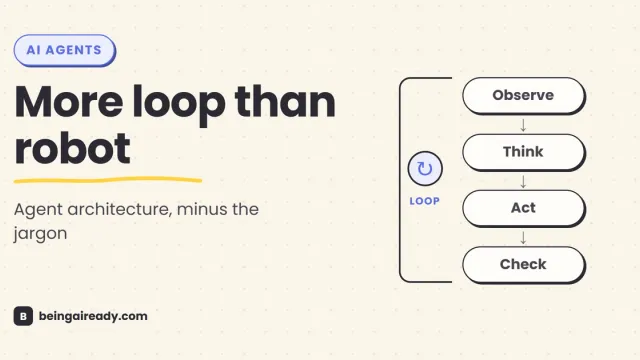
How Do AI Agents Actually Work? Architecture in Plain English
A plain-English guide to AI agent architecture: models, tools, memory, orchestration loops, guardrails, and what happens when an agent takes action.