
Gumloop
An AI-native workflow platform where individual steps are AI reasoning nodes — web scraping, document parsing, multi-model chaining — built for automating tasks that need judgment, not just data movement.
Visit website (opens in a new tab)Independent editorial listing. Features, pricing, and privacy terms can change; confirm details on the vendor site before buying or rolling out a tool.
What it does
Gumloop is a workflow automation platform built around the idea that many real business tasks need AI judgment at each step, not just data moved between apps. Its visual canvas looks similar to tools like n8n or Make, but the nodes available are commonly AI reasoning steps — scraping a website, parsing a document, analyzing an image, chaining multiple models together — alongside conventional automation actions. Pre-built agent templates for common operations work (data analysis, CRM updates, meeting prep, customer support) give teams a working starting point instead of building every workflow from a blank canvas.
The platform positions itself as model-agnostic, supporting GPT, Claude, Gemini, and other providers rather than locking a workflow to one vendor, and it has invested in an enterprise security posture — SOC 2 Type II certification, GDPR compliance, optional zero-data-retention agreements with AI providers, and VPC deployment — that’s more thorough than many comparably new entrants in this space. Recurring background agents can run on a schedule or trigger and be deployed directly into Slack or Microsoft Teams, so the output shows up where a team already works rather than in a separate dashboard.
Gumloop’s tradeoffs mirror its focus: its integration catalog is smaller than Zapier’s or Make’s, so teams relying on long-tail or niche software may find gaps, and its credit-based pricing can vary significantly depending on which AI models and node types a workflow actually uses. It’s best suited to workflows where the AI reasoning is the point — research, enrichment, document understanding — rather than as a general-purpose replacement for simple data-sync automation.
Ideal users
- Teams automating tasks that require AI judgment at each step — data enrichment, lead research, document processing — rather than simple data movement between apps
- Operations and RevOps teams who want pre-built agent templates (data analysis, CRM updates, meeting prep) they can adapt instead of building from scratch
- Security-conscious organizations that need SOC 2 Type II compliance, zero-data-retention agreements with AI providers, and VPC deployment options
Who should avoid it
- Your workflows are mostly simple data-sync between mainstream apps with no AI reasoning involved — Zapier or Make are simpler and likely cheaper for that
- You want the largest possible integration catalog — Gumloop's roughly 50-130 integrations (reported inconsistently across sources) is smaller than Zapier's or Make's
- You want full self-hosting or source-level control — Gumloop is a hosted platform, unlike n8n or Activepieces
- You want a natural-language, describe-the-outcome interface rather than a visual node canvas — Lindy is closer to that model
Key features
- Visual canvas where nodes can be AI reasoning steps (web scraping, document parsing, image analysis, multi-model chaining) alongside standard automation actions
- Pre-built agent templates for common workflows: data analysis, customer support, CRM updates, meeting prep, call analysis
- Model-agnostic AI access — supports GPT, Claude, Gemini, and other models without vendor lock-in
- Recurring background agents with configurable triggers, deployable to Slack and Microsoft Teams
- SOC 2 Type II certification, GDPR compliance, role-based access control, and audit logging
- Zero Data Retention agreements available with third-party AI providers, plus VPC deployment for enterprise customers
Pros / Cons
Pros
- AI reasoning is a first-class part of the workflow builder, not a bolt-on module, which suits judgment-heavy tasks
- Pre-built agent templates reduce the time to a working automation for common operations use cases
- Strong enterprise security posture out of the box (SOC 2, GDPR, VPC, zero-retention options) compared to some newer entrants
- Model-agnostic design avoids locking a workflow to a single AI provider
Cons
- Smaller integration catalog than Zapier or Make, which matters if you rely on long-tail or niche software
- Credit-based pricing means costs can vary significantly depending on which AI models and node types a workflow uses
- Newer, smaller company than the established incumbents, which carries more platform-risk uncertainty
- Best suited to AI-reasoning-heavy workflows — plain data-sync automations may be over-served by its feature set relative to cost
Pricing
Free — $37/month (Pro/Solo plan) for roughly 10,000-20,000 credits/month, depending on current plan structure
Confirmed on gumloop.com/pricing: the Free plan includes 5,000 credits/month, 1 seat, 1 active trigger, and 2 concurrent workflow runs. The Pro plan is $37/month (with a 20% annual-billing discount), including 20,000+ credits/month, unlimited seats, 5 concurrent runs, and 25 concurrent agent interactions, with additional credit blocks purchasable up to 1.5M/month. Enterprise is custom-priced with RBAC, SCIM/SAML, VPC, and audit logging.
Typical workflows
- A RevOps team deploys a recurring agent that enriches every new inbound lead with company research pulled from the web, then updates the CRM record automatically before a sales rep ever opens it.
- A support team uses a Gumloop agent deployed in Slack to parse incoming documents, extract key fields, and flag anything that doesn't match expected patterns for human review.
Integrations
- Slack and Microsoft Teams
- Gmail
- Salesforce and HubSpot
- Google Sheets
- GitHub, Linear, Asana
- GPT, Claude, and Gemini model access
Privacy & security notes
Gumloop's security page confirms it is SOC 2 Type II attested and HIPAA compliant (with BAAs available on eligible plans), GDPR-aligned, and certified under the EU-U.S. Data Privacy Framework including the UK Extension. It states zero-data-retention agreements with major LLM providers and offers VPC deployment in a region of choice, though the exact provider list and contract terms behind those zero-retention agreements aren't detailed publicly — confirm specifics for your provider mix before routing sensitive data through it.
Frequently asked questions
How is Gumloop different from Zapier or Make?
Zapier and Make are built primarily around moving data between apps with optional AI steps added on. Gumloop flips that emphasis — its nodes are commonly AI reasoning steps (research, document parsing, multi-model chaining) with standard automation actions available alongside them, which suits workflows that need judgment rather than just data movement.
How is Gumloop different from Lindy?
Gumloop is a visual node-canvas builder where you assemble AI reasoning steps explicitly, similar in spirit to n8n or Make but AI-first. Lindy instead asks you to describe an outcome in natural language and figures out the steps itself, closer to delegating to an assistant than building a diagram. Teams that want visibility into and control over each step tend to prefer Gumloop; teams that want to describe a task and hand it off tend to prefer Lindy.
Does Gumloop lock me into one AI model?
No, Gumloop is designed to be model-agnostic, supporting GPT, Claude, Gemini, and other models, so a workflow can use different models for different steps rather than being tied to a single provider.
Is Gumloop suitable for regulated or security-sensitive industries?
It advertises SOC 2 Type II certification, GDPR compliance, role-based access control, audit logging, and VPC deployment options on its Enterprise tier, which puts it ahead of many newer automation tools on paper — but any regulated use case should independently verify current certifications and contractual terms before relying on them.
Best alternatives
Lindy
PaidAn AI work assistant you delegate open-ended tasks to in plain English — inbox triage, meeting prep, calendar coordination, CRM updates — rather than a visual workflow you diagram step by step.
n8n
FreeA source-available, self-hostable workflow automation platform built for technical teams, combining a visual canvas with the ability to drop in custom JavaScript or Python and build AI agents directly into workflows.
Related tutorials
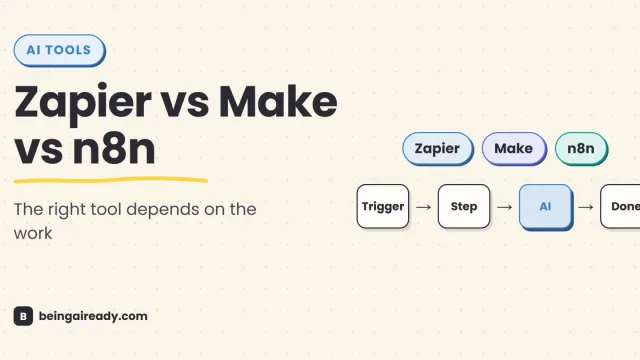
Best No-Code AI Automation Tools in 2026: Zapier vs Make vs n8n
Zapier, Make, or n8n? A practical 2026 comparison of ease of use, AI features, integrations, pricing, control, and real-world fit.
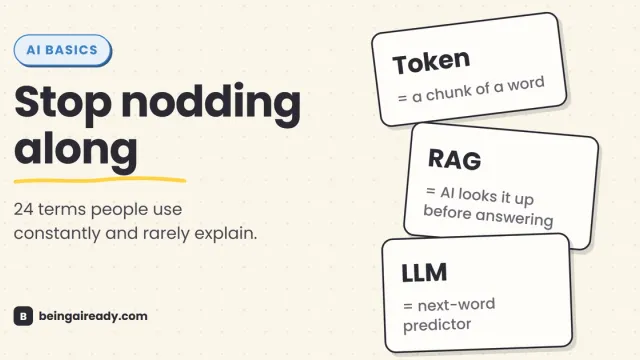
AI Terms Explained: A Plain-English Glossary of 24 Words
The 24 AI terms everyone uses but nobody defines — LLM, tokens, RAG, agents and more — explained in plain English, with analogies that actually stick.