
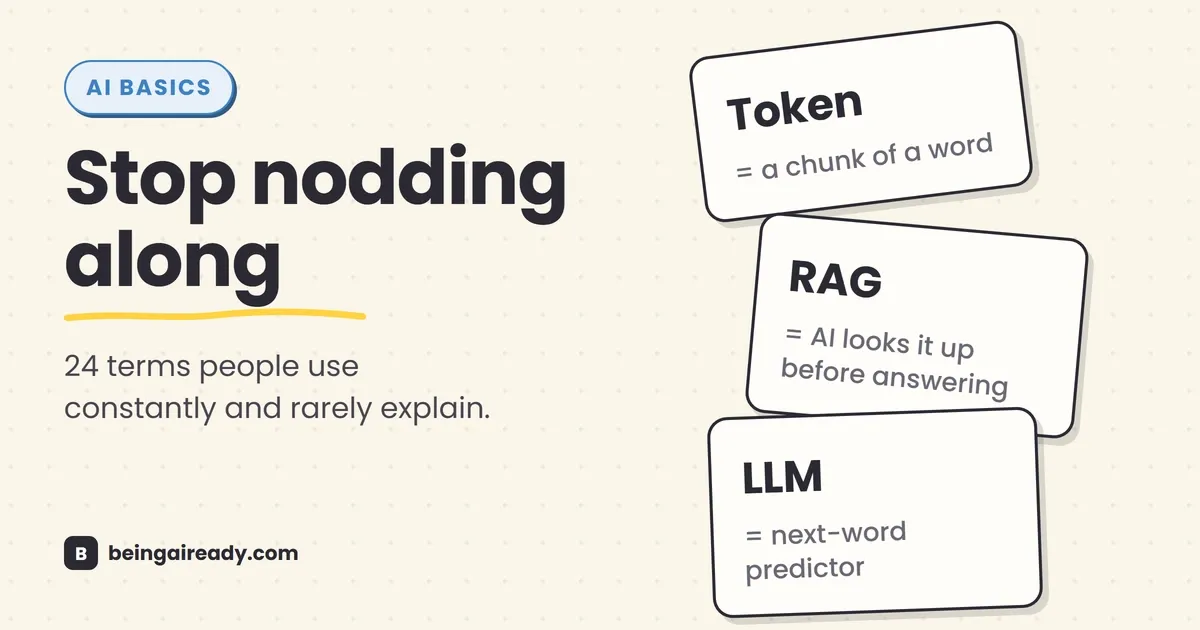
AI Terms Explained: A Plain-English Glossary of 24 Words
The question comes up constantly: “What’s a token? My team keeps saying it in meetings and I’ve been nodding for three months.”
It’s a great thing to admit. Not because the person asking didn’t know — but because so many people are in exactly the same spot and won’t say it out loud. AI went from “cool demo” to “thing your boss expects you to understand” in about eighteen months. Nobody handed out a glossary. The words just started flying around: LLM, prompt, fine-tune, RAG, agent, hallucination. And most explanations you find online are written by engineers, for engineers.
So this is the version they could have found. Twenty-four terms. Plain English. An analogy for each one so it actually sticks. And a quick note on why you’d care, because trivia is boring and useful is not.
You don’t need to read it top to bottom. Skim, jump around, bookmark it, send it to the person on your team who’s been nodding for three months. Let’s go.
Quick answer: This is a plain-English glossary of the 24 AI terms you keep hearing but nobody stops to define — AI, machine learning, deep learning, neural networks, LLMs, tokens, context windows, prompts, fine-tuning, RAG, agents, and hallucination among them. Each term gets the same three-part treatment: what it means in one sentence, an analogy that actually sticks, and why it matters to you. No math, no code — skim to whichever word you got stuck on.
First, a promise about how this works
Every term below gets the same three-part treatment: what it means in one sentence, an analogy, and why it matters to you. No math. No code. If a second piece of jargon shows up to explain the first, this glossary has failed.
One more thing. These concepts build on each other. The order isn’t random — it starts with the big picture and works toward the buzzwords you’re hearing this year. If you read it start to finish, the later stuff will click faster. Your call.
The big picture: AI, machine learning, and deep learning
People use these three words like they’re interchangeable. They’re not. They’re nested.
Artificial Intelligence (AI) is the broad idea of getting machines to do things that normally require human smarts — recognising a face, understanding a sentence, making a decision. That’s it. It’s an umbrella, and a huge one. A chess program from 1997 counts. So does the thing writing your emails today.
Analogy: AI is “transportation.” Useful as a category, but it doesn’t tell you whether we’re talking about a bicycle or a rocket.
Machine Learning (ML) is the part of AI that got everything moving. Instead of a programmer writing out every rule by hand, you show the system thousands of examples and let it figure out the patterns itself.
Analogy: You don’t teach a kid what a dog is by listing rules about ears and tails and fur. You point at a hundred dogs and say “dog” until it clicks. Machine learning learns the same way.
Deep Learning is a specific, powerful flavour of machine learning that uses something called a neural network (more on that soon). It’s the breakthrough behind almost everything you think of as “modern AI” — the image generators, the chatbots, all of it.
Analogy: Picture Russian nesting dolls. Deep learning sits inside machine learning, which sits inside AI.
Why this matters to you: When someone says “we’re adding AI,” that could mean anything from a simple if-then rule to a billion-dollar model. Knowing the layers helps you ask the one question that cuts through hype: “Okay, but what kind?”
How AI actually learns: training data, training, and the model
Here’s where the fog usually rolls in. Let’s clear it with three words that always travel together.
Training Data is the giant pile of examples an AI studies — text, images, code, whatever it’s meant to learn from. Quality matters enormously here. Feed it messy, biased, or wrong examples and you get a messy, biased, or wrong AI. Garbage in, garbage out, at planetary scale.
Analogy: It’s the stack of textbooks. A student who studies great material learns well. A student who studies nonsense confidently repeats nonsense.
Training is the actual process of the AI working through that data and adjusting itself to spot patterns. This is the expensive, slow part that happens behind closed doors, often for weeks, on rooms full of specialised chips. You never see it. You just meet the result.
Analogy: Studying for a huge exam. Long, unglamorous, and it happens before anyone sees the grade.
Model is that finished result. The “trained brain” you actually interact with. When you open ChatGPT or Claude, you’re not talking to “an AI” in some vague sense — you’re using a specific model that finished its training and got shipped.
Analogy: The graduate who walks out with the diploma. Training is the four years. The model is the person you actually hire.
Why this matters to you: Two things. First, when you hear a company brag about their data, now you know why — it’s the textbooks. Second, models have a “cutoff.” They only know what was in their training data, so a model trained last year genuinely doesn’t know what happened last week unless it can look it up. Which brings us to some tricks later on.
Under the hood: neural networks, parameters, and algorithms
You can use AI happily without ever opening this box. But three terms leak out of it constantly, so here’s just enough to sound informed at dinner.
Neural Network is the structure that makes deep learning work. It’s a big web of tiny, simple math units — loosely, very loosely, inspired by how brain cells connect. Each unit does a trivial calculation, but stack millions of them and pass signals through the web, and the whole thing can do genuinely complex work.
Analogy: One ant is not smart. An ant colony builds bridges and farms fungus. The intelligence lives in the connections, not any single piece.
Parameters (also called weights) are the dials inside that network. During training, the model tweaks these dials — billions of them — until it gets good at its task. The parameters are, in a real sense, where the model’s “knowledge” is stored.
Analogy: A giant mixing board with billions of tiny knobs. Training is the slow process of turning each knob to exactly the right spot. When you hear “this model has 70 billion parameters,” that’s the knob count. More isn’t automatically better, but it’s why big models are, well, big.
Algorithm is the step-by-step recipe the system follows — to learn, or to reach an answer. It’s one of the oldest words in computing and it just means “a defined set of steps.” No mystique.
Analogy: A recipe. Same ingredients, different recipes, wildly different dinners.
Why this matters to you: Mostly, it demystifies. There’s no ghost in the machine and no tiny brain in there. It’s math, dials, and steps, operating at a scale that’s hard to picture. Impressive? Absolutely. Magic? No.
The stuff you actually use: generative AI, LLMs, and foundation models
Now we’re in the terms you meet every day, probably without a clear definition of any of them.
Generative AI is AI that creates new things — writing, images, music, video, code — rather than just sorting or predicting. That “generative” is the whole shift of the last few years. Older AI mostly labelled things (“this email is spam”). Generative AI makes things (“here’s a first draft”).
Analogy: The difference between a librarian who finds you a book and a writer who produces a new one. Both useful. Very different jobs.
Large Language Model (LLM) is the specific type of generative AI behind the chatbots you know — ChatGPT (OpenAI), Claude (Anthropic), Gemini (Google). Underneath all the personality, an LLM does one deceptively simple thing: it predicts the next chunk of text, over and over, incredibly well.
Analogy: The autocomplete on your phone, but scaled up so absurdly that it can draft a cover letter, explain a contract, or write a poem. Same core trick. Different universe of capability.
That “just predicting the next word” line trips people up, so it’s worth being honest about it. It sounds too simple to explain something that can pass a bar exam. But prediction, done well enough on enough text, turns out to look a lot like reasoning. Whether it is reasoning is a genuine, unsettled debate. For your purposes: it’s astonishingly capable, and it’s still, at heart, a prediction engine.
Foundation Model is one big, general-purpose model that gets reused as the starting point for thousands of narrower tasks. Instead of building a new AI from scratch for every job, companies build on top of a foundation model.
Analogy: A well-rounded new graduate. They can’t do your specific job yet, but they’ve got the general capability, and a couple of weeks of onboarding gets them there. The foundation model is the graduate everyone starts from.
Why this matters to you: “Generative AI,” “LLM,” and “foundation model” get used almost interchangeably in headlines, but now you can hear the distinctions. And you know the punchline: when most people say “AI” in 2026, they usually mean a generative LLM built on a foundation model. You just quietly understood a sentence that would’ve been soup a year ago.
How AI reads and remembers: tokens, context window, and inference
Remember that token question from the opening? Here’s the answer, plus its two closest cousins.
Token is how AI chops up text to process it. A token is roughly three-quarters of a word — sometimes a whole word, sometimes a piece of one. The AI doesn’t read letters or words the way you do; it reads tokens.
Analogy: Puzzle pieces of language. “Understanding” might be one piece or split into two. You see a word; the AI sees pieces.
Why does anyone care? Money and limits. AI tools usually charge by the token, and they cap how many they can handle at once. So “tokens” is the unit that quietly runs the whole economy of this stuff.
Context Window is how much the AI can hold in mind at one time, measured in tokens. Everything in your current conversation — your messages, its replies, any document you pasted — lives in this window. Go past the limit and the earliest material falls out the back. The AI doesn’t get a warning. It just quietly forgets the start.
Analogy: Your short-term memory, or the amount of desk space you’ve got. Big desk, you can spread out a whole project. Small desk, papers start falling off the edge.
This is why a long chatbot conversation sometimes “forgets” what you said at the top. It’s not being rude. That part slid out of the window.
Inference is the moment the AI is actually doing the work of answering you — as opposed to being trained. Every time you hit send, you trigger an inference. It’s the “live performance” versus the “rehearsal” of training.
Analogy: Training is the years of drama school. Inference is opening night, every night, every time you ask.
Why this matters to you: These three explain most of the weird behaviour people complain about. Costs adding up? Tokens. Chatbot forgot your earlier point? Context window. Slow or pricey responses on a big request? That’s inference doing real work. Knowing the vocabulary turns “why is it being weird” into “ah, that’s the context window.”
Getting good answers: prompts, prompt engineering, and hallucinations
This section is where you get practical value fast, because these three directly affect whether AI is useful to you or a waste of ten minutes.
Prompt is simply what you type or ask. Your instruction, your question, your request. That’s the entire definition. People overcomplicate it.
Analogy: The question you bring to a very well-read, very literal assistant.
Prompt Engineering is the slightly grand name for a genuinely useful skill: wording your request so you get a better result. Being specific. Giving context. Showing an example of what “good” looks like. It’s less “engineering” and more “learning to ask clearly,” but the name stuck. It’s worth building deliberately — we walk through it in a complete guide to prompt engineering for non-technical people.
Analogy: The difference between telling a contractor “make it nice” and handing them a detailed brief with photos. Same contractor. Radically different outcome.
Quick, real example. “Write about dogs” gets you mush. “Write a 150-word, friendly intro for a blog post aimed at first-time golden retriever owners, warm but not cutesy” gets you something you might actually use. Same tool. The second person just asked better.
Hallucination is the term for when AI states something false with total confidence. It doesn’t lie, exactly — lying needs intent. It generates a plausible-sounding answer that happens to be wrong, and it has no built-in sense that it’s wrong. Fake statistics, invented quotes, citations to papers that don’t exist. All classic hallucinations. We break down exactly why this happens, and how to catch it, in a full guide to AI hallucinations.
Analogy: That one friend who answers every question with total certainty whether or not they know. Confident. Convincing. Sometimes completely made up.
Why this matters to you: This is the single most important safety habit with AI, so here’s the blunt truth: never trust an AI’s factual claims on anything that matters without checking. It’s a phenomenal first-drafter and a terrible last word. Use it to get moving, then verify. The people who get burned by AI are almost always the ones who skipped that second step.
Making AI smarter and more reliable: fine-tuning, RAG, and multimodal
These are the upgrades — the techniques that turn a general model into something sharper, more current, and more useful. They come up constantly in any serious conversation about deploying AI.
Fine-tuning is extra, focused training that turns a general model into a specialist. You take a foundation model that knows a little about everything and train it further on a narrow slice — legal documents, your brand’s writing style, medical Q&A — until it’s genuinely good at that one thing.
Analogy: Sending the well-rounded graduate to grad school. Same person, now an expert in one field.
RAG (Retrieval-Augmented Generation) is a mouthful that describes a simple, powerful idea: let the AI look things up before it answers. Instead of relying only on what it memorised during training, the system retrieves relevant, up-to-date documents — your company handbook, this week’s data, a specific PDF — and uses them to ground its response.
Analogy: An open-book exam instead of a memory test. The model can check the actual source instead of reciting from a training run that ended months ago.
RAG is a big deal for two reasons non-tech folks feel directly: it dramatically cuts hallucinations (the model is working from real documents, not vibes), and it lets AI answer questions about your private, current information without retraining the whole thing. Most useful “chat with your documents” tools are RAG under the hood.
Multimodal means the AI can handle more than just text — images, audio, video, sometimes all at once. You can show it a photo and ask what’s wrong with your plant, or hand it a chart and ask for the takeaway. “Modal” refers to the mode of information; “multi” means more than one.
Analogy: Going from a system that can only read to one that can also see and hear. More senses, more it can do.
Why this matters to you: Fine-tuning, RAG, and multimodal are how AI stops being a clever toy and starts being useful for real work. When a vendor pitches you an “AI solution,” these are the words to listen for — and to ask about. “Is it fine-tuned on our stuff? Does it use RAG so it’s actually current? Can it handle our images and PDFs?” Those three questions make you sound like you’ve done this before.
The words everyone’s throwing around in 2026: agents, reasoning, and AGI
If the earlier terms are the foundation, these are the frontier. This is the vocabulary of right now, and it’s where a lot of the hype (and a little of the substance) lives.
AI Agent (Agentic AI) is AI that takes actions and completes multi-step tasks, instead of just chatting back. A regular chatbot answers you. An agent can plan out steps, use tools (search the web, run code, book something, update a spreadsheet), and push a whole task to completion with less hand-holding.
Analogy: The difference between an assistant who answers your question and an intern who takes the assignment and comes back with it done. “Agentic” is the buzzword of the year for exactly this reason — the shift from AI that talks to AI that does.
A fair warning, so you don’t get oversold: agents are genuinely exciting and still genuinely rough around the edges. They fumble, they get stuck, they need supervision. The demos are further along than the daily reality. Watch the space, but keep a hand on the wheel.
Reasoning Model is a type of AI built to “think” step by step before it answers, instead of blurting out the first thing. It works through a problem more deliberately, which makes it noticeably better at math, logic, and multi-step problems — at the cost of being a bit slower and pricier.
Analogy: Showing your working in a school exam. Slower than guessing, but you get more of the hard ones right.
AGI (Artificial General Intelligence) is the big, sci-fi one: a hypothetical AI that’s as broadly capable as a human across almost any task, not just narrow ones. Today’s AI, impressive as it is, is still specialised — brilliant at some things, clueless at others. AGI would be the general article. We’re not there. Whether we ever get there, and when, is one of the most argued questions in the field, and anyone who tells you they know for sure is selling something.
Analogy: Right now we have world-class specialists. AGI would be a true generalist that matches a capable human anywhere. Still on the horizon, or over it, depending on who you ask.
Why this matters to you: These three are where the marketing gets loudest, so they’re where clear definitions protect you most. When a headline screams “AGI is here” or a product promises a fully autonomous agent, you now have the context to read it with a calm, slightly raised eyebrow. That eyebrow is worth a lot.
The 30-second cheat sheet
Bookmark this table. It’s the whole glossary in one screen, for the next time a term ambushes you in a meeting.
| Term | In plain English |
|---|---|
| Artificial Intelligence (AI) | Machines doing things that normally need human smarts |
| Machine Learning | AI that learns from examples, not hand-written rules |
| Deep Learning | Machine learning that uses neural networks |
| Training data | The examples an AI studies |
| Training | The process of learning patterns from that data |
| Model | The finished “trained brain” you actually use |
| Neural network | A web of tiny math units, loosely brain-inspired |
| Parameters (weights) | The billions of dials that store what a model knows |
| Algorithm | A step-by-step recipe the system follows |
| Generative AI | AI that creates new content |
| Large Language Model (LLM) | AI that generates text by predicting the next chunk |
| Foundation model | One general model reused as a base for many tasks |
| Token | A chunk of text, about three-quarters of a word |
| Context window | How much the AI can hold in mind at once |
| Inference | The moment the AI is answering, not training |
| Prompt | What you type or ask |
| Prompt engineering | Wording requests well to get better answers |
| Hallucination | A confident, convincing, wrong answer |
| Fine-tuning | Extra training that makes a model a specialist |
| RAG | Letting AI look things up before answering |
| Multimodal | AI that handles text, images, audio and video |
| AI agent (agentic AI) | AI that takes multi-step actions, not just chats |
| Reasoning model | AI that thinks step by step before replying |
| AGI | Hypothetical human-level AI across almost any task |
Frequently asked questions
What is an LLM in simple terms? A Large Language Model is an AI trained on enormous amounts of text that produces language by repeatedly predicting the most likely next chunk of text. ChatGPT, Claude and Gemini are all LLMs. The “large” refers to both the training data and the number of parameters, which run into the billions.
What’s the difference between AI, machine learning and deep learning? AI is the entire field. Machine learning is a part of AI where systems learn from examples instead of hard-coded rules. Deep learning is a part of machine learning that uses neural networks. They’re nested, not separate — deep learning is inside machine learning, which is inside AI.
What is RAG, and how is it different from fine-tuning? RAG (Retrieval-Augmented Generation) lets a model look information up in real documents at the moment it answers, so it can use current or private data it never trained on. Fine-tuning instead retrains the model itself on a specific dataset to change its default behaviour or expertise. RAG adds knowledge on the fly; fine-tuning changes the model. Many real systems use both.
Why does AI hallucinate, and how do I avoid getting burned? Language models generate plausible-sounding text from patterns, not from a verified database of facts, so a confident-but-wrong answer is a natural side effect. You reduce the risk by using tools that ground answers in real sources (RAG), asking the model to cite where its claims come from, and — the non-negotiable one — verifying anything that actually matters before you rely on it.
Do I need to learn to code to understand or use AI? No. Everything in this glossary, and the vast majority of everyday AI use, requires zero coding. The most valuable skill for most people isn’t programming — it’s learning to ask clearly (prompting) and knowing when to double-check the output.
What does agentic AI actually mean? An AI agent is AI that takes actions and completes multi-step tasks — planning, using tools, and following a job through — rather than only replying with text. It’s the shift from AI that talks to AI that does. As of 2026 it’s promising but still needs human supervision.
Where to go from here
Here’s the honest truth about AI vocabulary: you don’t need all of it, all at once. You needed a map, and now you’ve got one. The next time “context window” or “RAG” lands in a conversation, it won’t be a wall anymore. It’ll be a word you know.
The five that’ll serve you most in daily life are these: LLM (what you’re using), prompt (how you talk to it), hallucination (why you verify), RAG (how it stays factual), and agent (where it’s all heading). Learn those cold and you’re ahead of most people in most meetings.
We write BeingAiReady for exactly this reason — to keep you fluent in AI without the jargon and without the hype cycle. If this cleared something up, subscribe to the newsletter and we’ll send you one genuinely useful, plain-English breakdown a week. No spam, no doom, no “10x your life with this one prompt.”
And do one thing: send this to the person on your team who’s been nodding along for three months. They’ll thank you.
Which of these 24 terms tripped you up the most before today? Reply and tell us — it tells us what to write next.
Frequently asked questions
What is an LLM in simple terms?
A Large Language Model (LLM) is an AI trained on huge amounts of text that generates language by repeatedly predicting the most likely next chunk of text. ChatGPT, Claude and Gemini are all LLMs.
What's the difference between AI, machine learning and deep learning?
AI is the whole field. Machine learning is a part of AI where systems learn from examples instead of hard-coded rules. Deep learning is a part of machine learning that uses neural networks. Think nesting dolls: deep learning sits inside machine learning, which sits inside AI.
What is RAG and how is it different from fine-tuning?
RAG (Retrieval-Augmented Generation) lets an AI look information up in real documents at the moment it answers. Fine-tuning changes the model itself through extra training. RAG adds fresh knowledge on the fly; fine-tuning changes the model's default behaviour and expertise.
Why does AI hallucinate?
Language models predict plausible-sounding text based on patterns, not verified facts. They have no built-in sense of truth, so a confident but wrong answer is a natural failure mode. That's why grounding, RAG and human verification matter.
What does agentic AI actually mean?
Agentic AI (an AI agent) is AI that takes actions and completes multi-step tasks for you, rather than just replying with text. Instead of answering a question, it can plan steps, use tools and get a job done.
Related articles
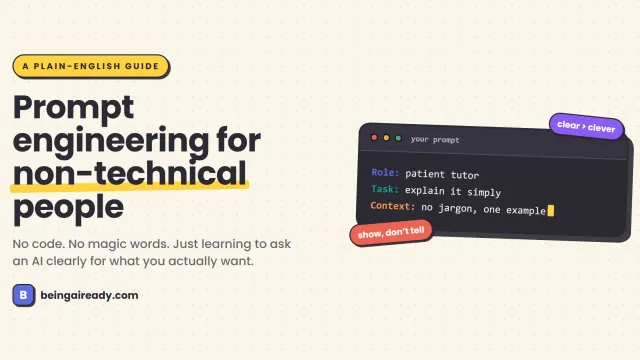
Prompt Engineering for Non-Technical People
Prompt engineering isn't coding — it's telling AI clearly what you want. A plain-English guide to prompts that get better results, no tech background needed.
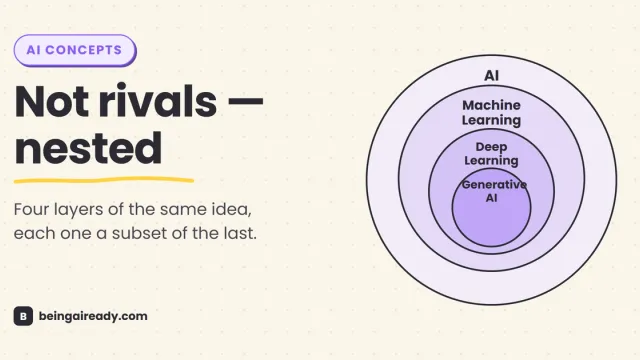
AI vs Machine Learning vs Deep Learning vs Generative AI
AI, machine learning, deep learning, and generative AI aren't rival technologies, they're nested layers. The plain-English map, with real history and examples.
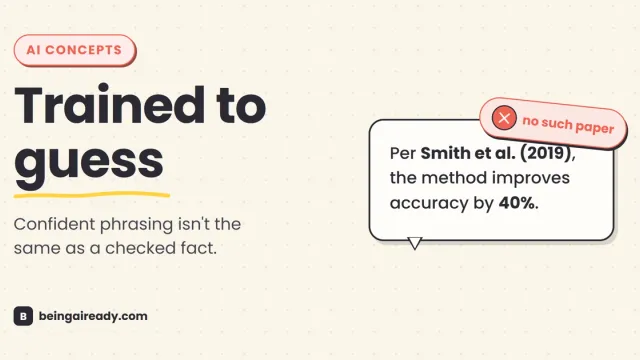
AI Hallucinations: Why AI Confidently Makes Things Up
AI hallucinations aren't random glitches. New research shows they're a predictable result of how models are trained and scored, and how to catch one.