
AI Presentation & Pitch Tools
Introduction
Pitch decks have a narrower, higher-stakes job than ordinary slides: persuade a specific audience — an investor, a buyer, a deal committee — to take a specific action. AI pitch tools focus on that job, with investor- and sales-deck structure, data storytelling, and after-you-send features like per-slide analytics, e-signature, and CRM-linked tracking. This page is for founders raising money and sales teams closing deals — people for whom a deck's success is measured by an outcome, not by how it looks.
Top recommendations
Pitch
FreeCollaborative presentation platform built for sales and fundraising teams, combining AI-assisted deck creation with a shared brand library and per-slide link analytics that show who viewed a deck and for how long.
Storydoc
PaidAn AI-native tool for interactive, narrative-driven sales and pitch content — closer to a trackable microsite than slides — with CRM, e-signature, and payments built in.
Comparison
| Tool | Best for | Pricing |
|---|---|---|
| Pitch | Sales and fundraising teams that need to know when and how a shared deck was actually viewed | $12/month (Plus plan, individual) |
| Storydoc | Sales teams that want a shared deck to double as an interactive proposal, with next steps built in | $19.80/month (Starter plan, billed annually) |
| Alai | Founders who want an AI generator that already understands standard pitch-deck sections and layouts, not a generic slide template | $20/month (Plus plan) |
| Slidebean | Seed-to-Series-A founders who need an investor-ready deck fast and don't have in-house design help | $7/month (Starter plan, billed annually) |
| Presentations.AI | Teams that need investor, sales, and board decks to stay current with live CRM or BI data instead of being manually updated | $20/month (Pro plan) |
Reviews
Pitch
Collaborative presentation platform built for sales and fundraising teams, combining AI-assisted deck creation with a shared brand library and per-slide link analytics that show who viewed a deck and for how long.
Read the full review — Pitch →Storydoc
An AI-native tool for interactive, narrative-driven sales and pitch content — closer to a trackable microsite than slides — with CRM, e-signature, and payments built in.
Read the full review — Storydoc →Alai
AI presentation design tool trained specifically on pitch decks, with pitch-relevant layouts (traction timelines, competitive matrices, TAM pyramids), engagement analytics, and an API for pulling in live traction data.
Read the full review — Alai →Slidebean
AI pitch deck builder built specifically for startup fundraising, with investor-tested templates, financial modeling tools, view tracking, and an optional tier that adds human expert feedback and an investor CRM.
Read the full review — Slidebean →Presentations.AI
An AI presentation platform that structures decks by purpose — investor pitch, sales deck, or board update — and connects to live data from Salesforce, HubSpot, and Tableau.
Read the full review — Presentations.AI →Frequently asked questions
How is this different from AI Presentation Makers?
AI Presentation Makers (Canva, Gamma, Beautiful.ai, Decktopus, Microsoft Copilot for PowerPoint, Plus AI) are general-purpose slide generators for any presentation — meetings, teaching, internal updates, client decks. This category covers tools built specifically for persuasive pitch content, where the differentiator is investor- or sales-specific narrative structure, data storytelling, or sales-outcome features like per-slide analytics, e-signature, and CRM-linked deal tracking. None of the tools recommended here duplicate that other category's picks.
Can I just use Gamma or Canva to build a pitch deck?
Yes, for a first draft — both handle general slide generation well. What they don't offer is what most of the tools on this page are built around: investor-deck-specific structure and analytics, or deal-closing features like e-signature and CRM sync built into the deck itself.
Which tool should I use for raising venture capital?
Slidebean and Alai are both built specifically around fundraising. Slidebean pairs its AI builder with financial modeling, a cap table tool, and an optional tier with human expert feedback. Alai is a faster, more self-serve AI generator trained specifically on pitch-deck layouts, with an API for connecting live traction data.
Which tool is best for sales teams closing deals rather than fundraising?
Storydoc is built around that use case directly, with CRM integrations, e-signature, and payment collection inside the document. Pitch is a strong alternative if your priority is team collaboration and per-slide link analytics rather than closing a deal inside the deck itself.
Do these tools replace a CRM?
No. They generate and track individual pitch or sales documents. Several connect to a CRM (Storydoc to HubSpot and Salesforce, Presentations.AI to Salesforce and HubSpot among other sources) so that deck activity stays linked to the right deal record, but none manage a full pipeline on their own.
When a dedicated pitch tool is worth it (and when it isn’t)
A pitch-specific tool earns its place when the deck’s success is a concrete outcome — funding raised, a deal signed, a sale closed — and you want to know how it performed after you sent it, not just how it looked while you built it. That’s what the analytics, e-signature, and CRM tracking in this category are for.
For a routine internal deck, a team update, or training material, that machinery is overkill, and a general AI presentation maker is simpler and cheaper. The quickest way to tell which you need: if no one is being persuaded to do something, and you don’t care how the deck performed after the meeting, you don’t need a pitch tool.
How to choose the right AI pitch tool
Start from the outcome you’re optimizing for, then check that the features you’re actually paying for aren’t locked behind a higher tier:
- Fundraising vs. sales. Raising venture capital points toward tools built around investor-deck structure and financial modeling. Closing a sale points toward tools that build tracking, e-signature, and payment collection into the document itself.
- Do you need after-send tracking? Per-slide view analytics and CRM-linked activity tell you how a deck performed and where a prospect dropped off. If you just need a good-looking deck, a general presentation maker will do.
- Live data or static? Some tools connect a deck to a CRM or BI source so numbers refresh automatically — useful for recurring investor updates or board decks that would otherwise go stale between meetings.
- Check the feature at your real budget. This is the category’s main trap: the features that justify a pitch tool over a general one — deep analytics, CRM sync, e-signature — are often gated behind a mid-tier or custom-quoted plan. Confirm the exact feature is included at the price you’d actually pay.
How AI pitch tools differ from a general slide maker
A general AI slide tool optimizes for one thing: fast, good-looking slides for any purpose. That’s genuinely useful for a first draft of a pitch, too. What it doesn’t give you is everything that happens around the persuasion — narrative structure tuned to how investors or buyers actually read a deck, pitch-specific visuals like traction charts and competitive matrices, and the tracking that tells you whether the deck did its job. AI helps on both sides, but a pitch tool points that help at the outcome (did this close?) rather than at the artifact (does this look good?). If the deck is just carrying information, use the general tool; if it’s carrying a decision, the narrower tool tends to pay for itself.
Related articles
How to Choose the Right AI Tool: A Buyer's Framework
A calm, no-hype framework for choosing the right AI tool for any task: define the job, judge the real criteria, run a cheap trial, and avoid costly switching.
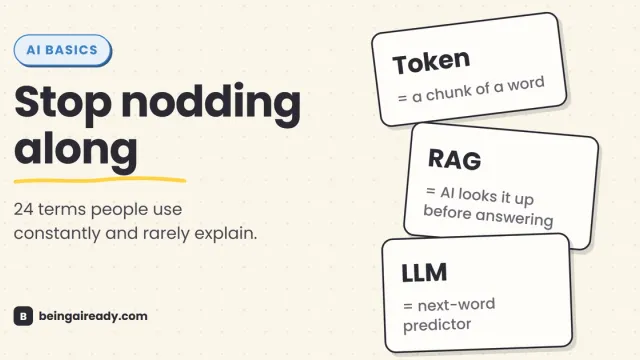
AI Terms Explained: A Plain-English Glossary of 24 Words
The 24 AI terms everyone uses but nobody defines — LLM, tokens, RAG, agents and more — explained in plain English, with analogies that actually stick.