
How to Break Into AI Without a Degree: A No-Hype Roadmap
Most people who want to work in AI right now don’t have a computer science degree. That isn’t a motivational line, it’s just the shape of the labour market. The field grew faster than universities could mint specialists in it, and a large share of what companies are actually hiring for didn’t exist as a job description five years ago. Nobody has a degree in “RAG pipelines.” The credential everyone assumes is the gate, in this particular corner of tech, mostly isn’t.
This is the guide for someone smart and motivated who is starting from close to zero and wants a real job in AI. Not the vague ambition to “get into AI,” but the actual sequence: which skills in what order, which certifications are worth the money and which aren’t, what a portfolio that gets you interviews looks like, and how to get past a hiring process that wasn’t designed with you in mind. It’s long, deliberately, because the honest version of this is not a listicle. Bookmark it, read it in sections, come back to the phase you’re on.
A note on what this isn’t. It isn’t ten tips, it isn’t a pitch for a bootcamp, and it isn’t a pep talk about how anyone can do anything if they believe hard enough. Some people won’t finish this transition, and it usually isn’t for lack of talent. Think of this instead as a spec document for a career change: here’s what you need to know, roughly how long it takes, the specific ways people waste months without meaning to, and how to prove you know your stuff to someone who has forty other résumés open in other tabs.
One more framing note before we start. The thing that trips people up most isn’t any individual skill on this list. It’s sequencing — doing things in an order that compounds, instead of an order that feels productive. Almost everyone who stalls does so because they skipped a foundation and spent three months confused, or because they collected knowledge they never converted into evidence. This guide is really about the order.
The short version: Yes, you can get hired in AI without a degree, but not by getting generically “better at AI.” You get hired by building a small number of specific, deployed things that prove you can do the job, then routing around the parts of the hiring process built to filter out exactly the kind of applicant you are. Budget nine to fifteen months of consistent, part-time effort. There’s no shortcut that removes the work. There are only shortcuts that remove the wasted work, and most of this guide is about those.
Why this is actually possible now
For most of the last two decades, breaking into a technical field without a degree meant fighting the system. You had to be exceptional, extremely lucky, or both. That’s changed, and not because companies suddenly got generous. It changed because AI hiring has a supply problem a university system running on four-year cycles simply can’t solve in time.
Three things are true about this market at once, and the third is what makes the first two survivable.
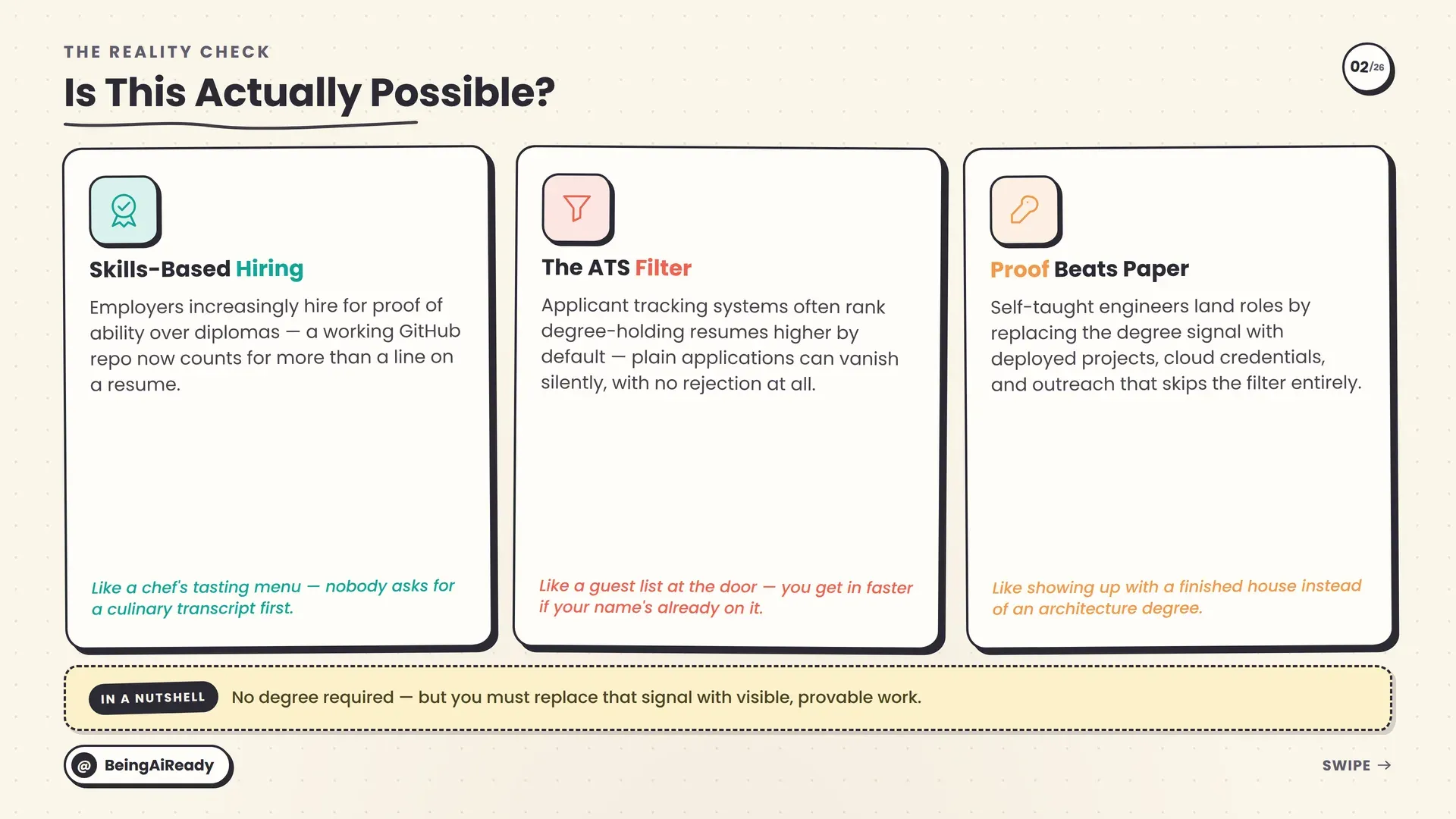 Three things are true about AI hiring at the same time — and the third is how you route around the other two.
Skills-based hiring isn’t a slogan, it’s a response to scarcity
Demand for people who can build with modern AI tools has outrun the supply of computer science graduates who have that specific experience. That gap exists for a simple reason: most of the current stack — retrieval-augmented generation, agent frameworks, the present wave of LLM tooling — didn’t exist when today’s new graduates picked their majors. A degree completed in 2024 was largely designed around a 2020 syllabus. It’s genuinely valuable, but it wasn’t built for the job that’s open now.
Meanwhile, a working GitHub repository tells a hiring manager something a transcript can’t: that you can finish something, unsupervised, with no professor enforcing a deadline. That signal has become more valuable precisely because it’s harder to fake than a grade. Google, Apple and IBM have been publicly dropping degree requirements from technical postings for years, and they’re not doing it out of charity — they’re doing it because the requirement was screening out people who could obviously do the work. AI teams specifically tend to be the most understaffed, highest-pressure teams in a company, which makes them the least precious about where a candidate’s knowledge came from. A manager drowning in work does not care whether you learned RAG at Stanford or on a laptop at your kitchen table. They care whether you can build the thing.
But the résumé filter is real, and pretending otherwise costs you six months
Here’s the part most optimistic “you don’t need a degree” content skips. Most mid-size and large companies run incoming applications through an applicant tracking system — ATS software that scans and ranks résumés before any human sees them. Left on default settings, a lot of these systems still weight degree fields and hand out bonus points for keywords lifted straight from a four-year curriculum.
So you get the uncomfortable middle truth of AI hiring: a company’s careers page can say “skills over pedigree” in good faith while its own filtering software quietly does the opposite. This isn’t a conspiracy. It’s what happens when a hiring process is assembled by committee over a decade and nobody circles back to revisit the defaults. The recruiter genuinely believes in skills-based hiring. The software they inherited was configured before they arrived.
This matters enormously for strategy, and it’s why two later sections of this guide — rewriting your résumé and doing direct outreach — exist at all. If you don’t know the filter is there, you’ll spend six months firing perfectly good applications into a system engineered to reject them, get no responses, and slowly conclude the problem is you. It usually isn’t. It’s that you’re playing a game without knowing the rules.
Proof routes around the filter entirely, instead of trying to beat it
This is the third truth, and it’s the one that makes the whole thing work. A deployed project with a live link, a referral from someone already inside the company, or a direct application to a smaller shop that still reads résumés by hand — all three bypass the ATS problem structurally rather than trying to out-keyword it.
Think about what each of those does. A referral drops your name directly onto a hiring manager’s desk, skipping the filter completely. A live demo link gives a reviewer something to click instead of a keyword to scan — it changes the medium of the conversation. A smaller company without an aggressive ATS is simply a game with fairer rules. None of these are hacks. They’re just the parts of the market where evidence is allowed to speak, and your entire strategy as a no-degree candidate is to spend as much time as possible in those parts and as little as possible feeding the filter.
That’s the throughline of everything that follows: spend less time optimising how you describe your skills, and more time building things that make the description unnecessary.
The degree, honestly, was never quite the point. It was a slow, expensive, reasonably reliable signal that a person could commit to something hard for four years and see it through. A deployed, documented, evaluated project sends a similar signal — just faster, and aimed much more precisely at the actual job. You’re not trying to prove you’re the sort of person who could learn to do this. You’re proving you already did.
The six-phase roadmap, at a glance
Here’s the shape of the whole thing before any of the detail. Six phases, roughly in order, though the first three tend to overlap once you get moving. Nobody actually finishes “math” before touching a line of machine learning code, and that’s fine — the phases are a sequence of centres of gravity, not walls.
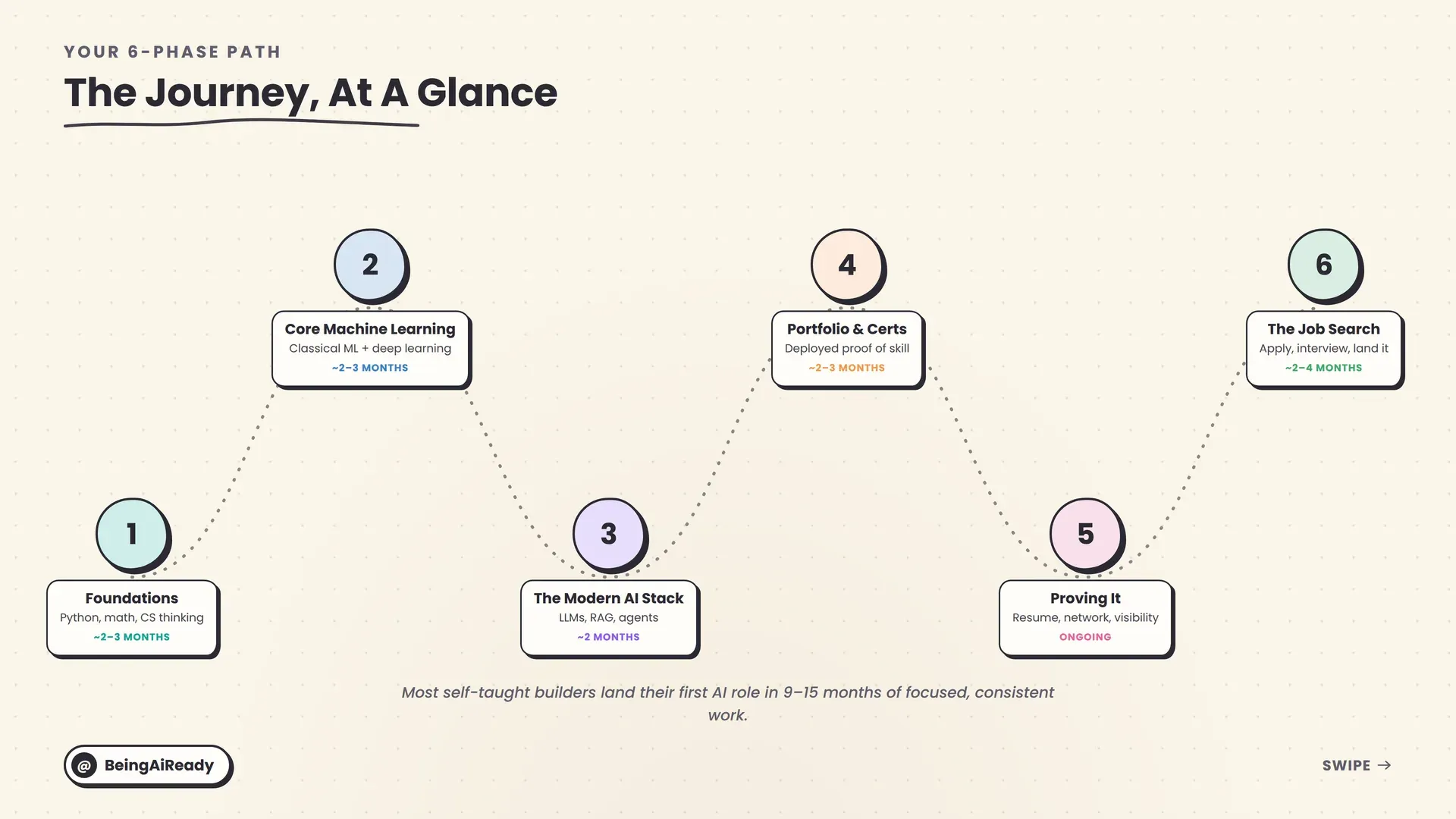 The six phases, laid out in roughly the order most self-taught builders move through them.
Foundations come first — the programming, math and computer-science habits that everything else quietly assumes you already have. Skip this and every later phase gets harder in a way that’s genuinely hard to diagnose, because you’ll be debugging code you don’t really understand and won’t be able to tell whether the concept is hard or you’re missing a prerequisite.
Core machine learning is next: the classical algorithms, the deep-learning fundamentals, and, just as important, the habit of working with messy real-world data instead of the pre-cleaned datasets every tutorial hands you.
The modern AI stack is where most current job postings actually live — LLM APIs, retrieval-augmented generation, agents, and the evaluation and deployment practices that separate a working demo from something a company could run in production. If you only have energy to go deep on one phase, it’s often this one, because it’s where the demand is most acute and the supply of experienced people is thinnest.
Portfolio and certifications is where you convert the first three phases into evidence: deployed projects and a small number of well-chosen credentials that make your skills externally verifiable rather than something you just assert. This is the phase people are most tempted to skip and the one that matters most.
Proving it is the ongoing work of making that evidence visible to the people doing the hiring — your résumé, your outreach, your presence in the places where these roles actually get filled. It’s less a phase than an ambient activity that runs alongside everything from Phase 4 onward.
The job search is its own phase, deliberately kept separate from “being ready.” Plenty of qualified people delay applying for months because they don’t feel ready yet. At some point readiness and application have to run in parallel, not in sequence, and one of the quiet jobs of this guide is to get you to start applying earlier than feels comfortable.
On timing: most self-taught builders who put in consistent, focused effort land a first AI role somewhere in the nine-to-fifteen-month range. That’s a genuine range, not a hedge. It moves with your starting point — a software developer bridging into AI moves faster than someone starting from no programming at all — with how many hours a week you can give it, and with how much of that time goes into building versus consuming. There’s a month-by-month breakdown further down.
For now, the beginning.
Phase 1: Foundations — programming, math, and thinking like an engineer
Phase one is the least exciting part of this roadmap and the one people are most tempted to shortcut. Resist that. Everything from Phase 3 onward — the parts that actually feel like “doing AI” — quietly assumes fluency in the material below. Skipping it doesn’t save time. It relocates the pain to six weeks from now, at which point it’s much harder to tell whether you’re stuck because a concept is genuinely hard or because you’re missing a prerequisite nobody mentioned. Budget two to three months here if you’re starting from scratch. Less if any of it overlaps with work you’ve already done.
The goal of this phase isn’t mastery. It’s fluency — the point where the mechanics stop being the bottleneck between having an idea and testing it. You’ll keep getting better at all of this for years. You just need enough to stop tripping over the basics.
Learn to speak to the machine
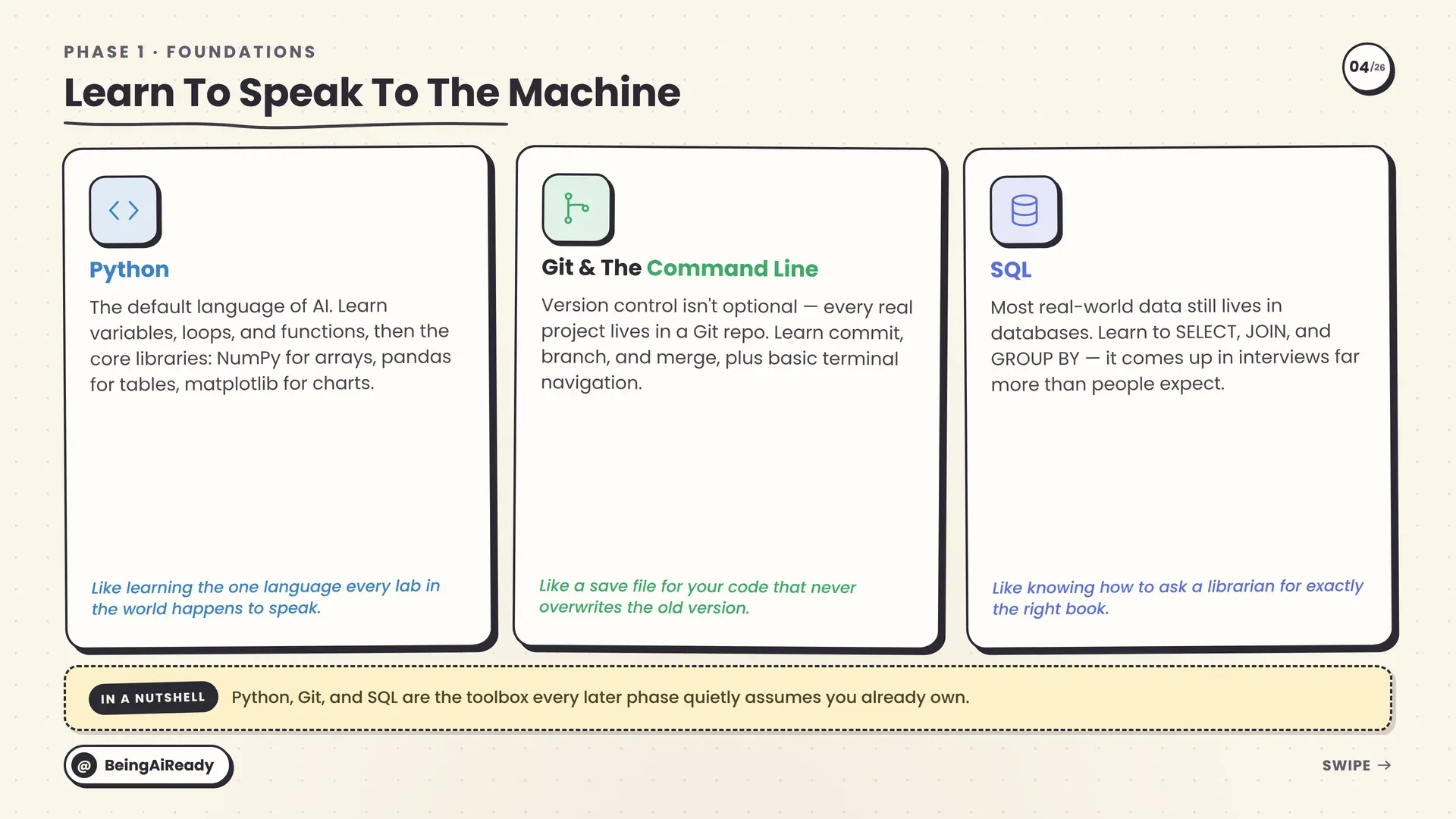 The toolbox every later phase quietly assumes you already own.
Three things, none of them optional.
Python is the default language of AI in the same way English is the default language of international aviation — not because it’s uniquely elegant, but because that’s what everyone standardised on, so that’s what the libraries, tutorials and job postings all assume. Start with the plain fundamentals: variables, loops, functions, conditionals, the basic data types (lists, dictionaries, sets). Then the three libraries that turn up in nearly every AI project you’ll touch. NumPy handles arrays of numbers efficiently — it’s the layer almost every other library sits on top of. pandas handles data that looks like a spreadsheet, and you’ll use it constantly for loading, cleaning and reshaping data. matplotlib turns that data into a chart you can actually look at, which matters more than it sounds, because a huge part of the job is looking at data until you understand it.
You don’t need to be a “great programmer” by the standards of a CS department. You need to be fluent enough that writing a for-loop or a function doesn’t require a search every time. A good test of readiness: can you load a messy CSV, clean it, compute a few summary statistics, and plot one relationship in it, without a tutorial open? When that stops being hard, you’re ready to move on.
Git and the command line are the part beginners most often treat as optional and most quickly regret. Git is version control — a system that keeps a complete history of every change to your code, so you can experiment without the fear of permanently breaking something. Learn to commit (save a checkpoint you can return to), branch (try something risky in an isolated copy), and merge (bring that experiment back into the main project), plus enough terminal navigation to move around, install things, and run scripts, because a surprising amount of real AI work happens outside a nice graphical interface.
This isn’t glamorous, and it’s tempting to defer. Don’t. A messy Git history — one giant commit called “final version,” or worse, no version control at all — is the single most common thing that makes a self-taught candidate’s code look amateur to a reviewer, regardless of how good the underlying idea is. Clean, incremental commits are a cheap signal that reads as professionalism, and you get it almost for free just by committing as you work.
SQL is the one people most underestimate. Despite the current obsession with unstructured text and vector databases, most real-world business data still lives in an ordinary relational database, and SQL is how you talk to it. Learn to SELECT the data you want, WHERE to filter it, JOIN two tables together, and GROUP BY to summarise results. That’s most of what you’ll use day to day. It comes up in technical interviews for AI roles far more than people expect, precisely because it’s such a reliable way to test whether someone can actually manipulate data rather than just talk about it. A candidate who can write a clean join under mild pressure signals something real.
The math — only what you’ll actually use
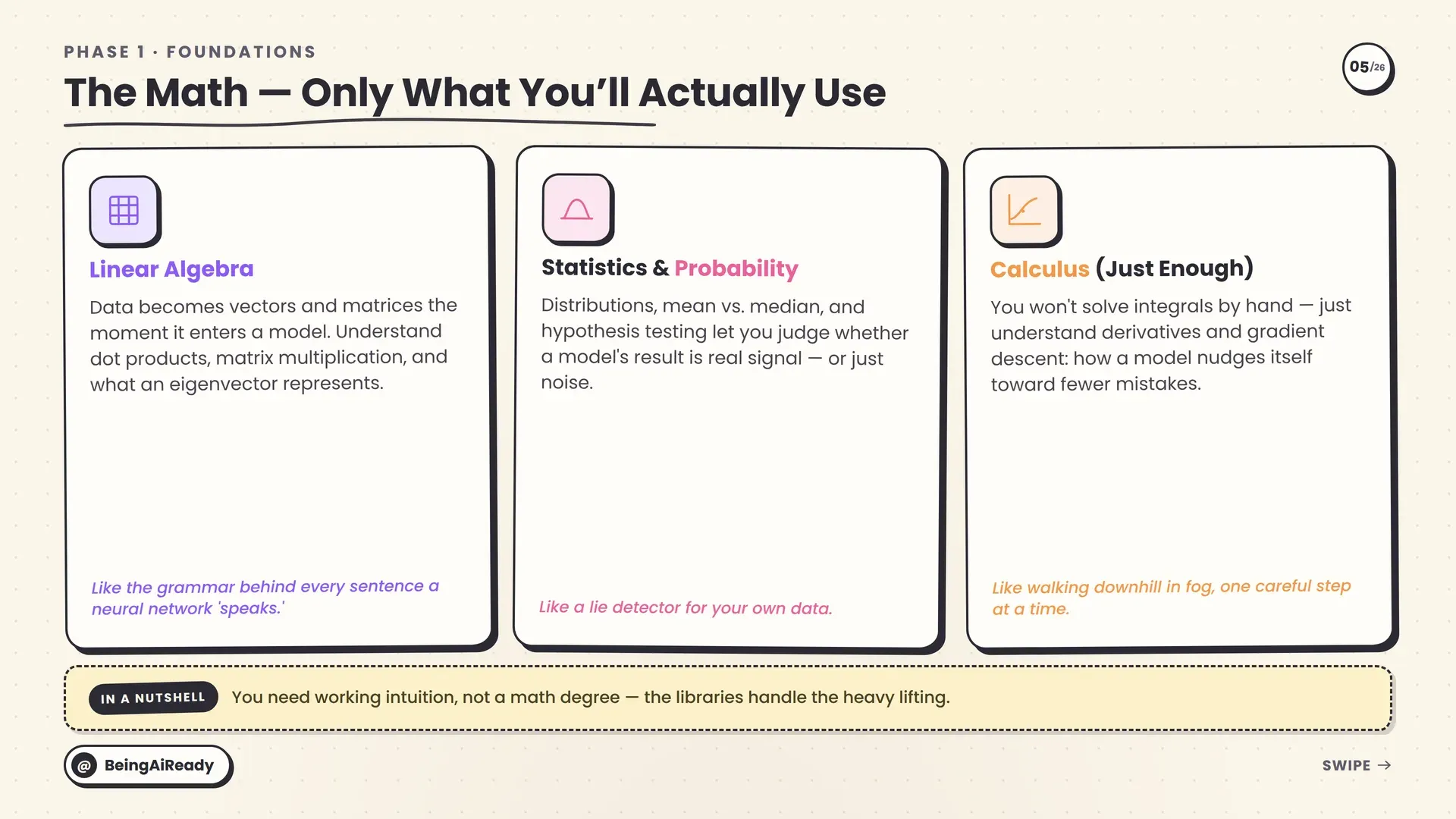 Working intuition, not a math degree — the libraries handle the heavy lifting.
If the word “math” just made your stomach drop slightly, take a breath. This section is shorter than the fear it usually produces. You are not being asked to become a mathematician, and the anxiety around AI math is wildly out of proportion to what applied roles actually require. You’re being asked to build intuition for three ideas that come up constantly, so that when a model does something confusing you have a mental model for why instead of a shrug.
Linear algebra is the grammar underneath everything a model does. The moment your data enters a model it becomes vectors and matrices — grids of numbers — and operations like matrix multiplication are how the model combines and transforms that data at every step. When you hear that an embedding is “a list of numbers,” that list is a vector, and comparing two of them for similarity is a dot product. You don’t need to compute any of this by hand; a library does it in microseconds. You do need a working sense of what a dot product represents (roughly, how aligned two things are) and what an eigenvector is, because those ideas explain why certain techniques work, not just that they do.
Statistics and probability are what let you tell a real result apart from noise dressed up as one. Distributions, the difference between a mean and a median (and when each one lies to you), the basic logic of hypothesis testing, correlation versus causation — these are the tools that stop you getting excited about a pattern that’s actually just chance. This matters enormously once you’re evaluating a model later on. A number that looks impressive can be statistically meaningless, and a model that looks great on your test set can fall apart in production for reasons that are, at bottom, statistical. Knowing the difference is a genuine, hireable skill, and it’s one of the clearest dividing lines between someone who can run a model and someone who can be trusted with its output.
Calculus, mercifully, you need in exactly one bounded way: understanding derivatives well enough to grasp gradient descent, the process by which a model nudges its own internal numbers, step by step, toward fewer mistakes. Nobody is asking you to solve an integral by hand. Picture walking downhill in thick fog, feeling out the slope under your feet and taking small steps in the direction that goes down — that’s gradient descent, translated into notation. Once that picture clicks, most of the training vocabulary you’ll meet later (learning rate, loss, convergence) stops being mysterious and starts being obvious.
A practical note on all three: learn the math alongside the code, not before it. The intuition sticks far better when you meet each concept at the moment you need it — linear algebra when you first touch embeddings, statistics when you first evaluate a model — than when you try to front-load it as abstract theory. Anyone telling you to spend three months on math before you write a line of ML code is giving you a great way to quit.
Think like an engineer, not just a scriptwriter
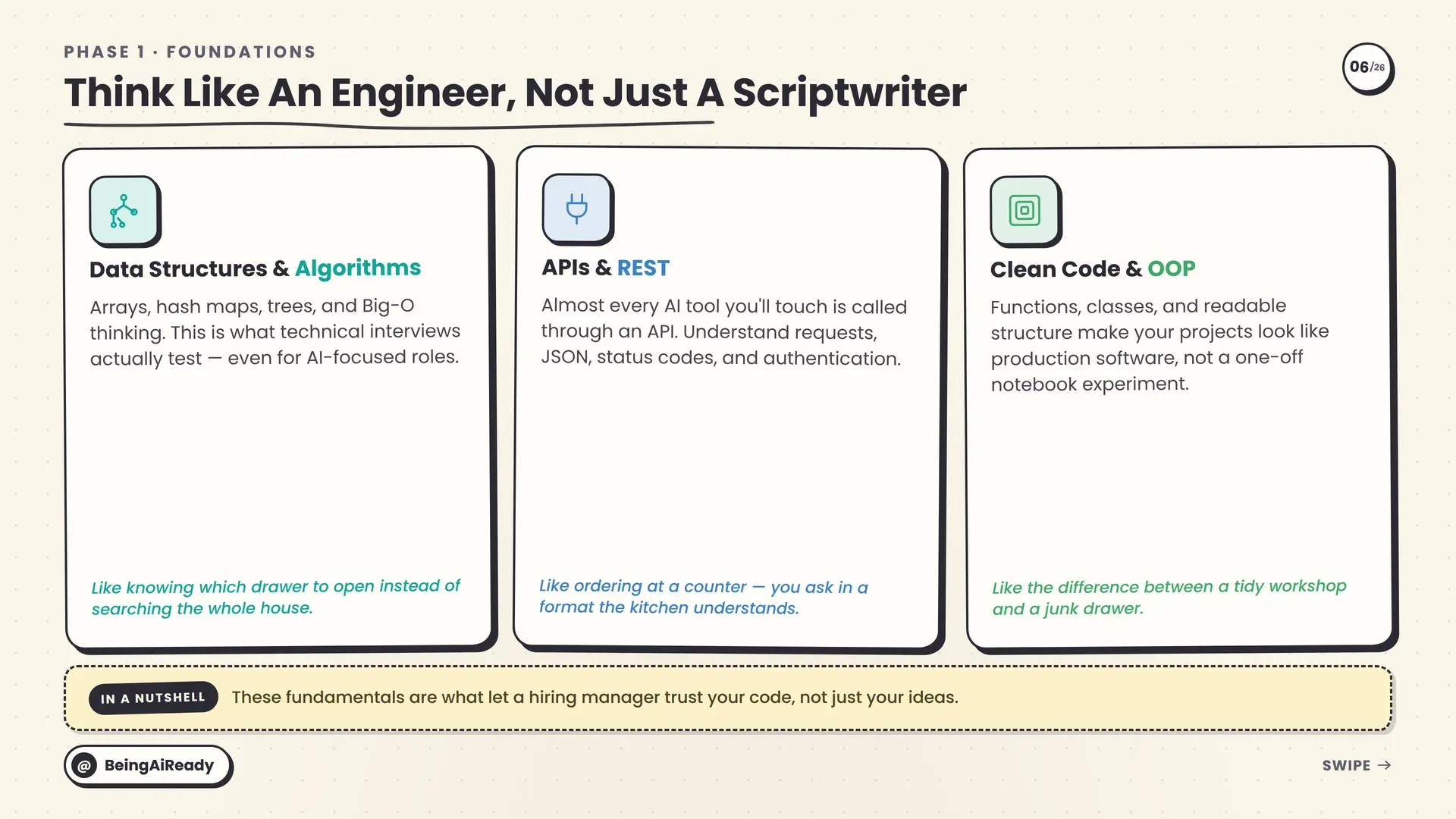 The fundamentals that let a hiring manager trust your code, not just your ideas.
The last piece of foundations is what separates someone who can follow a tutorial from someone who can build something a company would actually want to run. It’s also the part most self-taught learners underinvest in, because it’s less immediately rewarding than getting a model to spit out a prediction.
Data structures and algorithms — arrays, hash maps, trees, and a basic feel for Big-O notation, which is just a way of describing how much slower an approach gets as the data grows. This is, frankly, what most technical interviews still test, even for heavily AI-focused roles, because it’s a fast, standardised way to see how someone thinks under a bit of pressure. You don’t need to grind hundreds of competitive-programming problems. You need to genuinely understand why a hash map lookup is fast and a scan through a list is slow, and to be able to reason out loud about the trade-offs of an approach. That reasoning is what’s actually being graded.
APIs and REST matter because almost every AI tool you’ll touch — from calling a GPT-style model to querying a database over the network — happens through an API, a defined way for one piece of software to ask another for something. Understand how a request is structured, what JSON looks like (it’s just a nested structure of keys and values — you’ll read and write it constantly), what the status codes mean (a 200 is good news, a 404 means it went looking for something that isn’t there, a 401 means you weren’t allowed in, a 429 means you’re being rate-limited), and how authentication with an API key works. This isn’t advanced material, but it’s the connective tissue of every real project, and being fuzzy on it will slow you down every single day.
Clean code and object-oriented programming — functions, classes, and code organised well enough for someone else to read — is what makes your projects look like software a company could inherit rather than a one-off experiment that only makes sense to the person who wrote it. Learn what a function should and shouldn’t do (one job, clearly named), when to reach for a class, and how to structure a project into files that a stranger could navigate. It’s a genuinely underrated thing for self-taught developers to invest in, precisely because it’s the first thing a hiring manager notices in your repository — before they read a word of your README, they can see whether your code was written by someone who thinks about the next reader.
A realistic Phase 1 plan
If you want a concrete shape for these two-to-three months: spend the first few weeks purely on Python fundamentals until loops and functions are automatic. Add Git from day one — commit every session, even the messy ones, because the habit is the point. Layer in NumPy and pandas by working with a real dataset you actually care about, not a toy one. Bring in the math intuitively as each piece becomes relevant. Fold in SQL and API basics once you’re comfortable writing Python. And end the phase by building one small, complete thing — even a script that pulls data from an API, cleans it, and saves a chart — and putting it on GitHub with a readable README. That last step turns three months of learning into your first piece of evidence, and it sets the pattern for everything after.
Put those sections together and you have the toolbox. None of it is AI, specifically, and that’s the point. It’s the floor everything AI-specific gets built on top of, and it’s why people who skip it spend Phase 3 confused in ways they can’t name.
Phase 2: Core machine learning
With the tools in hand, phase two is where you actually start doing machine learning: first the classical techniques that predate the current wave of large language models, then deep learning, and then a habit that matters more than either — getting comfortable with data that doesn’t behave.
It’s tempting, in 2026, to skip straight to LLMs and agents. Resist that too, but for a subtler reason than in Phase 1. You can build impressive-looking LLM demos with almost no ML fundamentals — that’s what makes the modern tools so accessible. But the moment something breaks, or an interviewer asks why your system behaves the way it does, the gap shows instantly. Classical ML is where you learn how models actually learn, how they fail, and how to tell a real result from a lucky one. That understanding is what makes your later GenAI work credible instead of cargo-culted.
Where real ML begins
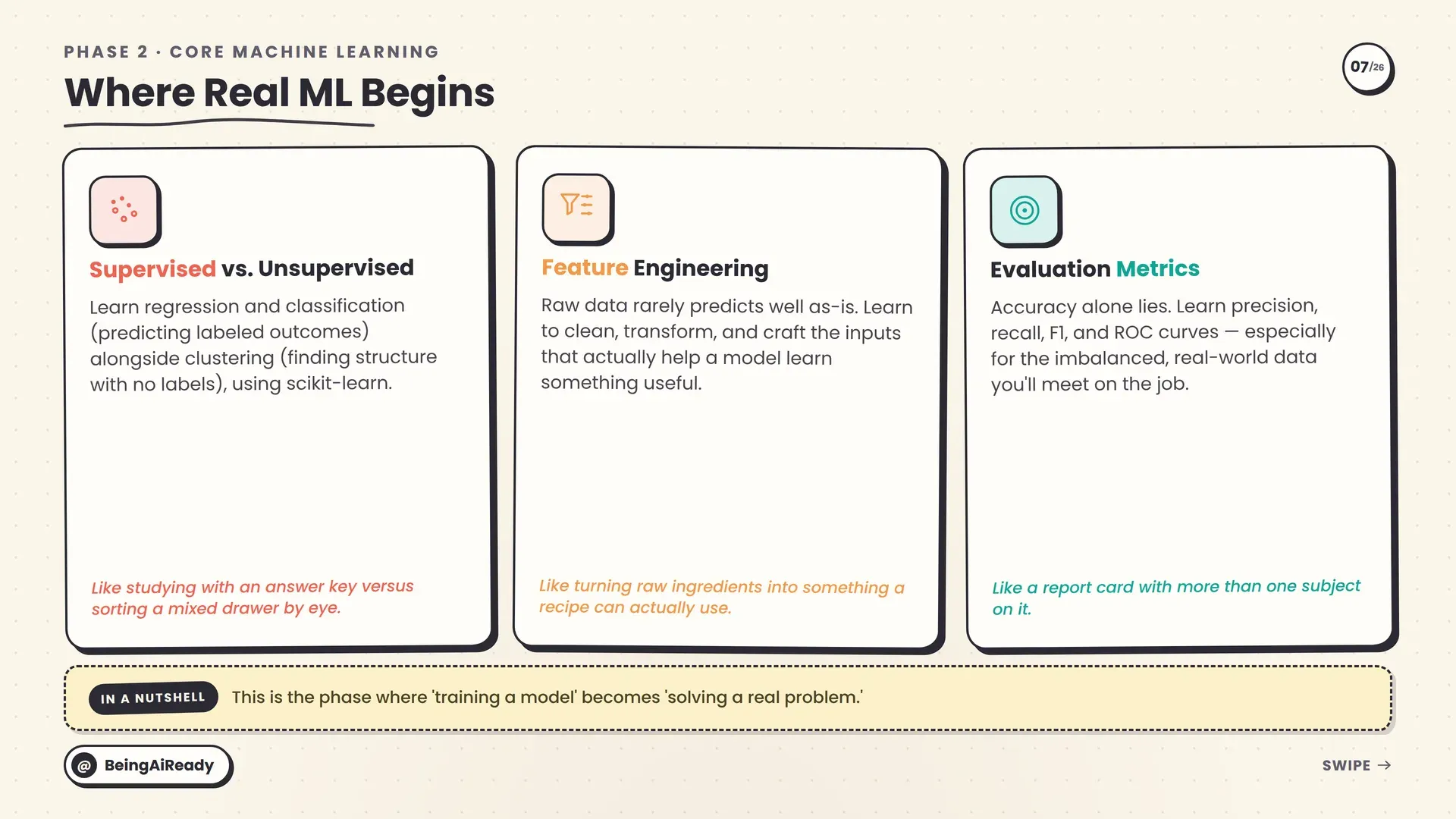 The phase where “training a model” turns into “solving a real problem.”
Supervised versus unsupervised learning is the first fork in the road, and it’s a simple idea buried under intimidating terms. Supervised learning means you have labelled examples — past data where you already know the right answer — and you’re teaching a model to predict that answer for new cases, whether that answer is a category (classification: spam or not spam) or a number (regression: what will this house sell for). Unsupervised learning means you have no labels, and you’re instead asking the model to find structure on its own, like grouping similar customers together (clustering) without being told in advance what the groups should be. Most business problems you’ll meet are supervised, but knowing the distinction — and recognising which one a problem actually is — is a basic fluency test. Learn both with scikit-learn, the standard library for classical ML in Python. It’s approachable, superbly documented, and exactly what most real teams reach for before they reach for anything heavier.
Feature engineering is the unglamorous, high-leverage skill of turning raw data into inputs a model can actually learn from. Raw data is almost never usable as-is — missing values, wildly different scales, categories stored as text instead of numbers, dates that need to become “day of week” to be useful. Learning to clean, transform and craft the right inputs is where a huge amount of a working data scientist’s time actually goes, far more than the model-training part that gets all the attention in tutorials. There’s an old line in the field that a good feature beats a fancy model, and it’s mostly true. The person who understands the data usually beats the person who only understands the algorithm.
Evaluation metrics matter because accuracy, on its own, lies more often than beginners expect. If you’re predicting something rare — fraud, a disease, customer churn — a model that just guesses “no” every single time can score 98% accuracy while being completely useless, because 98% of cases genuinely are “no.” Learn precision (of the things you flagged, how many were real), recall (of the real things, how many you caught), F1 (the balance between them), and ROC curves. This is exactly the nuance that separates someone who can call .fit() on a model from someone who can be trusted with a real dataset — and it’s a favourite interview topic precisely because it exposes whether you understand what your numbers mean or just how to produce them.
Neural networks, without the mystery
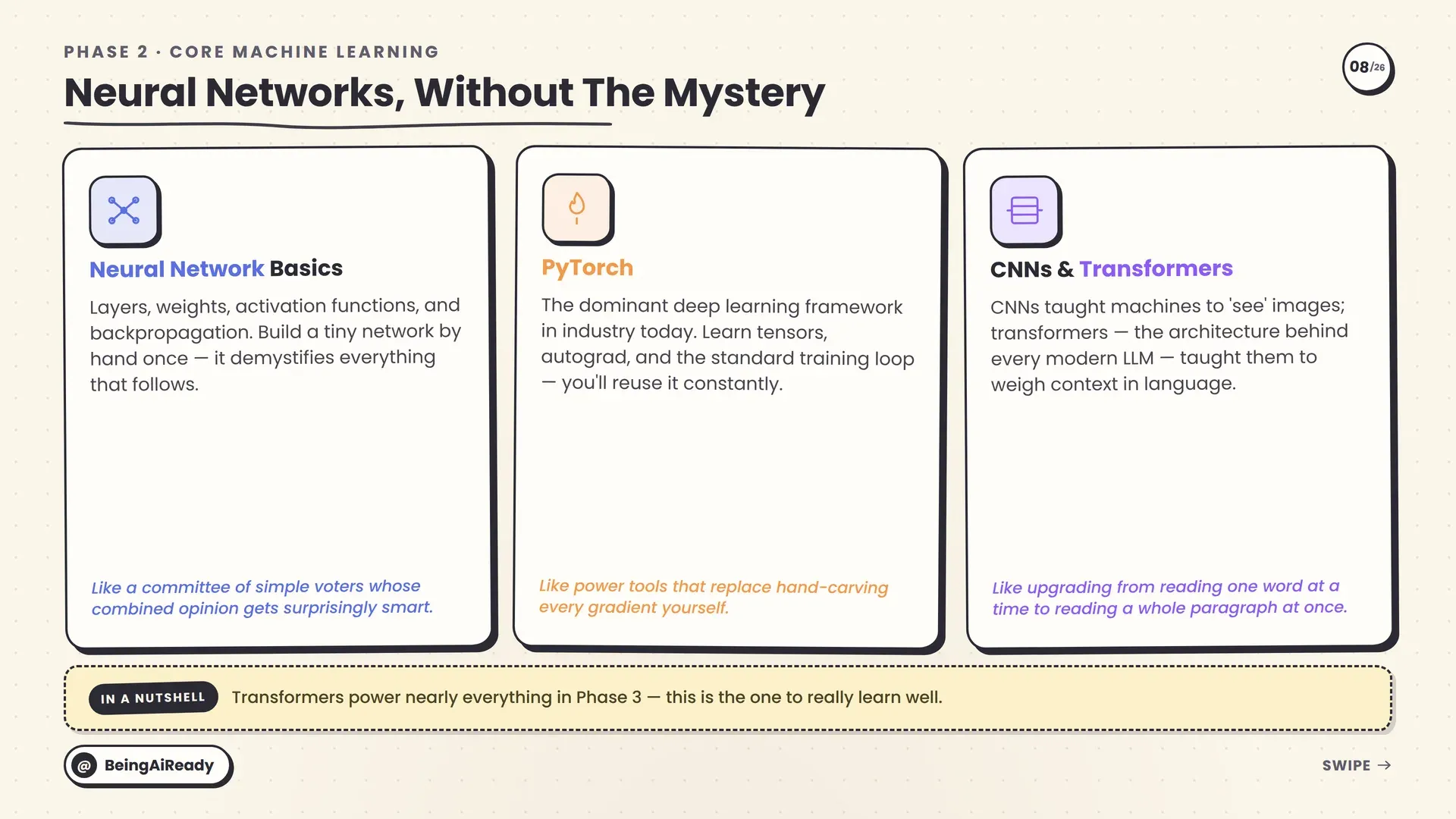 Transformers power nearly everything in Phase 3 — this is the one to really learn well.
Neural network basics are worth building once by hand, even a tiny one, before you import a framework: layers, weights, activation functions, and backpropagation, the process that adjusts those weights based on how wrong the model’s guess was. Building a toy version yourself — even a two-layer network that learns something trivial — demystifies everything you’ll later do at a higher level of abstraction. A reasonable mental model: a neural network is a large committee of very simple voters, each only slightly better than a coin flip, whose combined opinion, after enough training, becomes surprisingly sharp. The magic isn’t in any one unit. It’s in the connections, and in the training process that tunes them.
PyTorch is the dominant deep-learning framework in industry, and it’s worth learning properly rather than copying examples. Learn tensors (the multi-dimensional arrays everything is built from — think NumPy arrays that can run on a GPU), autograd (PyTorch’s system for automatically computing the gradients from calculus, so you never have to by hand), and the standard training loop — the repeating cycle of feeding data in, measuring the error, computing gradients, and adjusting the weights. You’ll reuse that exact pattern in almost every deep-learning project from here on, so it’s worth typing it out yourself a few times until the shape of it is in your fingers rather than copied from a tab.
CNNs and transformers are the two architectures worth understanding by name, because they mark two eras. Convolutional neural networks taught machines to “see,” recognising patterns in images by scanning small local regions at a time — they’re why your phone can find faces in photos. Transformers are the architecture behind essentially every modern large language model, and their core trick is letting a model weigh the relevance of every other word in a passage when interpreting any single word, rather than reading strictly left to right. If CNNs are like recognising a photo one square inch at a time, transformers are like reading a whole paragraph at once and understanding how each word changes the meaning of the others. Learn this one properly — nearly everything in Phase 3 is a transformer wearing a different outfit, and understanding the “attention” idea at its core will make the entire GenAI stack feel like variations on a theme rather than a pile of unrelated tools. (If any of these terms are still fuzzy, we keep a running plain-English AI glossary that defines most of them without the jargon.)
Now make it messy, on purpose
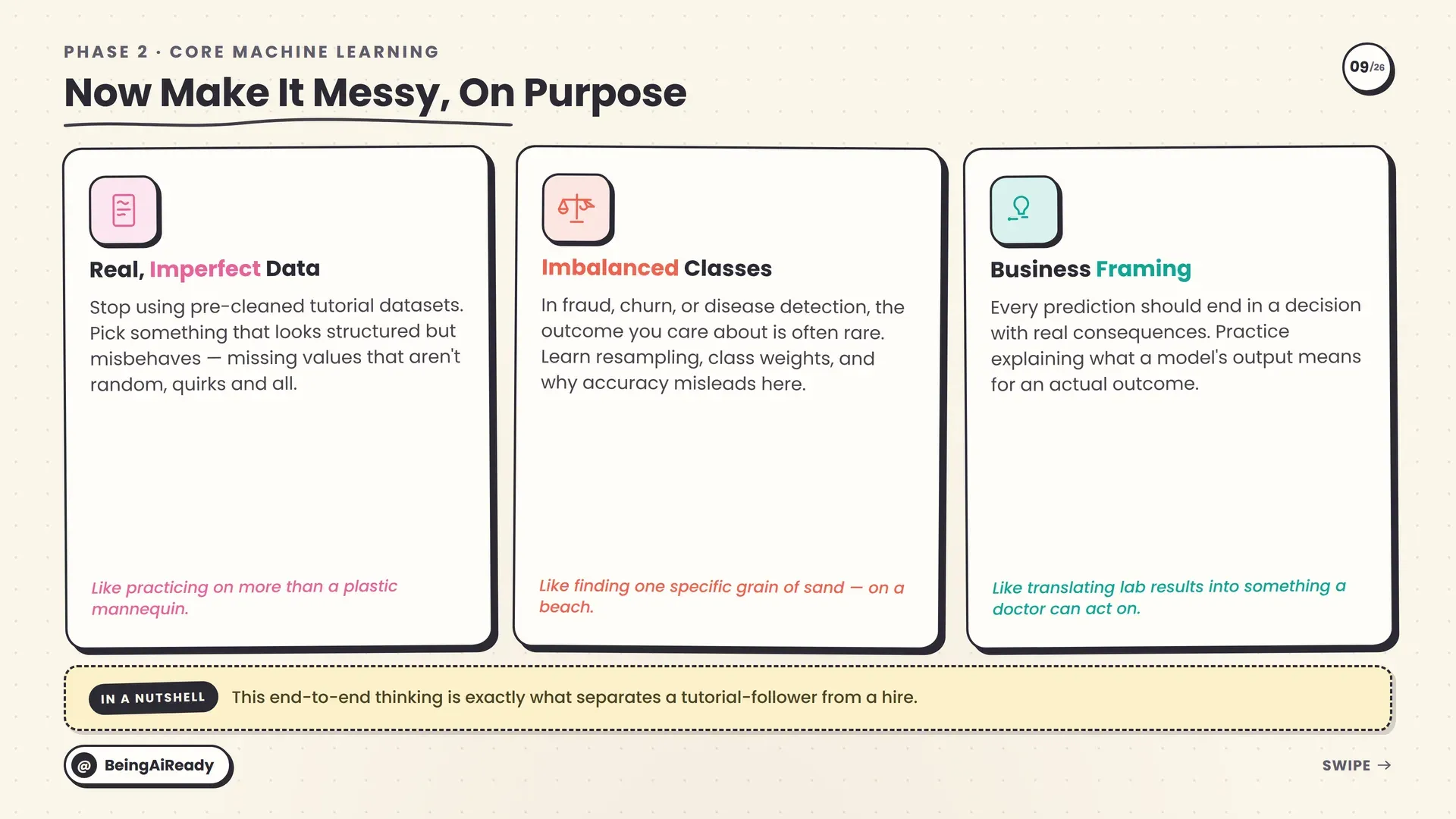 The end-to-end thinking that separates a tutorial-follower from a hire.
This last piece of Phase 2 isn’t so much a new technical skill as a change in habit, and it’s the one most tutorials actively work against. It’s also, honestly, the part that most separates people who get hired from people who have watched an enormous number of courses and still can’t get a callback.
Real, imperfect data — go and find some. Every popular tutorial dataset has already been cleaned, balanced and stripped of the weirdness real data always has. That’s convenient for teaching and terrible for learning, because it hides exactly the part of the job that’s hard. Deliberately picking something messier — a public dataset with missing values that aren’t random, inconsistent formatting, obvious quirks, columns that contradict each other — is closer to practising on an actual patient than on a plastic mannequin. It’s where you start developing the instincts that pre-cleaned datasets never teach: the reflex to look at the data before trusting it, to ask where a number came from, to notice when something is too clean to be true.
Imbalanced classes turn up constantly in the problems companies actually care about — fraud detection, churn, disease screening — because the outcome you’re trying to catch is rare by definition. Learn resampling techniques and class weighting, and understand precisely why plain accuracy misleads you here (see the 98%-accuracy trap from a moment ago). It’s less like finding a needle in a haystack and more like finding one specific grain of sand on a beach; the tools for that are different from the tools for a fair coin flip, and knowing which tools to reach for is a concrete, demonstrable skill.
Business framing is the habit of never letting a prediction just sit there as a number. Every prediction a model makes should end in a decision that has consequences for someone, and practising the translation — explaining what a model’s output actually means for an outcome a non-technical person cares about — is exactly the muscle that separates someone who followed a tutorial from someone a company would trust to own a real problem. A model that flags a customer as “83% likely to churn” is useless until someone decides what to do at 83%. Think of it as turning lab results into something a doctor can act on, rather than handing over a number and walking away. This is also, not coincidentally, the skill that makes your portfolio projects compelling, because a project framed as “I solved this business problem and here’s the impact” reads completely differently from “I trained a model and got this accuracy.”
That habit — data that fights back, classes that don’t cooperate, results framed as decisions rather than metrics — is what Phase 2 is really building toward. It’s also the mindset the next phase assumes you’re bringing, because the modern AI stack is unforgiving of anyone still thinking in tutorial mode.
Phase 3: The modern AI stack
This is where most current job postings actually live, and where the vocabulary starts moving fast enough that it’s worth defining terms plainly before using them. Everything here builds on the transformers you met at the end of Phase 2. This is that architecture, put to work.
It’s also the phase where the leverage is highest for a career-changer, for a specific reason: these skills are new. Nobody has ten years of RAG experience, because RAG in its current form is only a few years old. Nobody has a decade of experience with MCP, because it’s barely more than a year old. In most of tech, the self-taught newcomer is competing against people with a long head start. Here, the head start is measured in months, and hands-on experience with the newest pieces is genuinely scarce. That scarcity is your opening.
Welcome to the GenAI era
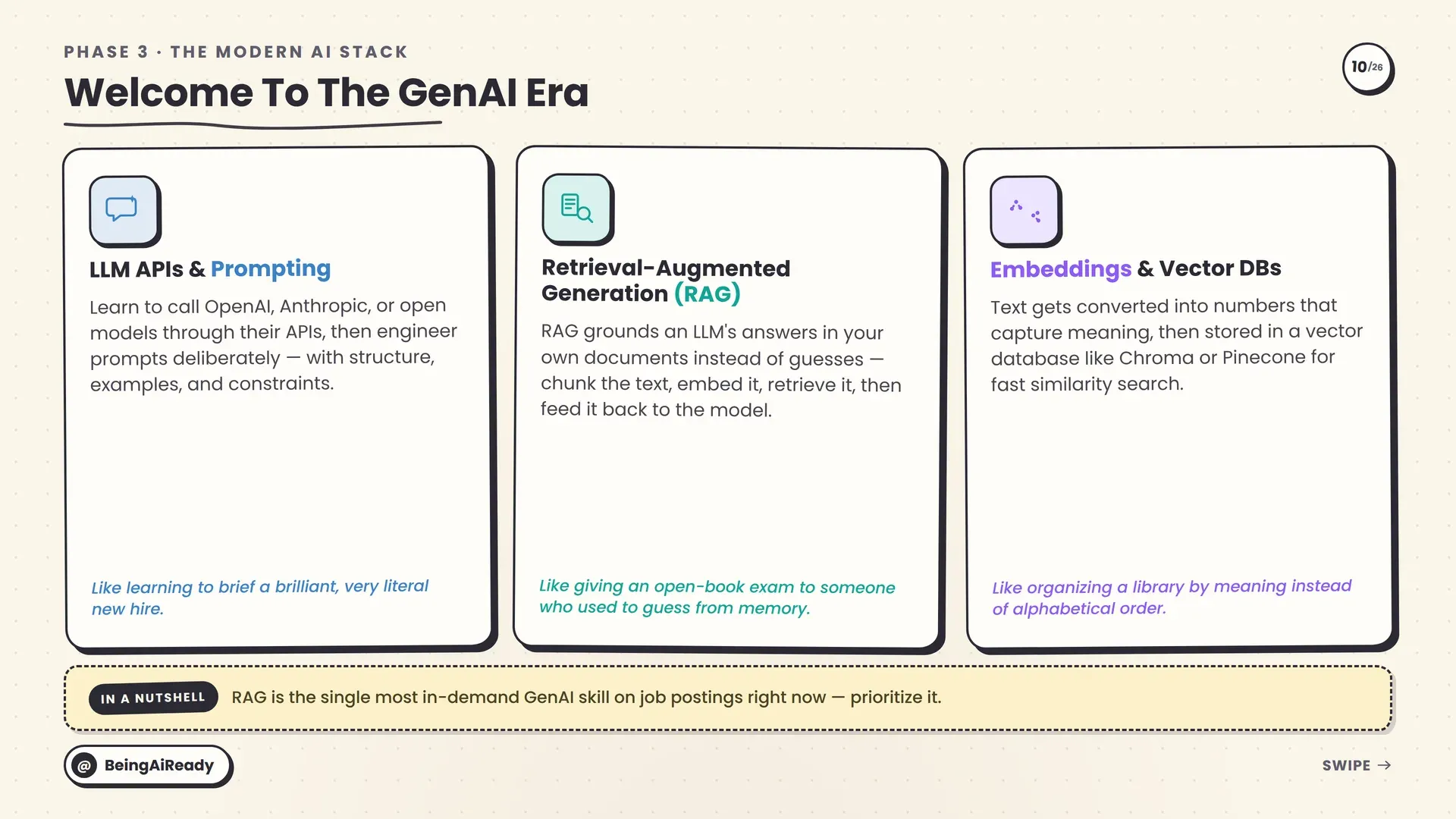 RAG is the single most in-demand GenAI skill on job postings right now — prioritise it.
LLM APIs and prompting is the entry point. “LLM” just means large language model — the category behind ChatGPT, Claude, Gemini and similar systems. Learn to call one through its API (OpenAI’s, Anthropic’s, Google’s, or an open model you run yourself), then learn to prompt it deliberately rather than conversationally: giving it structure, examples of the output format you want, explicit constraints, and a clear role, instead of typing a question and hoping. A useful mental model is briefing a brilliant new hire who is extremely capable but takes everything you say completely literally and has no memory of yesterday. Vague instructions get you vague, unpredictable results; specific instructions with examples get you specific, repeatable ones. Prompting well is a real skill, and doing it programmatically — wiring prompts into an application with structured inputs and outputs — is what separates it from just being good at chatting with a bot.
Retrieval-augmented generation, or RAG, is worth understanding properly because it solves a concrete, common problem that comes up in a huge share of real AI products. An LLM’s knowledge is frozen at whenever it was trained, and it knows nothing about your company’s internal documents, your product’s policies, or anything that happened after its cutoff. Worse, when it doesn’t know something, it often makes up a confident, plausible answer anyway. RAG fixes this by grounding the model’s answers in your own documents instead of its memory: you chunk the text into pieces, convert those pieces into a searchable form, retrieve the pieces most relevant to a given question, and feed them back to the model alongside the question, so it answers from what’s actually in front of it rather than guessing. It’s the difference between an open-book exam and one where the student works from memory alone.
RAG is, by a wide margin, the single most requested GenAI skill in job postings right now, which makes it worth prioritising over almost anything else in this section. If you build one thing well in this phase, build a RAG system, and build it properly — with attention to how you chunk documents, how you handle retrieval failures, and how you measure whether the answers are actually grounded. (We wrote a full, jargon-free explainer on what RAG really is and how it works if you want the deep version before you build one.)
Embeddings and vector databases are the machinery that makes RAG’s retrieval step fast. An embedding is a way of converting a piece of text into a long list of numbers that captures its meaning — texts with similar meaning end up with similar numbers, even if they don’t share a single word. “How do I get my money back” and “refund policy” land near each other in this number-space despite having no words in common. Those number-lists get stored in a vector database (Chroma and Pinecone are two common ones, and pgvector lets you do it inside an ordinary Postgres database), which is purpose-built for finding the closest matches quickly across millions of entries. Think of it as reorganising a library by meaning instead of alphabetical order: you ask for “how do refunds work” and it finds the relevant policy document even if that document never uses the word “refund.” Understanding embeddings also demystifies a lot of other AI features you’ve used, from semantic search to recommendation systems, because the same idea underlies all of them.
Give the model something to do
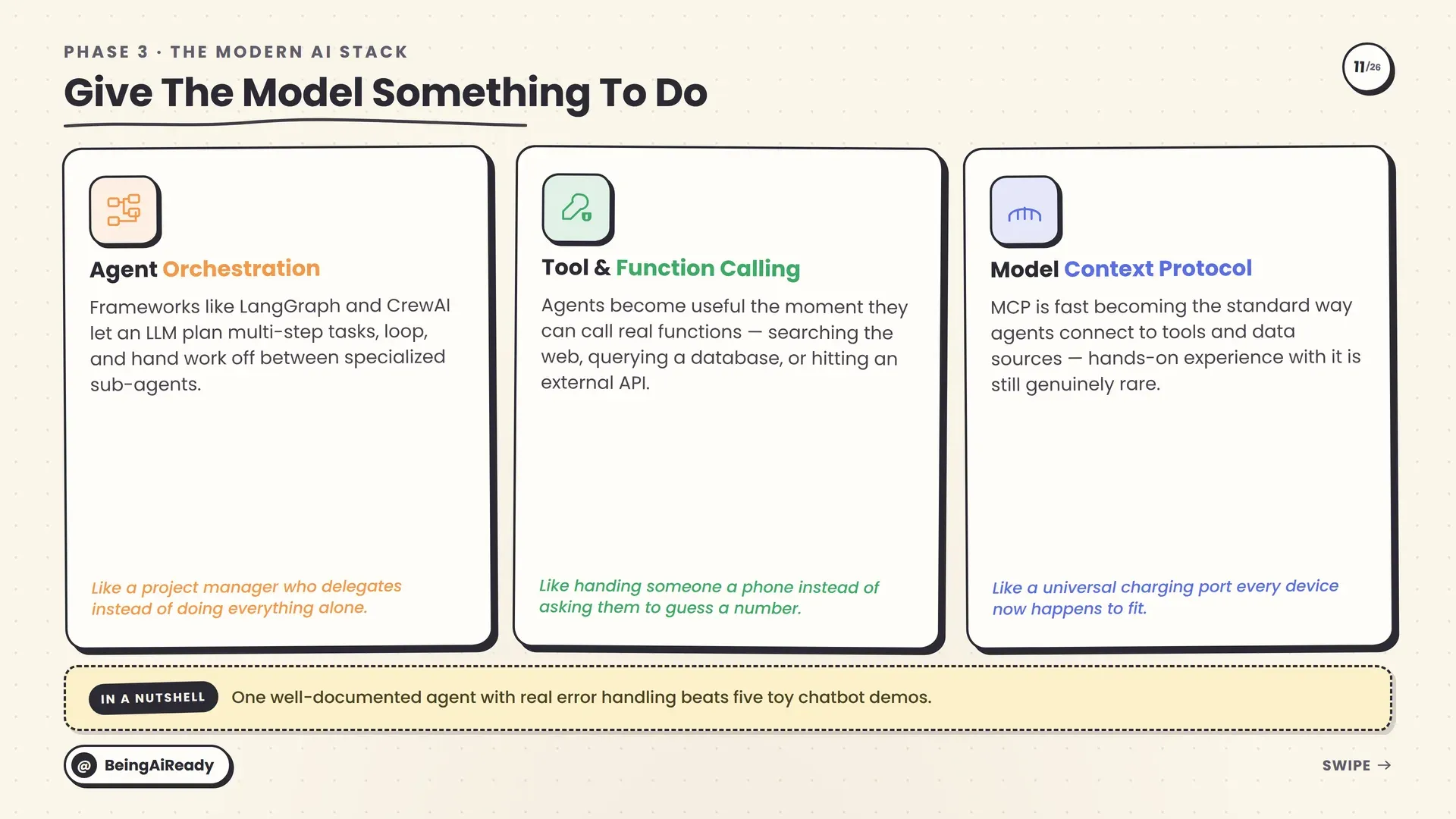 One well-documented agent with real error handling beats five toy chatbot demos.
It’s worth deflating the word “agent” a little first, because marketing copy has stretched it to mean almost anything. In practice, an AI agent is an LLM wrapped in a loop that can take an action, look at the result, and decide what to do next — not an autonomous digital employee, just a model with the ability to act and reassess rather than answer once and stop. That’s a genuinely powerful idea, and it’s also a lot more mundane than the hype suggests, which is useful to know both for building agents and for not being oversold one in an interview.
Agent orchestration is how you structure that loop for anything beyond a single step. Frameworks like LangGraph and CrewAI let a model plan a multi-step task, loop back when something doesn’t work, and hand pieces of the task to specialised sub-agents rather than cramming everything into one giant, unwieldy prompt — a bit like a project manager who delegates instead of insisting on doing every task personally. The hard part of agent work isn’t getting the happy path to run once for a demo; it’s making it behave reliably when a step fails, a tool returns garbage, or the model wanders off. That reliability is exactly what employers are screening for, and it’s what most portfolio agents conspicuously lack.
Tool and function calling is what makes an agent useful rather than just chatty. An agent becomes genuinely capable the moment it can call real functions: searching the web, querying a database, hitting an external API to check a shipping status, sending an email, running code. This is the practical difference between a model that can describe what it would do and one that can actually do it — handing someone a working phone instead of asking them to guess a number. Getting comfortable defining tools, handling their outputs, and dealing with the cases where a tool call fails is one of the most transferable skills in the whole modern stack.
The Model Context Protocol, or MCP, is a newer standard, and it’s fast becoming the default way agents connect to tools and data sources. Anthropic introduced it, and it’s since been adopted broadly enough that hands-on experience with it is a real differentiator on a résumé — precisely because it’s still uncommon. The analogy that holds up: it’s a universal charging port that every device happens to fit, replacing what used to be a pile of incompatible custom cables between every agent and every tool it needed to talk to. Building even one small project that uses MCP puts you in a genuinely small group of people who can say they’ve done it, and in a market moving this fast, that kind of recency is worth a lot.
Prove it actually works
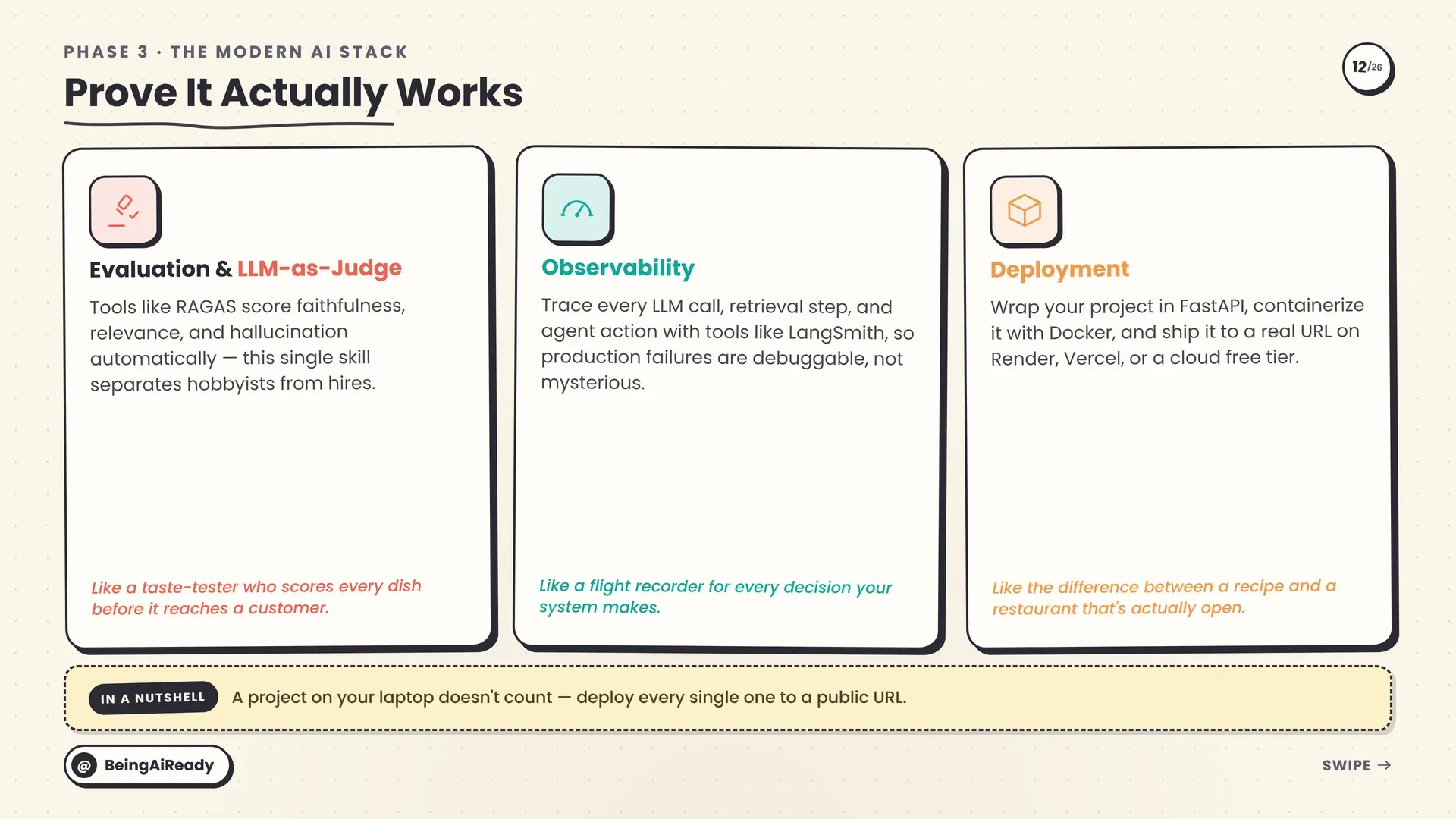 A project on your laptop doesn’t count — deploy every single one to a public URL.
This section is short, and it’s the one that most separates a hobbyist from someone a company would trust with production work. Almost everyone can now get an LLM to produce something that looks impressive in a demo. Far fewer people can prove it works, watch it when it doesn’t, and ship it somewhere real. That gap is where a lot of hiring decisions actually get made.
Evaluation and LLM-as-judge means measuring whether your system actually works, rather than eyeballing a few outputs and deciding they look fine. Tools like RAGAS automatically score things like faithfulness (does the answer actually match the source material?), relevance, and hallucination rate, often by using another LLM as an impartial judge. This one habit — measuring instead of vibing — is among the clearest signals in a portfolio project, because it’s exactly the kind of discipline that’s invisible in a demo video but obvious the moment someone opens your README and sees that you defined what “good” means and then measured against it. It’s also the honest answer to “how do you know it works,” which is a question you will absolutely be asked.
Observability means being able to trace exactly what happened inside your system after the fact: every LLM call, every retrieval step, every action the agent took, every prompt and response. Tools like LangSmith let you do this, turning “the AI did something weird and I have no idea why” into an actual debuggable trail — a flight recorder for every decision your system makes, rather than a black box you can only interrogate by guessing. When an AI system misbehaves in production (and it will), observability is the difference between a five-minute fix and a two-day mystery, and demonstrating that you think this way marks you as someone who has actually operated these systems, not just built them once.
Deployment is the step people skip most often and the one that matters most. Wrap your project in FastAPI (a common, lightweight way to expose Python code as a web service), containerise it with Docker (which packages your code and everything it depends on so it runs the same way on any machine, ending the “works on my laptop” problem), and put it on a real URL using something like Render, Railway, Vercel, or a cloud provider’s free tier. A project sitting in a notebook on your laptop, however good the underlying idea, doesn’t count for much to a hiring manager — it’s the difference between a recipe and a restaurant that’s actually open for business. Deployment proves you can ship, and shipping is the whole job.
The stack, stacked
If you zoom out, Phase 3 is really one connected skill: take a language model, ground it in real data (RAG, embeddings, vector search), give it the ability to act (tools, agents, MCP), and then make it trustworthy and real (evaluation, observability, deployment). A single project that does all of that — a deployed, evaluated, observable RAG agent that solves a real problem — is close to the platonic ideal of a modern AI portfolio piece, and it’s worth building deliberately toward exactly that, which is what Phase 6 will push you to do.
Phase 4: Choose your lane
One thing that trips people up early is assuming “a job in AI” is a single destination. It isn’t. It’s a cluster of related but genuinely different roles, and picking one to aim at — even provisionally — makes every phase after this one sharper and faster, because it tells you which projects to build, which certification to get, and which titles to apply for. Trying to be ready for all of them at once is how you end up ready for none of them.
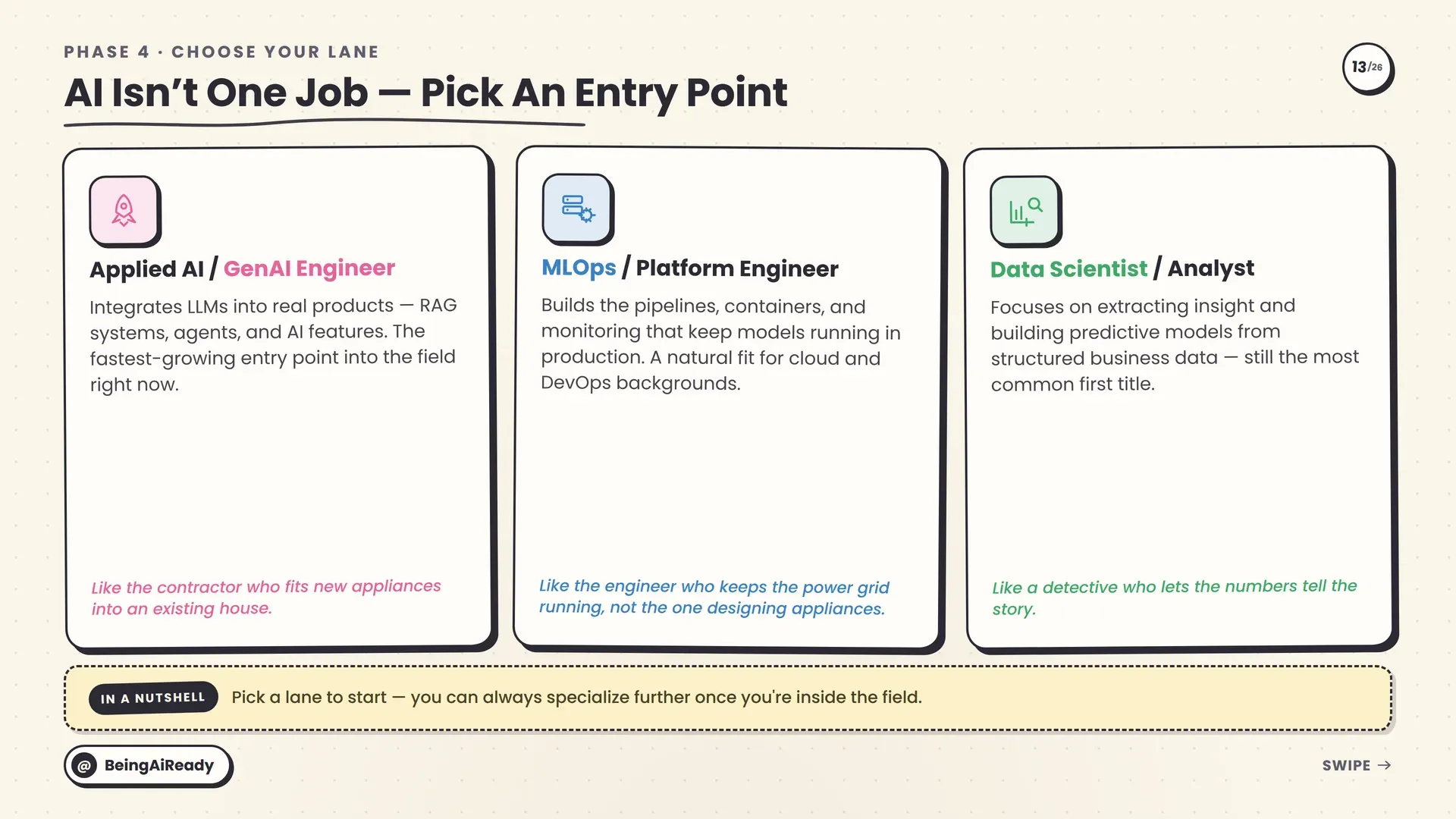 Pick a lane to start — you can always specialise further once you’re inside the field.
Applied AI or GenAI Engineer roles integrate LLMs into real products — building the RAG systems, agents and AI-driven features that Phase 3 just covered. Day to day, this looks a lot like software engineering with a heavy AI component: you’re wiring models into applications, designing prompts and retrieval, handling the messy edges, and shipping features. It’s currently the fastest-growing entry point into the field, largely because it’s the newest category and demand has outrun the supply of people with hands-on experience. A decent comparison: this is the contractor who fits new appliances into an existing house, rather than the architect who designed the house from scratch. If you like building things people use, this is probably your lane, and it’s the one most of this guide’s project advice points toward.
MLOps or Platform Engineer roles are about the infrastructure underneath — the pipelines, containers, monitoring and deployment systems that keep models running reliably in production. Less “train the model,” more “make sure the model keeps serving predictions at 3am without falling over.” It’s a natural landing spot for anyone with a cloud or DevOps background, because a large share of the skill set transfers directly and the AI-specific parts are a smaller addition than they look. Where the applied engineer designs the appliance, the MLOps engineer keeps the power grid running underneath the whole house. This lane is less crowded than the others and pays well precisely because the work is unglamorous and essential.
Data Scientist or Analyst roles focus on extracting insight from data and building predictive models, usually on structured business data rather than the unstructured text and documents that dominate the GenAI stack. There’s more emphasis on statistics, experimentation, and communicating findings to non-technical stakeholders. It’s still, by a wide margin, the most common first title for people entering the field — the detective who lets the numbers tell the story, rather than the person who builds the tools the detective uses. If you’re more drawn to answering questions with data than to building software, this is likely your entry point, and the Phase 2 skills matter more here than the Phase 3 ones.
You don’t have to pick forever, and your lane will probably shift once you’re inside and can see the roles up close. You have to pick a direction long enough to build a coherent portfolio — three projects that tell one story about what you can do — instead of three unrelated demos that add up to “dabbled in a lot of things.” Coherence is a signal in itself. It says you know what you’re aiming at.
Your past experience isn’t a blank slate
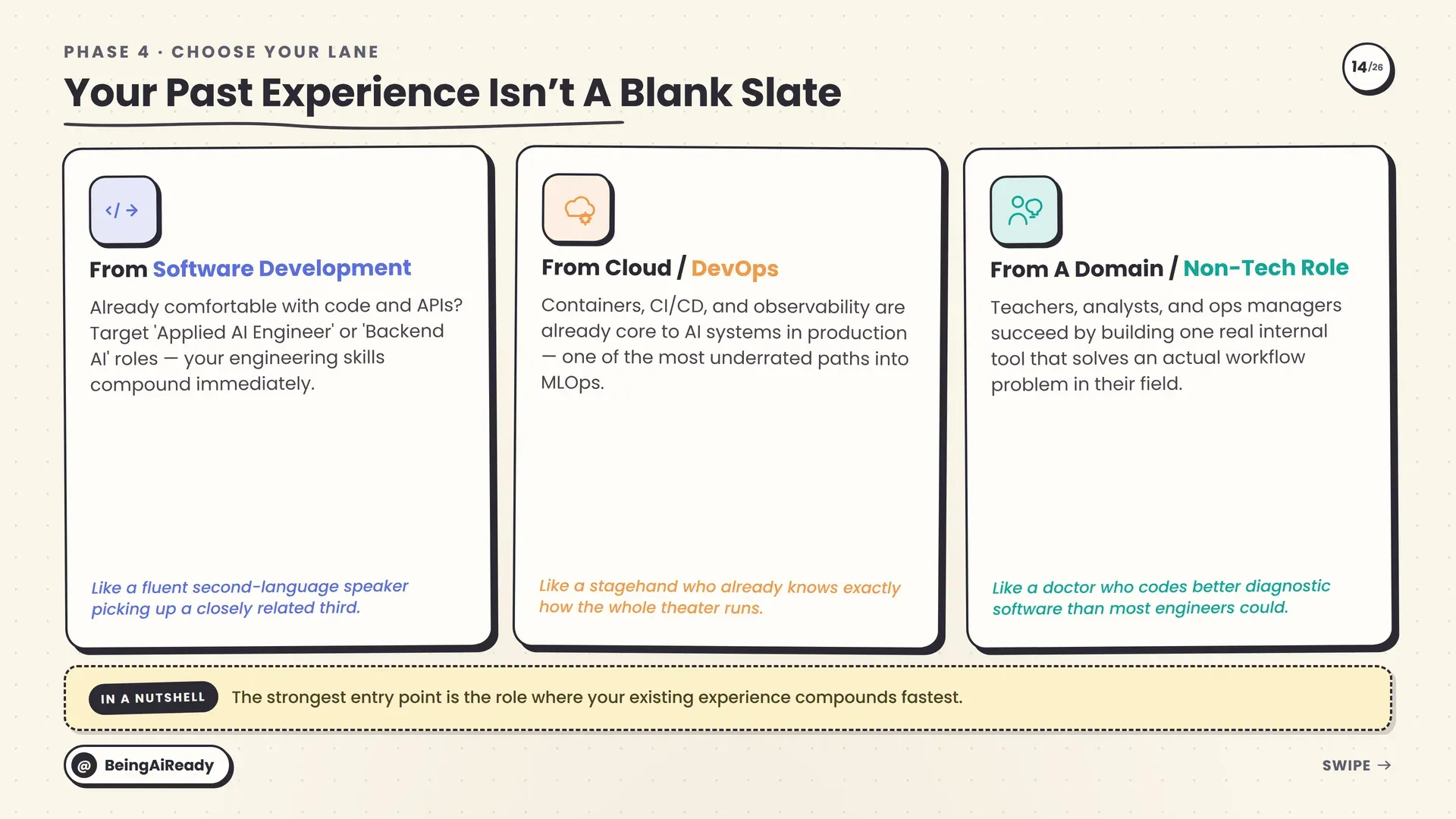 The strongest entry point is the role where your existing experience compounds fastest.
Whatever you were doing before this counts for more than most career-change advice gives it credit for. The instinct to throw out your past and start fresh as “an AI person” is almost always a mistake. Your fastest path in is usually the one where your existing experience does part of the work for you.
Coming from software development, you’re already comfortable with code, APIs, version control and shipping software, so target Applied AI Engineer or backend AI roles specifically. Your existing engineering skills compound immediately rather than starting from zero — you’re a fluent second-language speaker picking up a closely related third, not a beginner learning to talk. Your job is mostly to add the AI-specific layer (LLMs, RAG, agents, evaluation) on top of a foundation you already have, which is why developers often move through this whole roadmap in the faster half of the range. Lean into it: your GitHub already shows you can build; now show you can build with AI.
Coming from cloud or DevOps, you already live inside containers, CI/CD pipelines and observability tooling — all of which are core to running AI systems in production rather than adjacent to it. This is one of the most underrated paths into MLOps, because the gap between what you already know and what the role needs is genuinely narrow. You’re a stagehand who already knows exactly how the whole theatre runs; you just need to learn the specific demands of the new production. A cloud certification you may already have counts for real here, and the AI-specific additions (model serving, ML pipelines, LLM observability) sit naturally on top of your existing skills.
Coming from a non-technical domain — teaching, operations, healthcare, finance, law, whatever it is — the strongest move is usually building one real internal tool that solves a problem you understand better than most engineers do. This is the path that feels most intimidating and is often the most powerful, because domain knowledge is genuinely hard to hire for. A domain expert who can code a workable diagnostic tool often outperforms a generalist engineer who’s never seen the underlying problem up close — a doctor who can build genuinely useful diagnostic software has an edge no bootcamp graduate can match on that specific problem. Your unfair advantage isn’t your code; it’s that you know which problems are actually worth solving. Pick one from your old world, build the AI tool that solves it, and let that be the centre of your portfolio.
The through-line across all three: don’t discard what you already know in the rush to become “an AI person.” The fastest path in is usually the one where your existing experience does some of the work for you, and the candidates who understand this frame their past as an asset rather than apologising for it.
Phase 5: Certifications — what’s actually worth it
Certifications are the most polarising topic in this whole roadmap. Some self-taught builders treat them as the entire plan; a smaller, wiser group skips them completely. The honest position is in between: a handful are genuinely worth the money and the study hours, but only as an addition to a real project, never as a substitute for one. Get that ordering wrong and you can spend months and a lot of money assembling credentials that, on their own, move you almost nowhere.
The useful way to think about a certification is as a forcing function and a small credibility boost, not as a hiring trigger. It gives your learning a syllabus and a deadline, and it puts a recognisable name on your résumé that a keyword filter and a busy recruiter both understand. What it does not do is prove you can build, which is the thing that actually gets you hired. Keep that clear and certifications become useful. Forget it and they become an expensive way to procrastinate.
Certify on the platform you’ll actually use
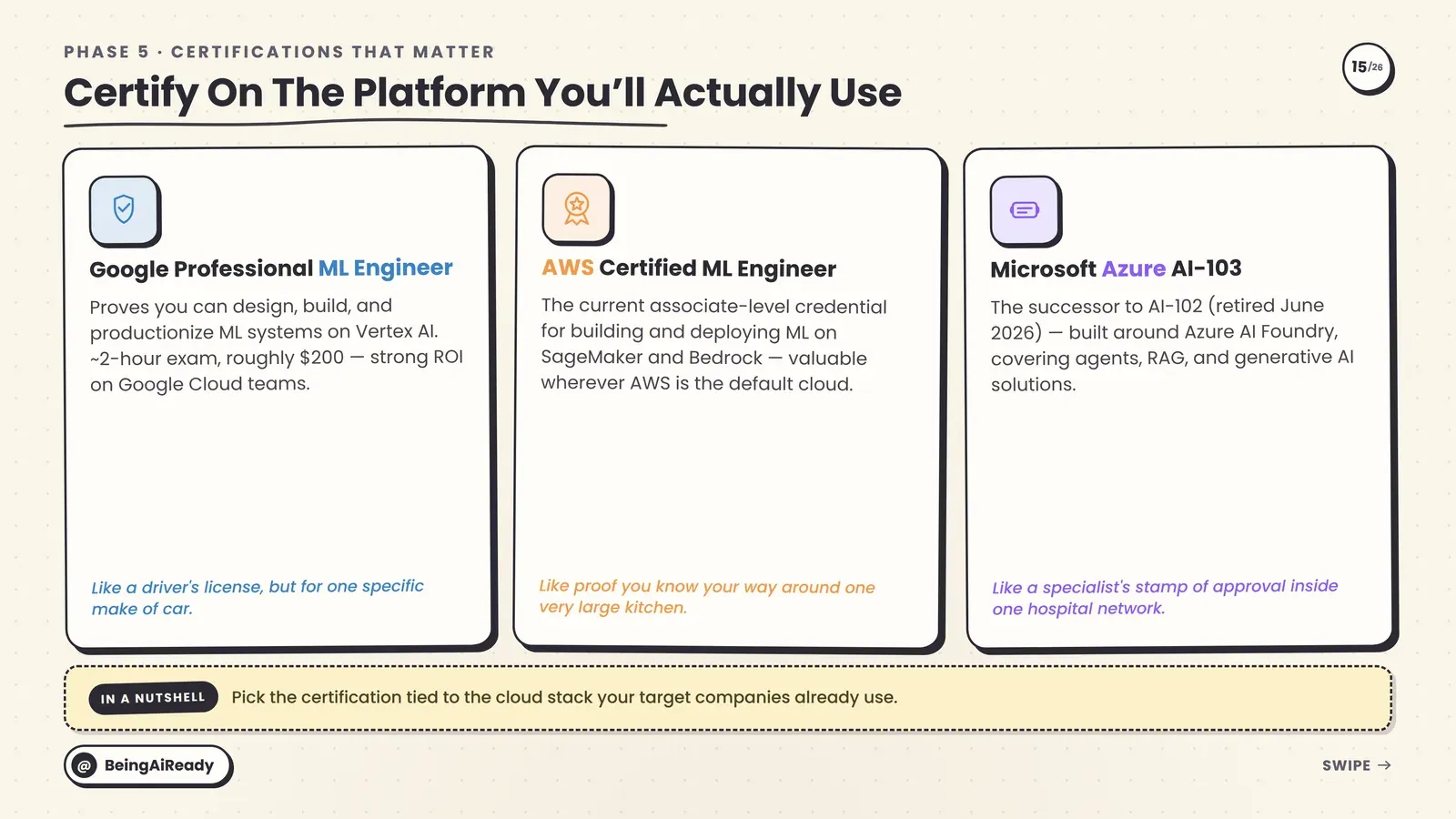 Pick the certification tied to the cloud your target companies already run.
If you’re going to get a certification, tie it to a specific cloud platform rather than a generic “AI” badge. A platform certification signals something concrete — that you can actually operate a specific set of tools that companies pay real money to run — in a way that a vague “AI fundamentals” course completion never will.
Google’s Professional Machine Learning Engineer proves you can design, build and productionise ML systems on Vertex AI. It’s a two-hour exam of roughly 50–60 questions, costs around $200, and stays valid for two years (recertification runs a discounted $100). It’s a solid choice with real return if you’re targeting Google Cloud shops, and worth noting: the exam has kept pace with the field, so its current scope now explicitly includes Vertex AI’s agent-building tools and retrieval-augmented generation patterns, not just classic ML pipelines. If your target companies run on Google Cloud, this is a genuinely strong credential.
AWS’s Certified Machine Learning Engineer – Associate is the associate-level credential for building and deploying ML on SageMaker and Bedrock, priced around $150. It’s valuable anywhere AWS is the default cloud, which in practice is a lot of places — AWS remains the most widely deployed cloud, so this certification travels well. One practical note: AWS periodically refreshes the exact version of this exam, as it does across its whole certification catalogue, so check the AWS certification page for the current exam code before you start studying. The underlying skills rarely shift much between versions, but the specific blueprint does, and you don’t want to prep against a retired one.
Microsoft’s Azure track is worth flagging carefully, because it changed recently enough that a lot of advice online is already out of date. AI-102 — the exam this space pointed to for the last couple of years — officially retired on June 30, 2026, a few weeks before this guide was written. Its replacement is AI-103, “Developing AI Apps and Agents on Azure,” which leads to the Azure AI Apps and Agents Developer Associate credential, costs around $165, and is arguably a better fit for where the field is now. It’s built around Azure AI Foundry and weighted heavily toward agentic and generative AI solutions, rather than the more service-by-service approach AI-102 took. If you’re on the Azure track, AI-103 is the current one to study for — and if you come across a guide still recommending AI-102, treat it as a useful signal that the guide hasn’t been updated this year.
Whichever of these three you pick, tie it to the cloud your target companies actually run. A Google certification means very little to a shop that’s fully on AWS, and vice versa. The point of a platform cert is specificity, so being specific about the right platform is the whole game. If you don’t yet know which cloud your target companies use, that’s a sign you haven’t looked closely enough at the actual job postings — which is itself worth fixing before you spend $200 on an exam.
The learning certificates — and the honest caveat
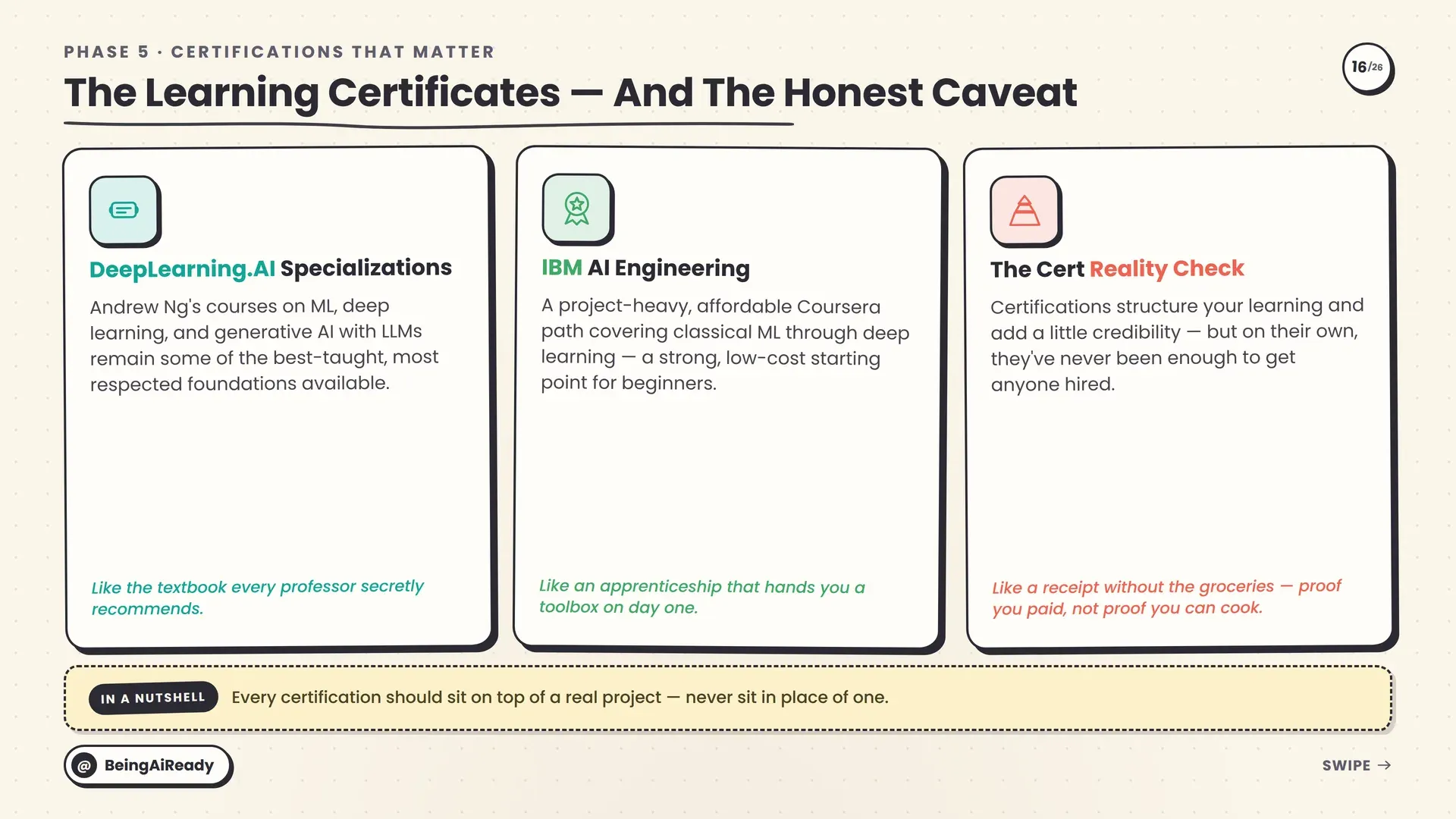 Every certification is worth it on top of a real project — never in place of one.
Beyond the cloud certifications there’s a second tier worth knowing about: course-based certificates that teach broader foundations rather than one vendor’s tools. These are less about a credential a recruiter recognises and more about giving your self-study a structure and a spine.
DeepLearning.AI’s specializations, built mostly around Andrew Ng’s teaching, remain some of the best-taught, most respected material for learning machine-learning and deep-learning foundations. Ng has a rare gift for making genuinely hard ideas feel approachable without dumbing them down, and the newer specializations have expanded into agentic AI and the modern GenAI stack specifically, keeping pace with where the field actually moved. If you want one trusted place to learn the material (as opposed to earn a badge), this is a defensible first stop.
IBM’s AI Engineering Professional Certificate, delivered through Coursera, is project-based and affordable relative to its scope. It now spans a wider course series that includes generative AI, retrieval-augmented generation and agentic workflows alongside the classical ML and deep learning it originally covered. Most learners finish it in around four months at roughly ten hours a week. It functions less like a badge and more like a structured, hands-on apprenticeship for people who’d rather have a syllabus than build one from scratch — which is genuinely useful if the blank-page problem is what’s stopping you.
Now the honest caveat, and it matters more than either certificate above: a certificate structures your learning path and adds a little credibility, but on its own, it has never been enough. Nobody gets hired purely because they paid a fee and passed a multiple-choice exam. Think of a certification the way you’d think of a textbook every professor recommends — genuinely useful, but nobody has ever been hired for having read it. What gets you hired is what you built while you were learning the material the certificate covers. Every certification mentioned here is worth doing on top of a real, deployed project. None of them is worth doing in place of one. If you can only invest energy in one thing this month, make it the project, every time.
Phase 6: Build a portfolio that gets you hired
If there’s one section of this entire roadmap to over-invest in, it’s this one. A portfolio is the actual mechanism by which “proof beats paper” — from way back in the reality-check section — turns into something concrete a hiring manager can click on. Everything before this phase is input. This is where it becomes output, and output is the only thing the market can actually see.
Here’s the mindset shift that makes this phase work: stop thinking of projects as practice and start thinking of them as evidence. Practice is for you. Evidence is for a stranger who has thirty seconds and a lot of skepticism. Those are different goals, and the second one has requirements — it has to be visible, it has to be verifiable, and it has to make sense to someone who wasn’t there while you built it.
What actually makes a project “hireable”
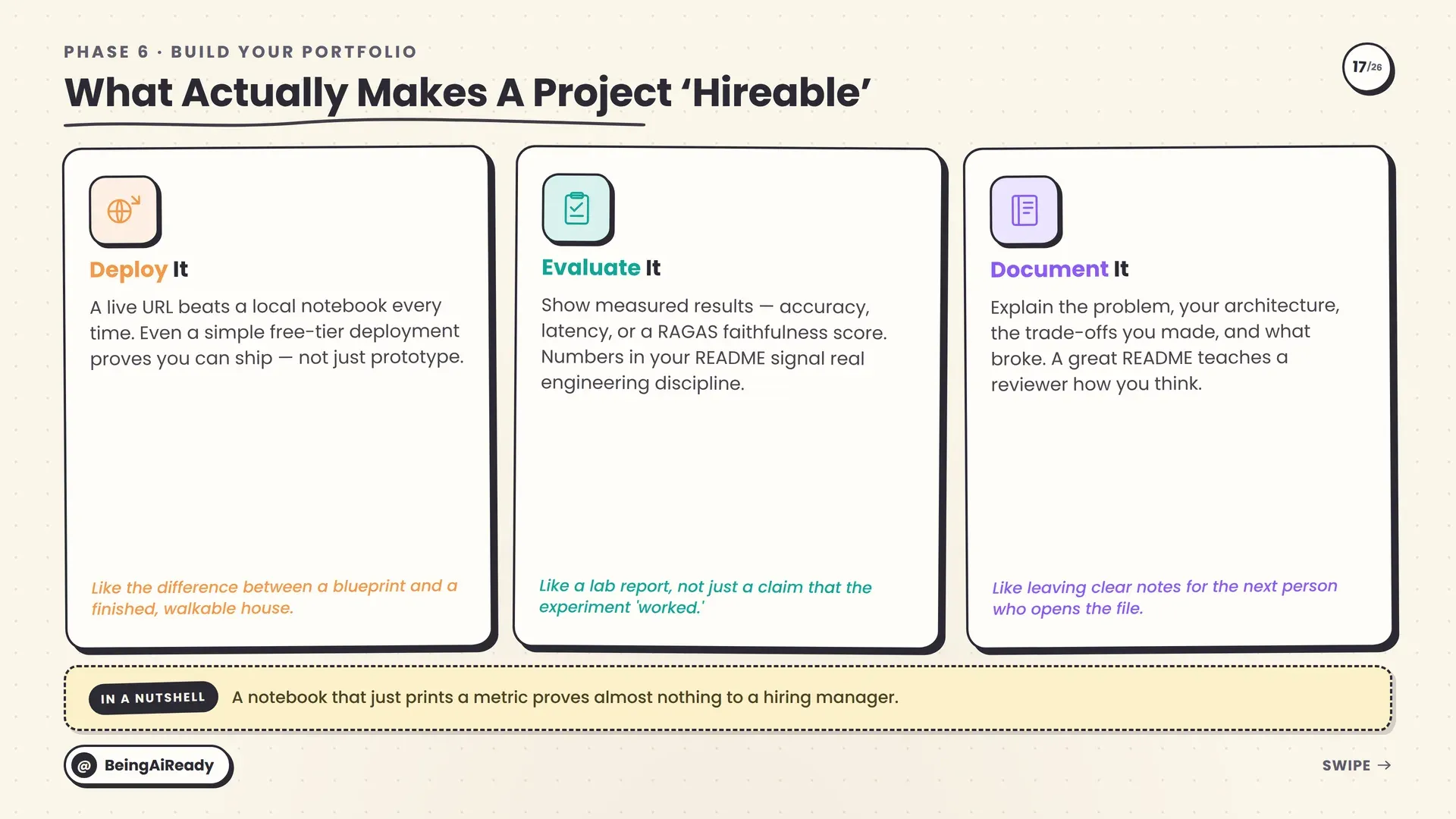 A notebook that only runs on your laptop is a private hobby. A live link is a portfolio.
Three things, and they matter more than the cleverness of the underlying idea. A relatively simple project that nails all three beats an ambitious one that nails none.
Deploy it. A live URL beats a folder of files by a wide margin — the difference between telling someone about a restaurant and handing them a working reservation link. Deployment proves you can ship, not just prototype, and that distinction is exactly what separates a tutorial project from something resembling real work. It also demonstrates a whole cluster of skills invisibly: that you can package an application, handle its dependencies, and put it somewhere the public internet can reach it. A reviewer clicking a link that just works has already learned more about you than a résumé could tell them.
Evaluate it. Show measured results, not adjectives. An accuracy figure, a latency number, a RAGAS faithfulness score — concrete numbers signal the same rigour discussed back in the “Prove It Actually Works” section, and they’re one of the fastest ways for a stranger reviewing your GitHub to trust that you know what you’re doing. “This RAG system answers support questions” is a claim. “This RAG system scores 0.91 on faithfulness across a 200-question test set, with a median latency of 1.2 seconds” is evidence, and the second sentence makes the reviewer take everything else you say more seriously.
Document it. Explain the problem you were solving, the architecture you chose, the trade-offs you made along the way, and — genuinely underrated — what a reviewer should try first if they want to see it work in under a minute. A project without documentation is a locked door. A project with a clear README is an open one with the lights already on. Your README is often the first thing a technical reviewer reads, before your code and long before your résumé, so it’s worth treating as a piece of writing in its own right: what it does, why it exists, how it’s built, how to run it, and what you’d do next.
Climb the project ladder, in order
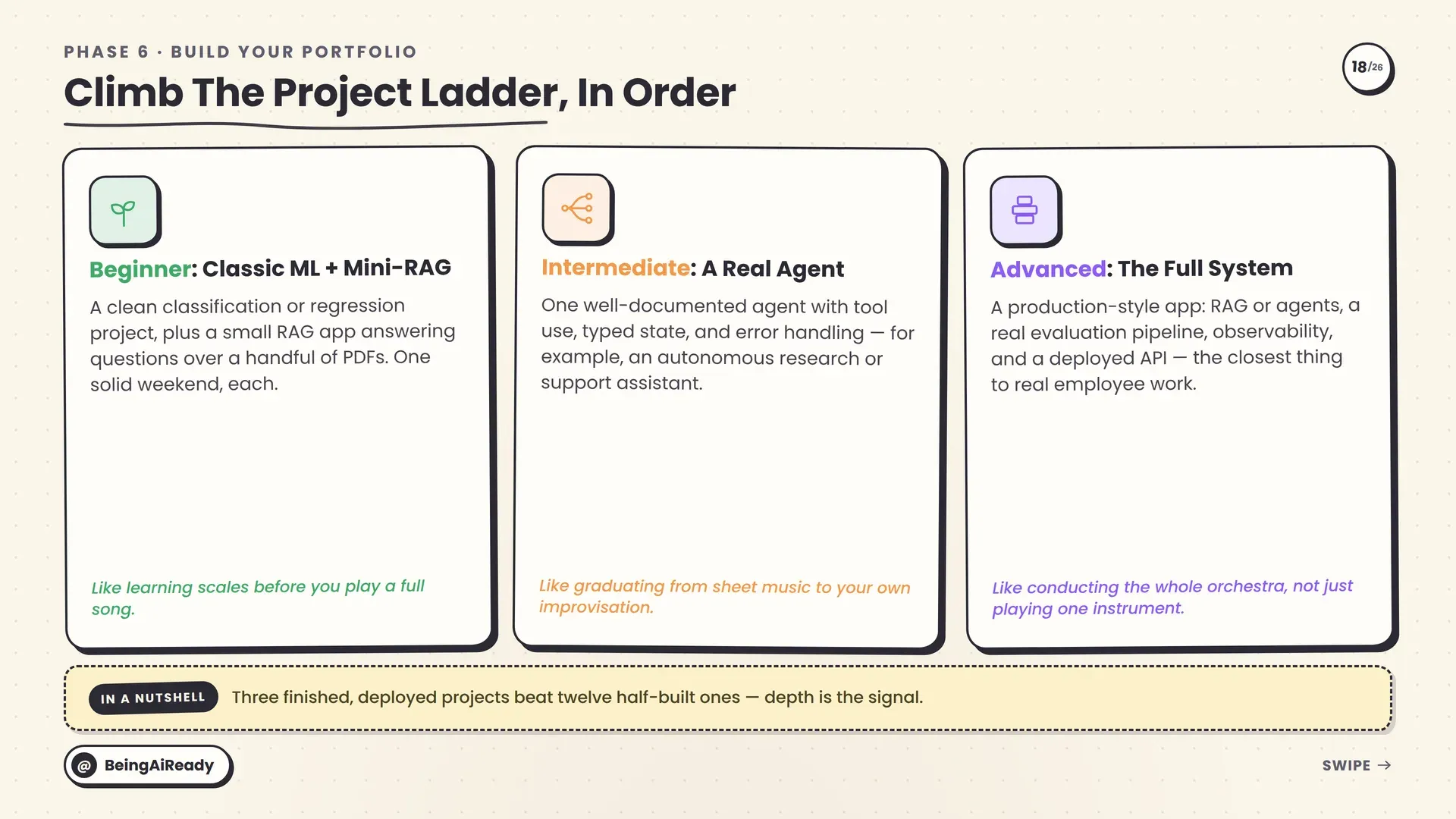 Three finished, deployed projects beat twelve half-built ones — depth is the signal.
Order matters here more than most people expect, because each rung deliberately builds the muscle the next one needs. Climb it in sequence and each project makes the next one easier. Jump straight to the top and you’ll build something impressive-looking that falls apart the moment anyone asks a follow-up question.
Beginner: classic ML plus a mini-RAG app. Start with a clean classification or regression project — predict something concrete from a real dataset, and evaluate it honestly with the metrics from Phase 2. Then pair it with a small RAG app that answers questions over a handful of PDFs you actually care about. Neither should take more than a solid weekend each. The goal at this stage is a complete, working, deployed thing, not an ambitious one. You’re proving to yourself, first, that you can carry a project all the way from data to a live URL — a loop most beginners have never actually closed.
Intermediate: a real agent. One well-documented agent with genuine tool use, tested behaviour and actual error handling — an autonomous research assistant, a support bot that can look things up and take actions, a tool that automates a real workflow. This is where the agent-orchestration material from Phase 3 gets tested against something that has to work reliably, not just impressively in a single demo run. The differentiator here is not that your agent works when everything goes right; it’s that you thought about what happens when a tool call fails or the model goes off the rails, and handled it. Say so, loudly, in your README, because it’s exactly the thing that separates your agent from the thousand toy chatbot demos a reviewer has already seen.
Advanced: the full system. A production-style RAG or agent setup, with a real evaluation pipeline, observability, and a deployed API — the closest thing to what actual employee work looks like. This is the project that, in an interview, you can walk someone through end to end and answer follow-up questions about for twenty straight minutes without running out of substance. It’s the one that demonstrates you can not only build an AI system but operate it: measure it, watch it, debug it, ship it. If you build only one thing you’re genuinely proud of in this whole journey, make it this, because it’s the project that most closely resembles the job you’re applying for.
Three finished, deployed projects climbed in this order will do more for your candidacy than twelve half-finished ones scattered across every trending framework. Depth reads as competence. Breadth without depth reads as someone still finding their footing — and a GitHub full of abandoned tutorials-with-your-name-on-them reads as exactly what it is. Finish things. Finishing is the rarest and most valuable signal on this entire list.
Make your work impossible to miss
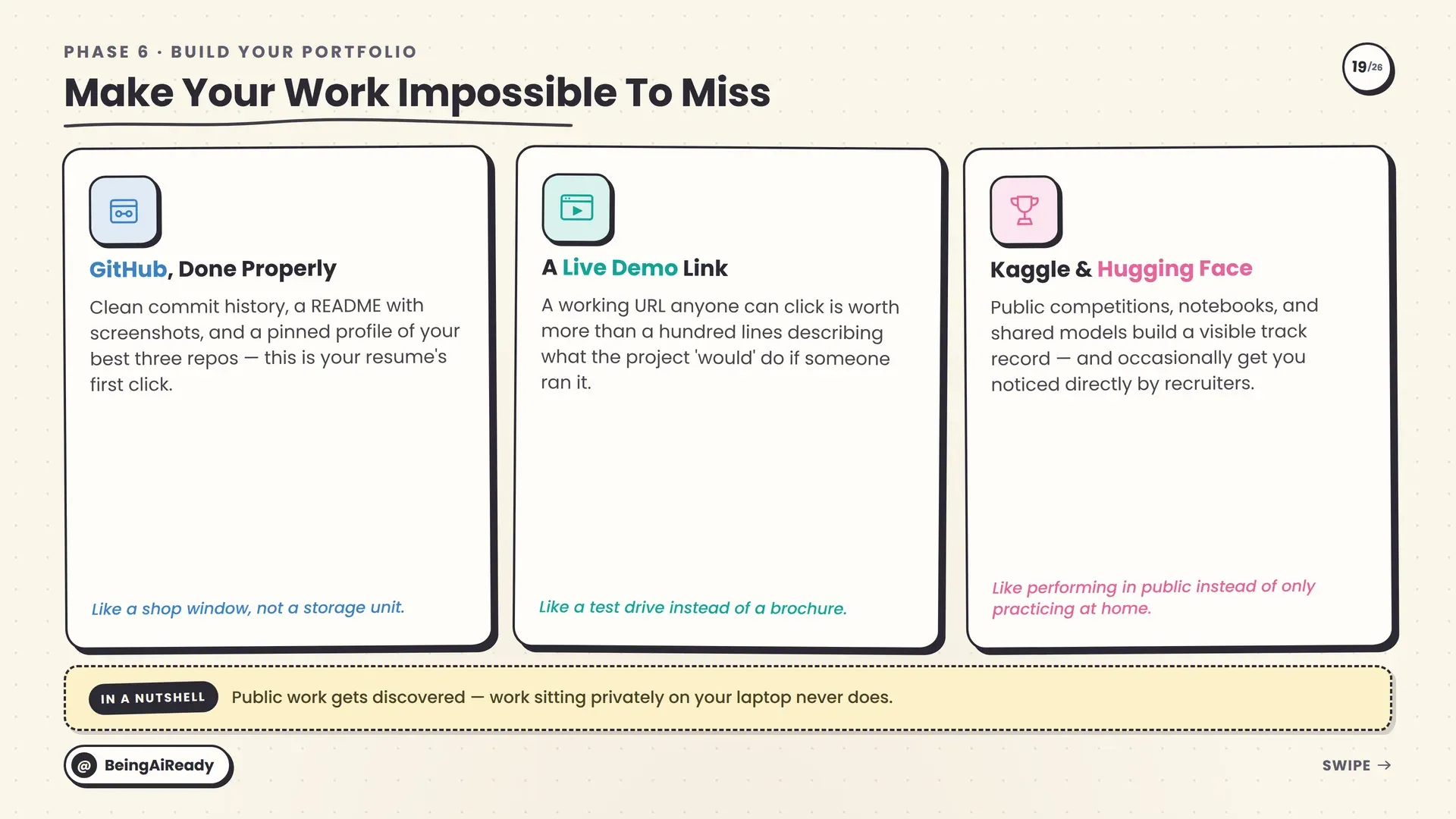 Public work gets discovered. Work sitting privately on your laptop never does.
Building the work is roughly half the job. The other half — the half people forget — is making sure it’s actually visible to someone deciding whether to interview you. A brilliant project nobody can find does nothing for your career.
GitHub, done properly means a clean commit history (not one giant “final version” commit dumped at the end), a README that actually explains the project rather than just naming it, and a screenshot or short GIF showing it working so a reviewer sees the result without running anything. Pin your best three repositories to your profile so they’re the first thing a visitor sees. For a lot of hiring managers, your GitHub profile — not your résumé — is the first click, and it’s often the one that decides whether the second click happens at all. Treat your profile as the shop window it is.
A live demo link does more persuasive work than a hundred lines of text describing what the project “would do” if someone bothered to run it. A working URL that a stranger can click, right now, from their phone, is worth disproportionately more than the same project sitting uncompiled in a repository. It converts a skeptic into a user in one click, and a reviewer who has actually used your thing is in a completely different frame of mind than one who’s reading about it. Put the demo link at the very top of the README, not buried at the bottom.
Kaggle and Hugging Face are worth a presence beyond your own GitHub — public competitions, shared notebooks and models you’ve uploaded build visible credibility in communities recruiters occasionally browse directly. It’s not unusual to get discovered there before you’ve applied anywhere at all, because these platforms are where a certain kind of recruiter actively goes looking. A decent Kaggle notebook or a model on Hugging Face is another public surface where your work can be found, and in a discovery-driven job search, more surfaces is strictly better.
The through-line, again: work that stays private on your laptop never gets discovered, no matter how good it is. Public is a feature, not an afterthought you bolt on at the end. Ship in public, from the first project.
Phase 7: Prove it without a degree
A finished portfolio doesn’t do much good sitting quietly. This phase is about the two places that portfolio actually needs to show up: the document a stranger skims for six seconds, and the people who might mention your name in a room you’re not in. Both are about converting the evidence you built in Phase 6 into interviews.
Rewrite your résumé around evidence
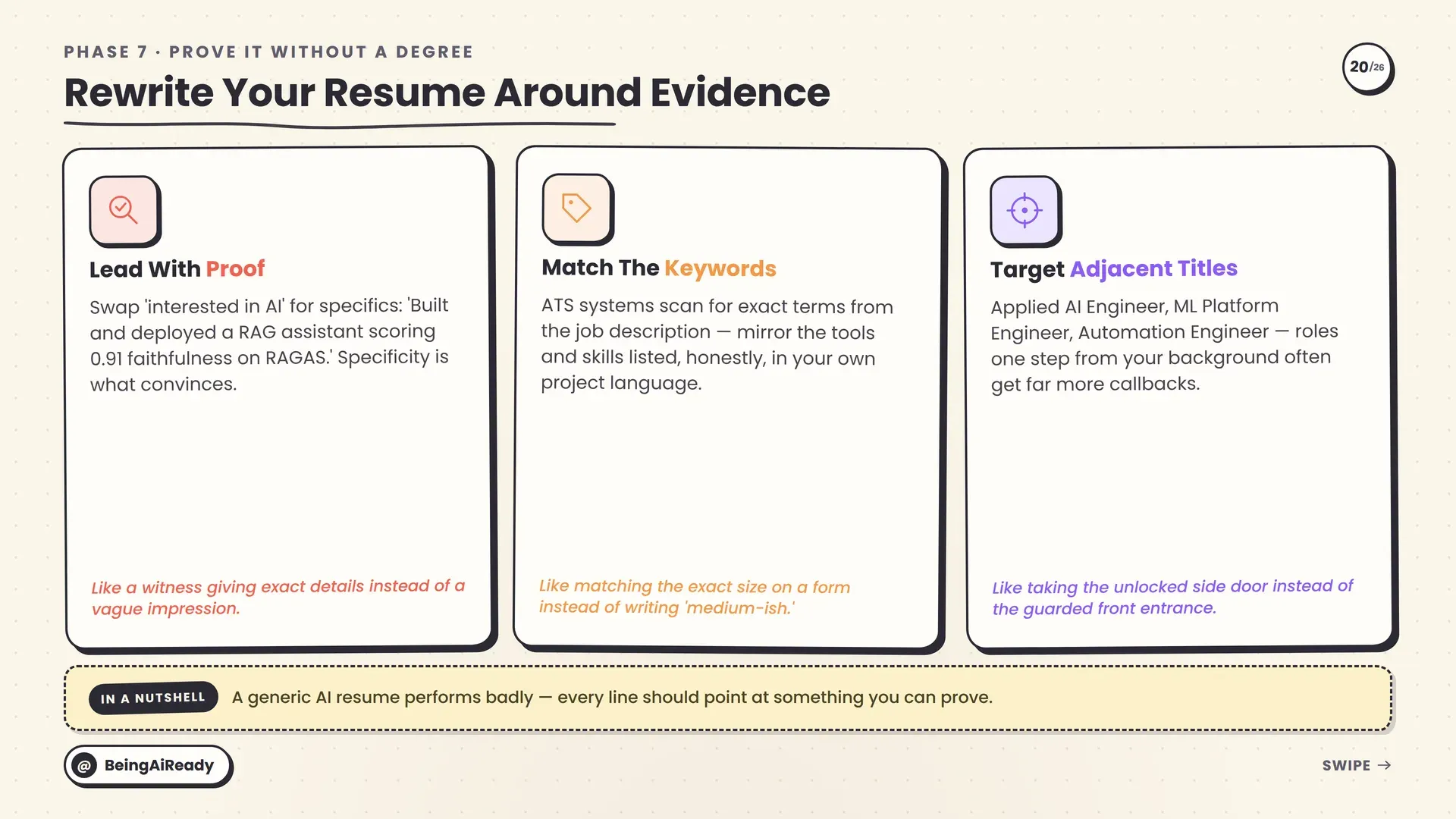 A generic AI résumé performs badly. Every line should point at something you can prove.
Lead with proof, not enthusiasm. Swap “interested in AI and eager to learn” for something like “built and deployed a RAG assistant scoring 0.91 on faithfulness, serving answers over 500 internal documents.” One is a feeling. The other is a fact someone can go and verify in about thirty seconds, and hiring managers reward the second kind of sentence disproportionately. Every bullet on your résumé should point at something real — a deployed project, a measured result, a specific tool you used to solve a specific problem. If a line could appear on the résumé of someone who has never built anything, cut it or make it concrete. The through-line of your whole résumé should be: I don’t just know about this, I’ve done it, and here’s the link.
Match the keywords, honestly. Remember the ATS problem from the very first section of this guide. Those systems scan for exact terms, so if a job description says “retrieval-augmented generation,” your résumé should say exactly that too, not a paraphrase like “AI search techniques” that a keyword filter won’t recognise. This isn’t gaming the system, and it isn’t lying — the “honestly” matters. You’re translating what you actually did into the specific vocabulary the filter, and the human reading after it, are scanning for. If you built a RAG system, call it a RAG system. Read three or four real job postings for your target role, note the terms that recur, and make sure the true ones appear in your own words on your résumé.
Target adjacent titles deliberately. Roles like Applied AI Engineer, Automation Engineer, AI Platform Engineer or ML Engineer — one step removed from the obvious “Machine Learning Engineer” search everyone runs — often generate far more callbacks precisely because they’re less crowded. Everyone applies to the job with “AI” in the title. Fewer people think to apply for the job three doors down that needs the exact same skills but describes itself differently. Widening your search to these adjacent titles is one of the highest-leverage, lowest-effort changes you can make to your job hunt, and it costs you nothing but the assumption that your target role has only one name.
Get discovered before you’re filtered out
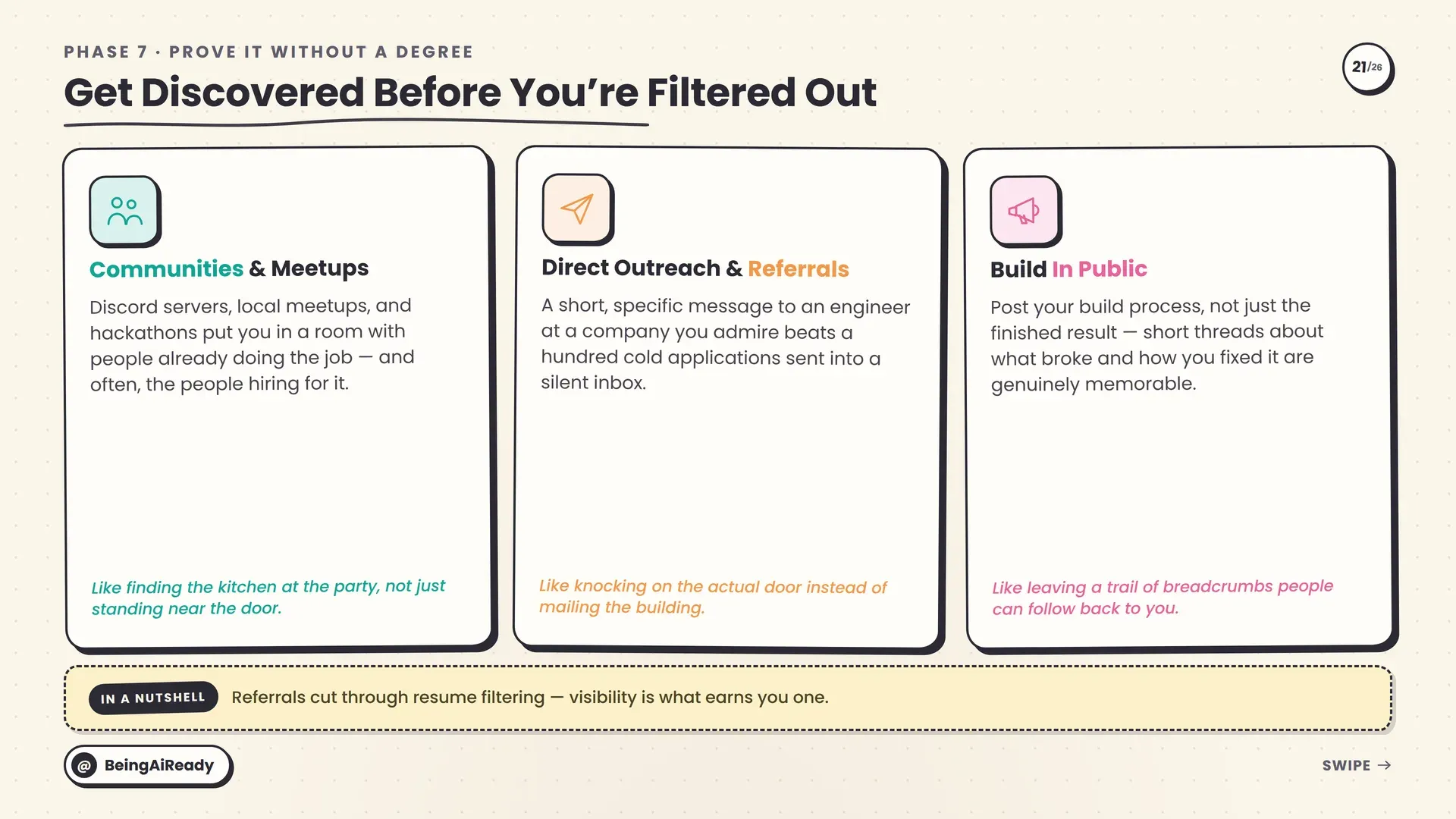 Referrals cut through filtering entirely. Visibility is what earns you one.
Communities and meetups — Discord servers, local meetups, hackathons, the comment sections where practitioners actually hang out — put you in front of people who are already hiring, frequently before a role is even posted publicly. A surprising number of AI hires start with a conversation months before any job listing exists, because managers would much rather hire someone they’ve already seen be helpful than roll the dice on a stranger from a pile of résumés. Show up consistently, help people with things you know, ask good questions about things you don’t, and let familiarity do its slow work. This is the least glamorous and most reliable networking there is.
Direct outreach and referrals beat cold applications by a wide margin — it’s not even close. A short, specific message to an engineer whose work you genuinely admire — referencing something particular about what they built, not a generic “I’d love to connect” — will outperform a hundred applications dropped into a black hole. Keep it short, make it specific, and ask for something small and concrete (a five-minute question, a pointer, feedback on a project), not “a job.” A referral is the single most reliable way to skip the ATS filter entirely, because it routes your résumé straight into a human’s hands with a name attached. The math here is stark: dozens of cold applications can produce nothing while a single warm introduction produces an interview. Spend your energy accordingly.
Building in public means posting your process, not just your finished threads — what broke, what you tried, how you actually fixed it, what you learned. It sounds like a minor detail, but it’s genuinely more memorable than a polished “look what I made” announcement, because it shows the working rather than just the highlight reel, and the working is what convinces people you can actually do the thing. People remember the engineer who posted honestly about wrestling with a stubborn bug for two days far more than the one who only ever posted “shipped!” Over months, this compounds into something valuable: a public track record that recruiters can find and that makes you a known quantity before you ever apply. You’re not performing expertise. You’re documenting the real thing, and that reads as trustworthy in a way that curated perfection never does.
Phase 8: Getting interview-ready
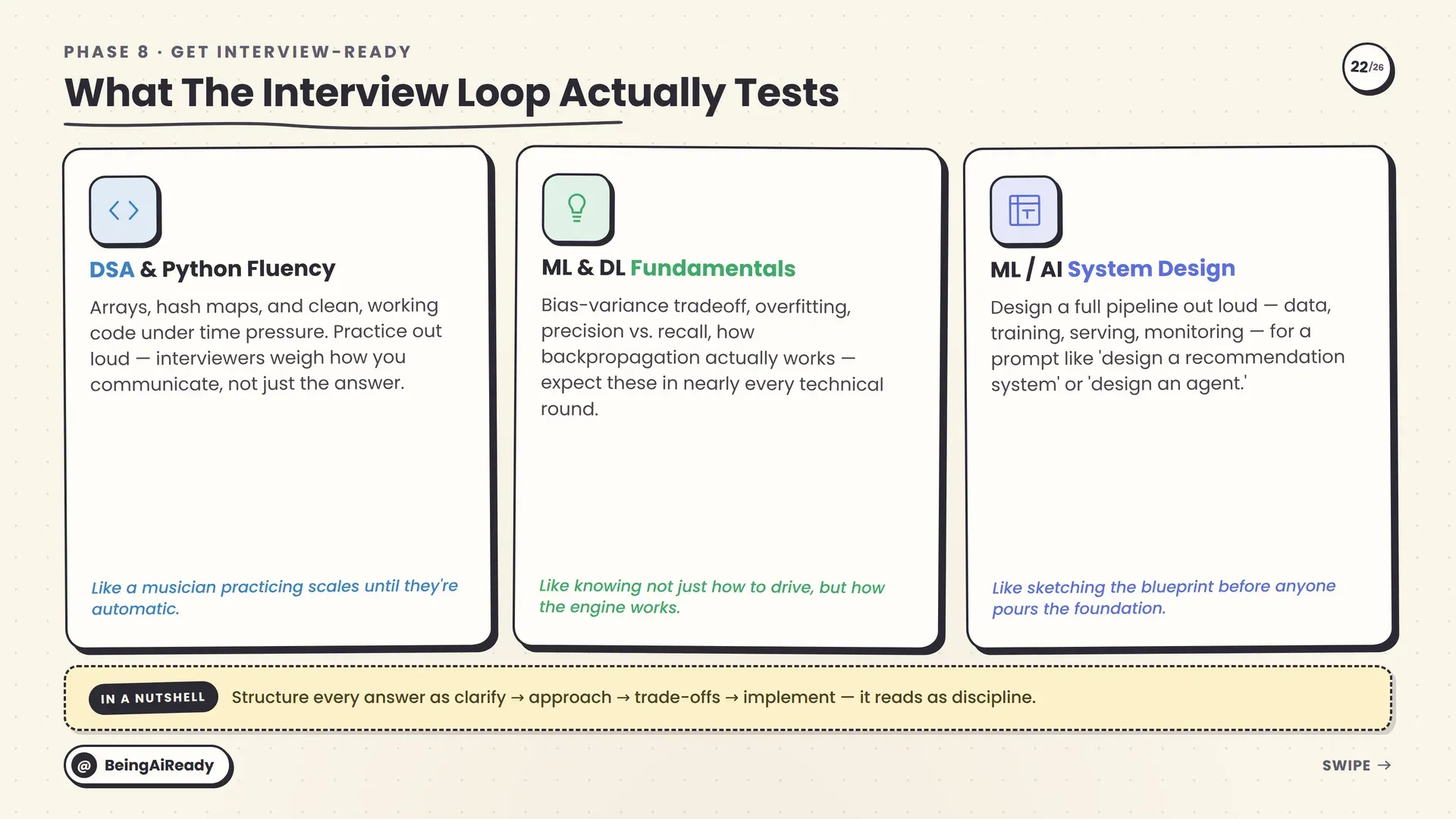 Structure every answer as clarify, approach, trade-offs, implementation. It reads as discipline, not memorisation.
The AI interview loop, once you look past the specific company, tends to test the same three things in some order. Knowing what they are lets you prepare deliberately instead of anxiously, and the good news is that all three build directly on work you’ve already done in the earlier phases.
DSA and Python fluency — arrays, hash maps, and basic Big-O thinking, the same material from Phase 1’s foundations. You’ll usually be asked to solve a problem in code while an interviewer watches. The single most important thing to practise is explaining your reasoning out loud while you work, because interviewers are weighing how you communicate and structure your thinking nearly as much as whether you land the perfect answer. A candidate who talks through a clear approach and gets 90% of the way there often beats one who silently produces a perfect solution, because the job involves working with other humans, and the interview is partly a test of that. Practise on a few dozen problems until the common patterns feel familiar, and practise narrating.
ML and DL fundamentals show up in nearly every technical round: the bias-variance trade-off, what overfitting actually looks like and how you’d catch it, precision versus recall and when you’d prioritise each, how backpropagation works under the hood, why you’d choose one model over another. These aren’t trick questions. They’re checking whether the concepts from Phase 2 actually stuck, or whether you can only operate the libraries without understanding what they’re doing. The tell they’re listening for is understanding versus memorisation — can you explain why precision matters more than recall for a spam filter, or are you reciting a definition? Prepare by being able to explain each core concept in plain language, with an example, as if to a smart colleague from another team.
ML and AI system design is the round most self-taught candidates underprepare for, because it doesn’t feel like something you can memorise. You’ll be asked to design a full pipeline out loud — data, training, serving, monitoring — for a prompt like “design a recommendation system,” “design a RAG system for customer support,” or “design an agent for X.” There’s rarely one right answer; they’re watching how you think through an open-ended problem. The strongest structure for any answer here is a consistent shape: clarity first (restate the problem and ask clarifying questions about scale, constraints, requirements), then your approach (the high-level design), then the trade-offs you’re consciously choosing between, then implementation detail. Applied consistently, that shape reads as discipline and senior-level thinking even when you don’t know every specific answer — and it’s a structure you can rehearse until it’s second nature. Your advanced portfolio project from Phase 6 is your best possible preparation here, because you’ve already made all these decisions for real once.
A general note on interview nerves as a no-degree candidate: you may walk in expecting to be quizzed on your lack of a degree, and it mostly won’t happen. By the time you’re in a technical loop, the degree question is already behind you — your portfolio got you in the room. What they want now is evidence you can do the work and reason about it clearly. Bring your projects, be ready to go deep on them, and let the work speak.
How long this actually takes
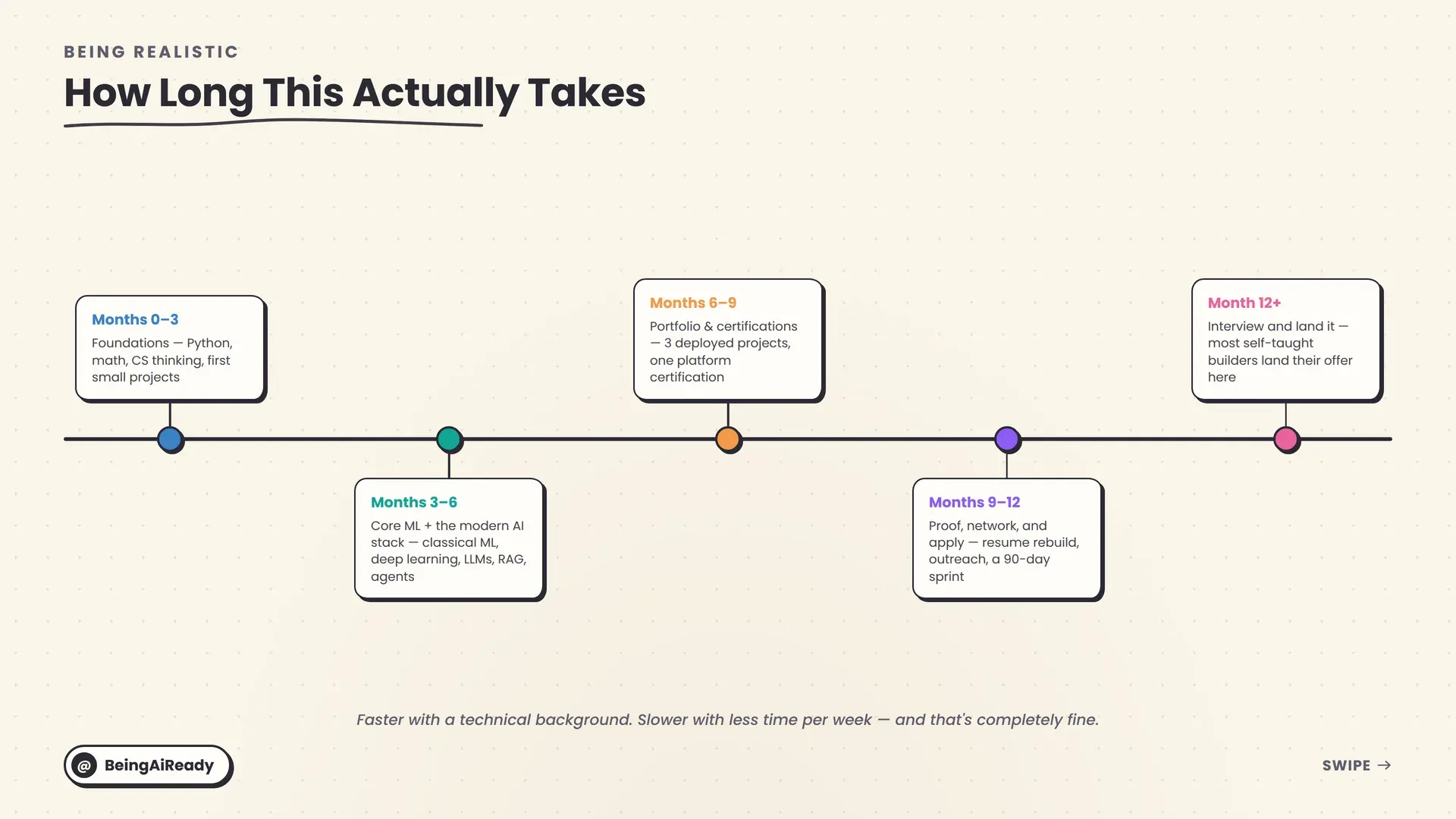 Faster with a technical background. Slower with less time per week — and that’s completely fine.
Here’s the honest, month-by-month version, assuming consistent part-time effort rather than a full-time sprint. Treat these as centres of gravity, not hard deadlines — real progress is lumpier than any timeline suggests, with weeks where nothing clicks and weeks where everything does.
Months 0–3 are foundations: Python, math, CS thinking, and your first small but genuinely finished projects. Nothing impressive yet, and that’s fine — this stage isn’t supposed to be impressive, it’s supposed to be solid. The temptation to rush through it toward the exciting stuff is exactly the trap; the people who take these months seriously move faster later, because they’re not constantly tripping over gaps.
Months 3–6 cover core ML and start moving into the modern stack: classical machine learning, deep-learning fundamentals, then LLMs, RAG and your first agents. This is where it starts to feel like you’re actually doing AI, and where momentum tends to build, because each new thing you learn connects to something you already have.
Months 6–9 are portfolio and certifications — three deployed projects climbing the ladder from Phase 6, plus one platform certification tied to whichever cloud you’re targeting. This is the phase that converts everything before it into evidence, and it’s the phase to protect most fiercely from distraction. Ship the projects.
Months 9–12 shift toward proof, network, and apply: the résumé rebuild from Phase 7, active outreach, building in public, and the start of a focused 90-day application sprint. Crucially, this overlaps with the phase before it — you should start networking and applying before you feel finished, because “finished” is a feeling that never quite arrives on schedule.
Month 12 and beyond is where most self-taught builders actually land the offer — not because something magic happens at the twelve-month mark, but because that’s roughly how long the compounding of the eleven months before it takes to become visible from the outside. The work you did in month three doesn’t pay off in month three. It pays off now, all at once, when a portfolio and a network and a sharpened résumé finally line up.
This moves faster if you arrive with an existing technical background, and slower if you can only give it a handful of hours a week. A slower timeline is not a sign you’re doing it wrong. It’s arithmetic — someone with ten hours a week will take longer than someone with thirty, and both can absolutely make it. The failure mode isn’t being slow. It’s being inconsistent, or quitting in month four because the payoff hasn’t arrived yet, right before the part where it starts to.
Phase 9: The job search sprint
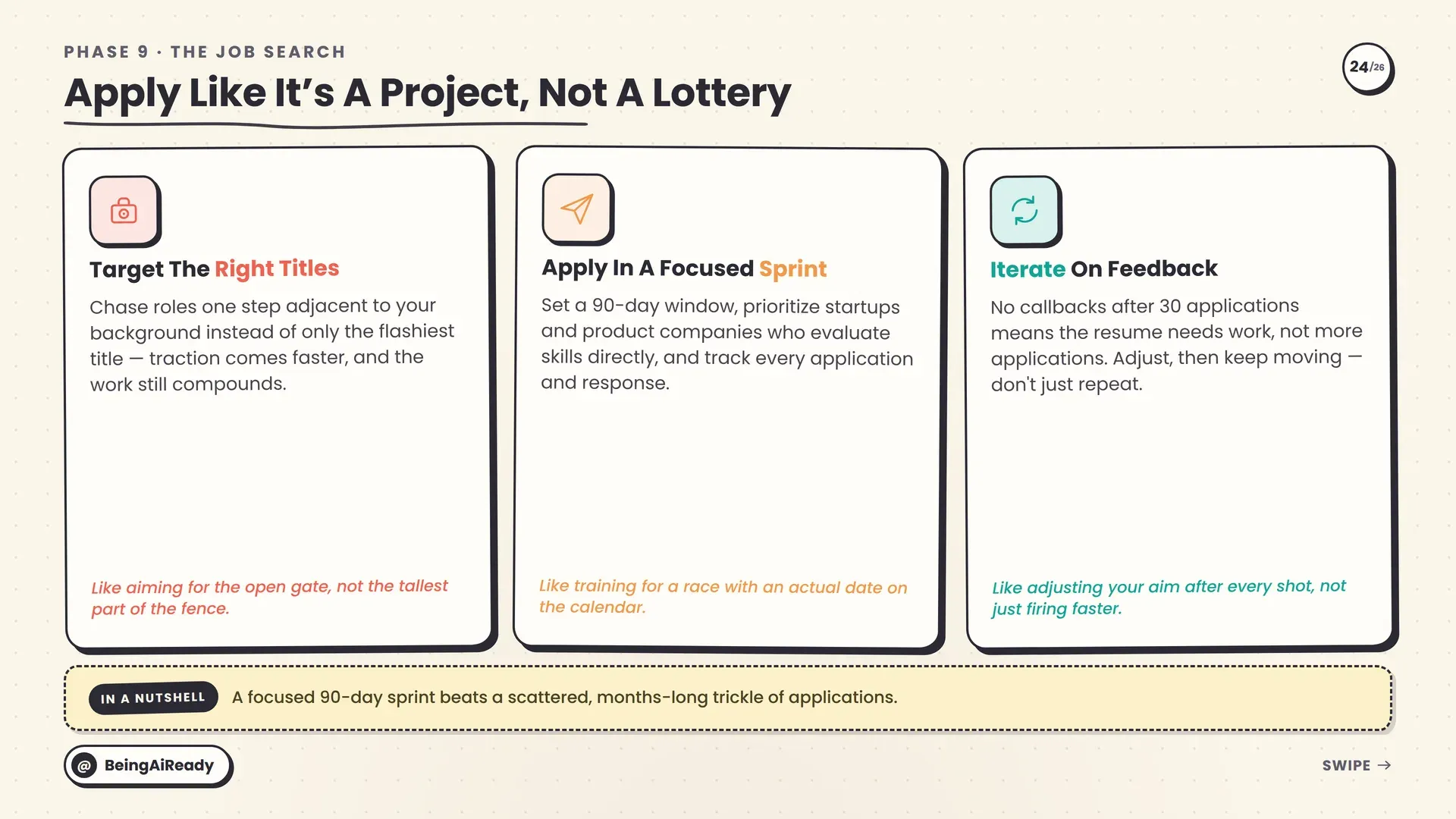 A focused 90-day sprint beats a scattered, months-long trickle of applications.
The job search deserves to be run like a project, because that’s exactly what it is — one with a goal, a timeline, inputs you control, and feedback you can act on. Run it like a lottery instead and you’ll get lottery odds.
Target the right titles. Chase the roles that align with the specific portfolio you’ve built and its strongest signal, not the flashiest title you can find and not the widest possible net. A scattershot application strategy usually just means every single application is generic, and generic applications lose to specific ones every time. Include the adjacent titles from Phase 7 — Applied AI Engineer, Automation Engineer, AI Platform Engineer — because they’re less crowded and often want exactly what you have. Quality and fit beat volume.
Apply in a focused sprint. Set an actual 90-day window, prioritise companies that evaluate skills directly rather than leaning entirely on ATS defaults — startups and product companies are often more willing to look at a portfolio and less wedded to credentials — and track every application in one place: role, date, status, contact, any feedback received. A tracked sprint is a project you can debug: you can see what’s working, spot patterns, and adjust. An untracked trickle of applications spread over six anxious months is just anxiety with extra steps, and it gives you no data to learn from.
Iterate on feedback, and treat silence as data. If thirty quality applications produce zero callbacks, that is not a signal to apply faster — it’s a signal that something upstream needs fixing, almost always the résumé or the targeting, not the volume. Doing more of what isn’t working just gets you more of nothing. Adjust one thing, test it, and read the results. And once something is working — a particular kind of role, a particular framing, a referral channel that produces responses — lean into it hard rather than continuing to spread yourself thin. The whole point of tracking is to find the thing that works and then do more of it.
A word on morale, because the job search is where a lot of otherwise-successful transitions quietly die. Rejection and silence are not verdicts on your worth or even, usually, your skills — they’re the normal, high-noise texture of any job search, made noisier by the volume of applicants. The people who make it through are frequently not the most talented; they’re the ones who treated it as a process to iterate on rather than a series of personal referendums, and who kept going long enough for the process to work. Keep your evidence in front of you, keep adjusting, and keep going.
The mistakes that quietly stall people
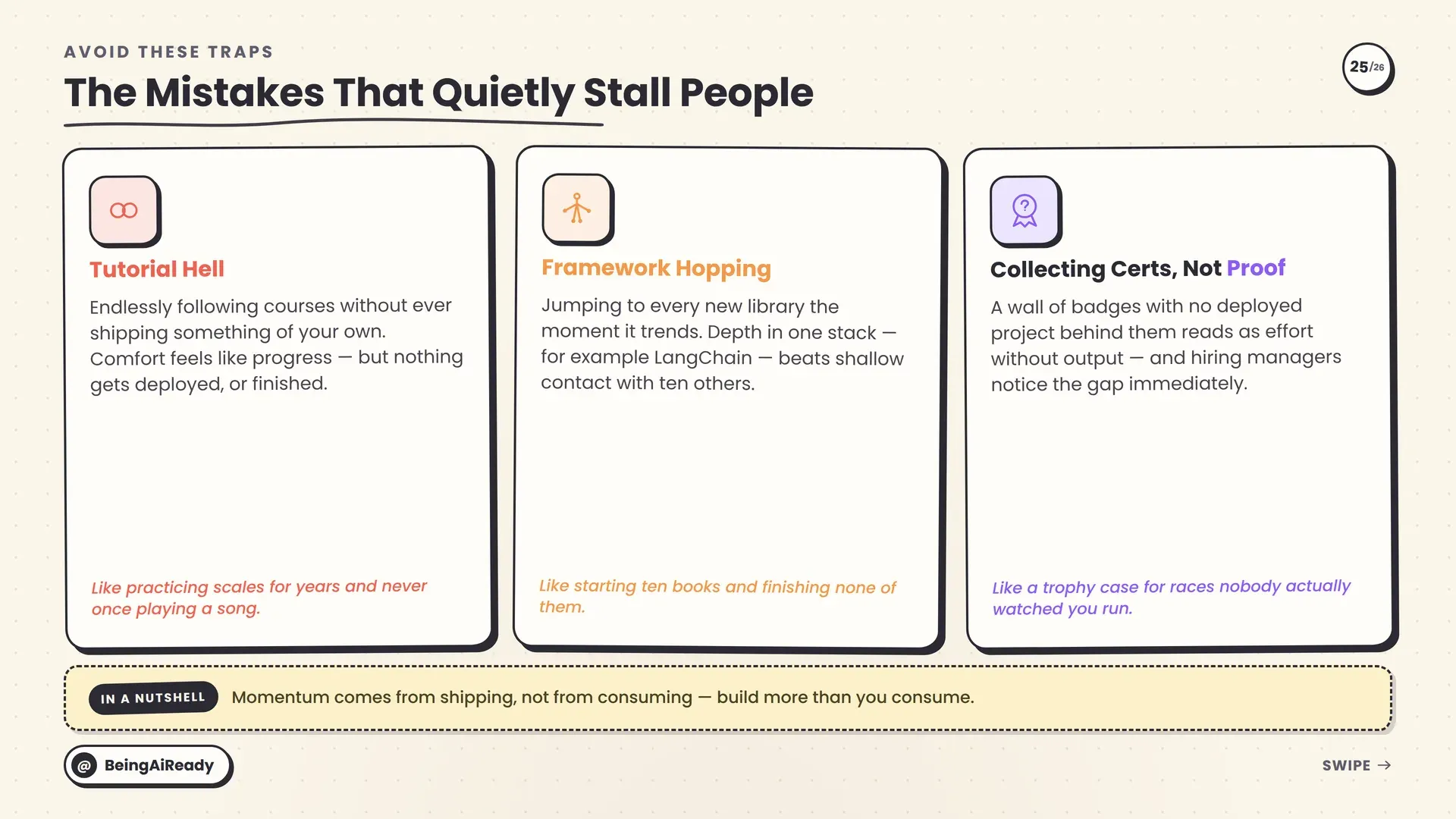 Momentum comes from shipping, not consuming. Build more than you consume.
Three traps account for most of the wasted years in this space, and all three are comfortable, which is exactly why they’re dangerous. Each one feels like progress while it quietly isn’t, and that’s what makes them so effective at eating months.
Tutorial hell is endlessly following courses without ever shipping anything of your own. It feels like progress because you’re constantly learning something new and the material keeps making sense in the moment — but nothing ever gets deployed, or finished, or made yours, and a résumé full of “completed course X” with no shipped project behind it reads as exactly what it is. The comfort of tutorials is that someone else has removed all the hard parts: the ambiguity, the debugging, the decisions. Real projects put those back, which is uncomfortable, which is precisely why they teach you what tutorials can’t. The escape is simple and hard: after every tutorial, build something small that the tutorial did not hand you, and finish it.
Framework hopping means jumping to whatever library just started trending, over and over, without ever going deep on one. There’s always a shiny new framework, and chasing each one feels like staying current, but it leaves you with shallow, surface-level contact with ten different tools you could each describe for about thirty seconds and no longer. Real depth in a single stack — LangChain learned thoroughly, say, or one agent framework you actually understand end to end — beats a scattered tour of everything, because depth transfers and breadth-without-depth doesn’t. The fundamentals underneath the frameworks change far more slowly than the frameworks themselves; learn those deeply through one tool, and picking up the next tool becomes trivial.
Collecting certificates instead of proof is the trap this guide has flagged more than once, because it’s genuinely common and genuinely seductive: a wall of badges, each one a small hit of visible accomplishment, with no deployed project behind any of them. Certificates feel safe because they have a clear finish line and someone else defines “done.” Building something real doesn’t — it’s open-ended, and it can fail. But hiring managers notice the gap immediately, and a stack of credentials with nothing built reads less like preparation than like avoidance of the harder, more convincing work. The certificate is the map. The project is the territory. Employers hire for the territory.
The antidote to all three is the same, and it’s the single most important sentence in this guide: momentum comes from shipping, not from consuming. Build more than you consume, on purpose, from the very first week. If you internalise nothing else here, internalise that, because it quietly determines who makes it and who spends two years almost getting started.
The complete glossary
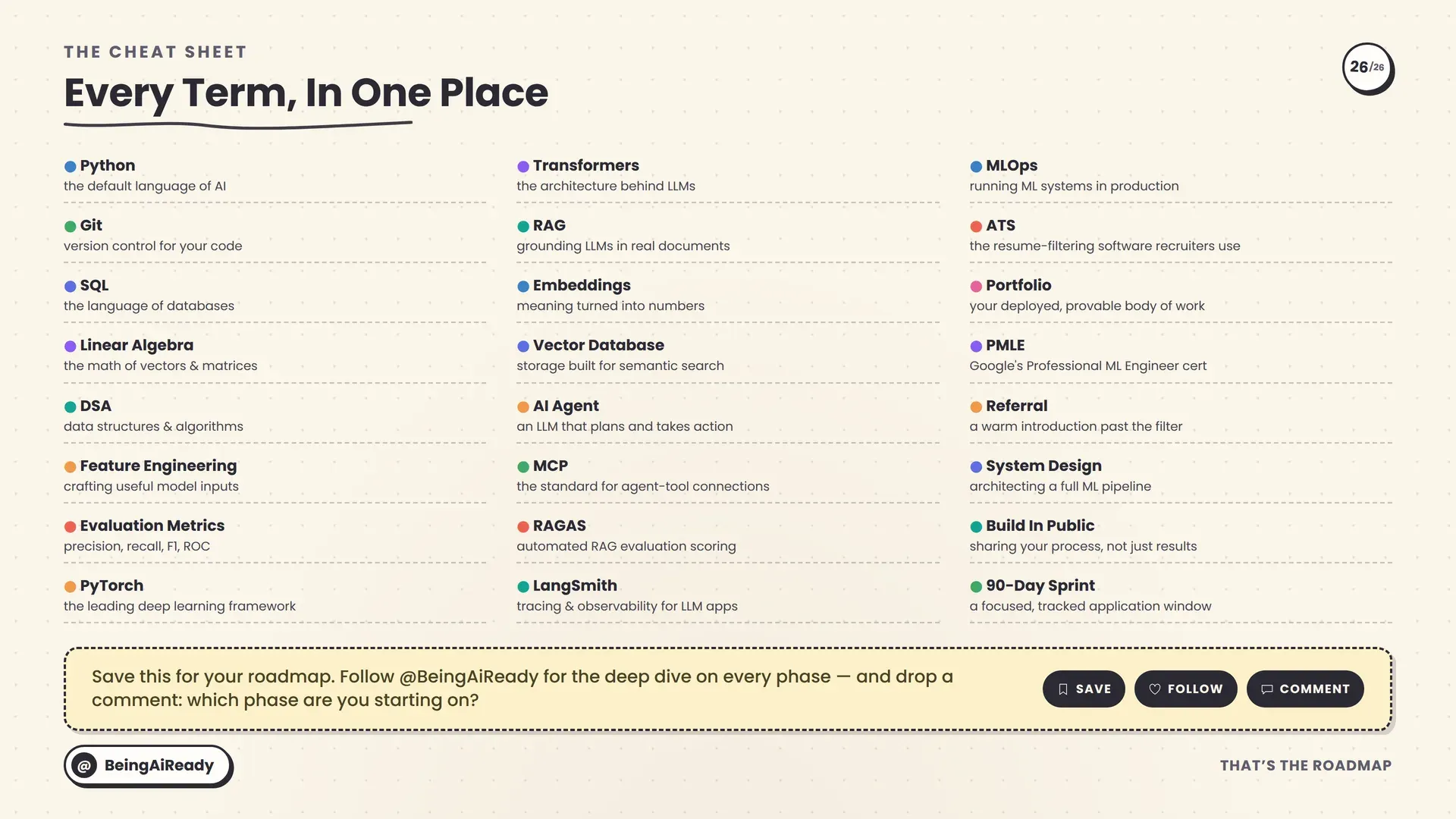 Every term from this guide, in one place — bookmark this section as your reference.
If you skimmed this guide, or you’re back here weeks later trying to remember what MCP actually stands for, here’s every term from the roadmap in one place.
| Term | What it means |
|---|---|
| Python | The default language of AI |
| Git | Version control for your code |
| SQL | The language of databases |
| Linear algebra | The math of vectors and matrices |
| DSA | Data structures and algorithms |
| Feature engineering | Crafting useful model inputs |
| Evaluation metrics | Precision, recall, F1, ROC |
| PyTorch | The leading deep-learning framework |
| Transformers | The architecture behind LLMs |
| RAG | Grounding LLMs in real documents |
| Embeddings | Meaning turned into numbers |
| Vector database | Storage built for semantic search |
| AI agent | An LLM that plans and takes action |
| MCP | The standard for agent-to-tool connections |
| RAGAS | Automated RAG evaluation scoring |
| LangSmith | Tracing and observability for LLM apps |
| MLOps | Running ML systems in production |
| ATS | The résumé-filtering software recruiters use |
| Portfolio | Your deployed, provable body of work |
| PMLE | Google’s Professional ML Engineer certification |
| Referral | A warm introduction past the filter |
| System design | Architecting a full ML pipeline |
| Build in public | Sharing your process, not just results |
| 90-day sprint | A focused, tracked application window |
Final thoughts
None of this is a trick, and it was never really about finding a shortcut around the degree requirement — because increasingly, there isn’t one required to route around. It’s about doing the actual work in an order that compounds, and then making that work visible to the specific people deciding whether to interview you. The people who make it through this transition aren’t the ones who found some clever hack. They’re the ones who kept building past the point where it stopped being fun, and who understood that a live URL says more than a paragraph ever could.
If you’re at the beginning of this, the roadmap above is genuinely the whole thing — there’s no second, secret phase that comes after. Foundations, core ML, the modern stack, a real portfolio, the right certifications, and a focused job search. Nine to fifteen months, roughly, if you keep showing up. The single biggest predictor of whether you’ll make it isn’t your starting point, your math background, or your access to a fancy course. It’s whether you keep shipping small things, consistently, when the payoff still feels far away.
This guide is part of an ongoing series at BeingAiReady on what it actually takes to build a career in AI — no hype, no fear-mongering, just the pragmatic version. If it helped, stick around. If you want the plain-English version of the jargon it leans on, start with what RAG really is and the running AI terms glossary. And if you’re starting today, here’s the only question that matters right now: which phase are you on, and what’s the smallest thing you could ship this week?
Frequently asked questions
Can you really get a job in AI without a college degree?
Yes, for applied roles. The field currently has more open positions than credentialed graduates to fill them, and most companies weigh a deployed portfolio more heavily than a diploma when they're hiring someone to build with AI. It's genuinely harder for research-scientist positions at frontier labs, which still lean on advanced degrees. But for the applied engineering roles this guide is about, the path is open — and it's opening wider, not narrowing.
How long does it take to break into AI without a degree?
Most self-taught builders land a first role in nine to fifteen months of consistent, part-time effort. People coming from software development or cloud/DevOps tend to move faster, because a lot of their existing skills transfer directly. People starting from zero programming take longer. The variable that matters most isn't talent, it's how many hours a week you can actually give it, and how much of that time goes into building rather than just watching courses.
Do I need to be good at math to work in AI?
No. You need working intuition for three things: linear algebra, statistics, and enough calculus to understand what gradient descent is doing. You do not need to derive any of it by hand. The libraries handle the actual computation. What matters is understanding roughly why a technique works, so that when a model does something strange, you have a mental model for it rather than a shrug.
Are AI certifications worth getting without a degree?
Selectively, and only on top of a real, deployed project, never in place of one. A platform certification tied to the cloud your target companies actually run (Google's Professional ML Engineer, AWS's ML Engineer Associate, or Microsoft's AI-103) adds real, verifiable credibility. A wall of certificates with no shipped project behind them reads as avoidance, and experienced hiring managers notice the gap immediately.
What's the best first job title to target in AI without a technical background?
It depends on where you're starting. Developers tend to move fastest into Applied AI or GenAI Engineer roles. People with cloud or DevOps experience often fit MLOps roles, because the gap between what they know and what the role needs is narrow. People from a non-technical domain usually do best building one focused internal tool that solves a real problem in a field they already understand better than most engineers do.
Do I really need a portfolio, or can I just apply with a resume?
You need a portfolio. A resume that claims skills is a claim. A deployed, evaluated, documented project is evidence, and evidence is what routes around the resume-filtering software most companies use by default. Three finished, deployed projects will do more for you than any number of resume lines describing things you 'know how to do.'
Is it too late to get into AI in 2026?
No, and the 'you missed it' framing gets the timing backwards. The tools most job postings now ask for — RAG, agents, MCP, LLM evaluation — are new enough that almost nobody has five years of experience in them, which is exactly why hands-on experience counts for so much. You're not late to a settled field. You're early to an unsettled one.
Which programming language should I learn first for AI?
Python, without much debate. It's the default language of the entire AI ecosystem, so the libraries, tutorials, courses and job postings all assume it. Learn Python fundamentals first, then NumPy, pandas and matplotlib, then move into scikit-learn and PyTorch. You do not need a second language to get hired for most applied AI roles.
Do I need to build my own AI models from scratch to get hired?
For most applied roles, no. The fastest-growing entry point right now is integrating existing models (via APIs) into real products — building RAG systems, agents and AI features — rather than training models from scratch. Training your own models matters more for research and some data-science roles. Build one small neural network by hand once to understand the mechanics, then spend most of your time applying models, not inventing them.
Related articles
How to Use AI to Land a Job: A Practical 2026 Guide
AI can speed up your job search or quietly sink it. A no-hype guide to using AI for résumés, applications, and interview prep — without getting screened out.
AI Skills Every Professional Needs in 2026
Prompting isn't the AI skill that pays. Real labor-market data on what separates professionals who benefit from AI from those it quietly hollows out.
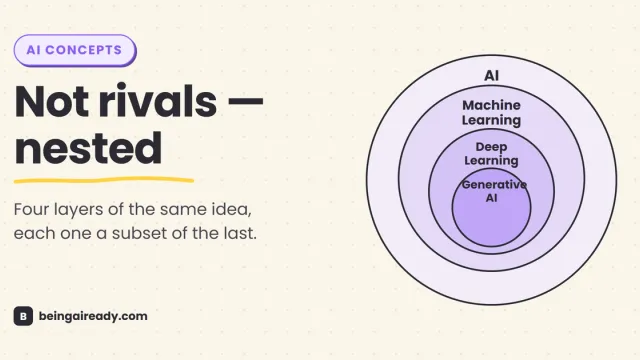
AI vs Machine Learning vs Deep Learning vs Generative AI
AI, machine learning, deep learning, and generative AI aren't rival technologies, they're nested layers. The plain-English map, with real history and examples.