
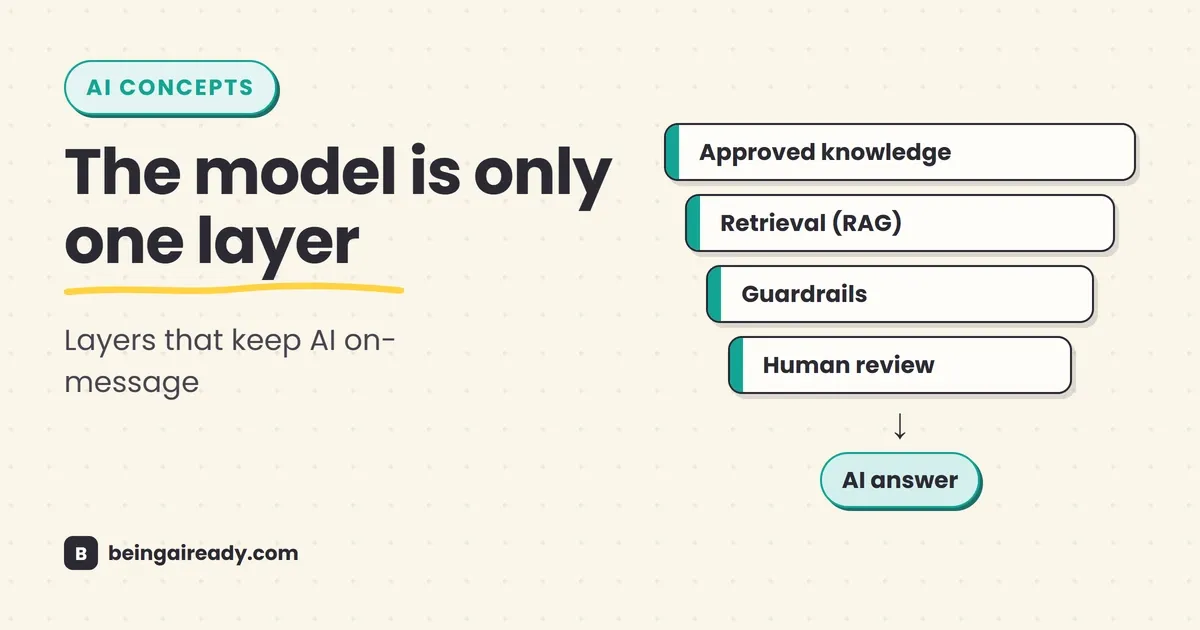
AI Answer Accuracy: How Companies Keep AI On-Message
In February 2024, a Canadian tribunal found Air Canada responsible after its website chatbot gave a passenger incorrect information about the airline’s bereavement-fare policy. The correct policy existed elsewhere on the same website. That did not help the airline’s case. Customers had no reason to assume that one part of the site was authoritative and the chatbot was not. The tribunal’s conclusion was blunt: the company was responsible for the information its chatbot published. (Moffatt v. Air Canada, 2024 BCCRT 149)
That case is the practical problem behind the phrase AI answer accuracy, and it has two sides. For an individual checking a questionable response, the workflow is covered in How to Fact-Check and Verify Anything an AI Tells You. This article looks at the other side: how a company designs the system so fewer questionable answers reach people in the first place.
A company does not merely need an AI that can write a plausible answer. It needs an AI that gives the company’s answer — based on the right source, using the current policy, within the assistant’s authority, in language the business is prepared to stand behind. That is a much bigger job than writing a clever prompt.
Quick answer: Companies keep AI on-message by surrounding the model with controls. They narrow what the assistant is allowed to do, connect it to approved and current information, keep exact business rules in software rather than prose, test responses against realistic questions, check outputs before they reach users, monitor failures after launch, and send high-risk cases to people. Prompts and fine-tuning help with behavior and style. Retrieval, tools, rules, evaluations, and human review do most of the work of reliability.
Here’s what you’ll walk away knowing:
- What “on-message” actually means beyond brand tone.
- Why a long system prompt cannot carry an entire company’s truth.
- How RAG, guardrails, fine-tuning, structured outputs, and evaluations fit together.
- Which facts should come from documents, which should come from live software, and which should never be generated at all.
- A practical control stack that works for customer support, employee assistants, sales tools, and AI agents.
- A 30-day plan for putting a narrow company AI into production without pretending it will be perfect.
What AI answer accuracy means inside a company
The phrase sounds like a marketing concern: make the bot use the approved tagline, avoid slang, and spell the product name correctly. That is one small part of it. In a production system, “on-message” usually covers at least five different kinds of accuracy.
| Type of accuracy | The real question | Typical failure |
|---|---|---|
| Factual accuracy | Is the answer supported by reliable information? | The assistant invents a feature or cites an old price. |
| Policy accuracy | Does the answer match the company’s current rules? | It promises a refund that the policy does not allow. |
| Operational accuracy | Did it use the correct account, order, or system data? | It gives a generic answer when the customer’s actual order is delayed. |
| Behavioral accuracy | Did it follow the required tone, format, and boundaries? | It sounds dismissive, gives an overlong answer, or ignores a required disclaimer. |
| Decision accuracy | Did it know whether to answer, refuse, ask, or escalate? | It guesses at a legal, medical, financial, or account-specific decision. |
A response can pass one row and fail the others. An AI may correctly explain the general idea of a return policy while applying the wrong version to a particular customer. It may retrieve the right policy but overstate what it means. It may produce an accurate answer in a tone that creates a customer-service problem. It may be perfectly polite while revealing information the user was not authorized to see.
This is why serious teams do not manage AI quality as a single “accuracy score.” They break it into separate, testable behaviors.
Why companies cannot prompt their way out of this
The first prototype of a company chatbot often works like this:
- Choose a capable language model.
- Paste the brand guidelines and policies into a prompt.
- Tell it not to make things up.
- Try a few friendly questions.
- Declare the demo surprisingly good.
The demo probably is good. The trouble begins when real users arrive.
They ask incomplete questions. They use product nicknames. They combine three issues in one message. They refer to an old policy. They ask for exceptions. They paste content from elsewhere. They insist that another employee promised something. They try to get the assistant to ignore its instructions. They ask account-specific questions that cannot be answered from a policy document.
A prompt alone struggles for several reasons.
The company’s “truth” is not one document
Prices may live in a commerce platform. Product specifications may live in a content management system. Customer status may live in a CRM. Refund eligibility may be calculated by application code. Legal wording may live in an approved policy repository. Internal procedures may sit in a knowledge base that is not visible to customers. Putting all of this into one prompt creates a large, stale copy of the business rather than a reliable connection to it.
Language models generate; they do not enforce
A sentence such as “Never offer refunds after 30 days” is an instruction written in the same medium as every other sentence the model reads. It is not the same as a software rule that calculates the purchase date and blocks an ineligible refund.
Models have become better at following instructions, but the distinction still matters: natural-language guidance is flexible; business logic is supposed to be exact.
The same question can produce different wording
Language models are probabilistic. Variation is useful when writing an email or explaining a difficult idea. It is less useful when the answer must contain a specific qualification, follow an approved sequence, or avoid making a contractual promise.
Source material can be wrong, stale, or contradictory
Connecting an AI to documents does not make those documents correct. Many companies discover their knowledge problem only after the chatbot begins exposing it: three versions of the same policy, an obsolete PDF that still ranks well in search, or two departments using different definitions for the same term.
The environment changes
Models are updated. Prompts are edited. Source documents change. Search settings are tuned. New products launch. Users find new ways to phrase old questions. A system that passed its tests in April can regress in May without anyone changing the visible chat interface.
The practical answer is not a perfect prompt. It is a set of layers, each responsible for a different kind of control.
The seven-layer control stack behind reliable company AI
The most useful way to think about enterprise AI accuracy is as a stack:
- Scope: Decide what the AI is and is not allowed to handle.
- Instructions: Define how it should behave and communicate.
- Approved knowledge: Give it current, governed sources.
- Live tools and rules: Fetch account data and calculate exact outcomes in software.
- Output controls: Check the answer before it is shown or acted upon.
- Evaluations and monitoring: Test expected behavior and detect regressions.
- Human escalation: Route uncertainty and high-consequence cases to people.
A small company may implement each layer with a document folder, a no-code chatbot, a spreadsheet, and a shared inbox. A large bank may use dedicated retrieval infrastructure, policy engines, identity controls, model gateways, automated evaluations, audit logs, and multiple review teams. The scale changes, but the architecture does not change as much as the vocabulary suggests.
Layer 1: Narrow the job before improving the model
The easiest way to improve an AI system is to ask it to do less.
“Answer every customer question” is not a useful scope. “Explain product setup using the public help centre, check order status for authenticated customers, and hand refund exceptions to a person” is much closer.
A good scope defines four possible outcomes for each request:
- Answer: The assistant has the authority and information to respond.
- Ask: It needs one or two missing details.
- Refuse: The request is prohibited or outside the product’s purpose.
- Escalate: A person needs to make the decision or review the case.
This matters because many apparent hallucinations are really scope failures. The model did not know enough to answer, but the product gave it no graceful alternative. So it filled the silence.
Build a scope map, not a mission statement
A practical scope map can be a simple table:
| User intent | AI action | Source or tool | Human handoff? |
|---|---|---|---|
| Product setup | Answer | Public help centre | Only after troubleshooting fails |
| Order status | Fetch and answer | Order-management API | If data is missing or inconsistent |
| Refund eligibility | Calculate and explain | Policy rule + order data | For exceptions |
| Legal threat | Acknowledge and escalate | Approved response template | Always |
| Competitor comparison | Answer carefully | Approved comparison sheet | If claim is disputed |
| Request for employee data | Refuse | Access-control policy | Security review if repeated |
This is not glamorous work, but it is the foundation. Until the company decides what the assistant may decide, the model will make that decision on its behalf.
Layer 2: Use instructions for behavior, not as a company database
The system prompt, policy prompt, or instruction layer tells the AI how to behave. Different platforms use different names, but the role is similar.
A useful instruction set usually covers:
- The assistant’s job and audience.
- The sources it may rely on.
- The order in which it should use tools.
- The tone and level of detail.
- Words or claims it must avoid.
- Situations that require clarification.
- Situations that require refusal or escalation.
- The required response structure.
- How to express uncertainty.
The best instructions are less like inspirational brand copy and more like an operating manual. “Be helpful and professional” is too vague to test. “Start with the direct answer, use no more than five sentences for routine questions, do not describe a refund as approved until the eligibility tool returns eligible, and offer a human handoff after two failed troubleshooting steps” can be tested.
Examples often work better than adjectives
Teams commonly describe voice with words such as warm, premium, expert, or friendly. Those words leave a great deal to interpretation.
A small set of approved examples is usually more useful:
- A good answer to a frustrated customer.
- A good explanation of a limitation.
- A good refusal that does not sound accusatory.
- A good short answer and a good detailed answer.
- A bad answer with a note explaining why it is bad.
Examples turn taste into something closer to a specification.
Keep instructions short enough to govern
A 40-page prompt is difficult to review, version, and debug. It also makes conflicts more likely. Companies get better results when they split responsibilities:
- Instructions define behavior.
- Retrieval supplies approved explanatory content.
- Tools supply live data.
- Code enforces exact rules.
- Validators check the output.
The prompt is the traffic controller, not the warehouse.
Layer 3: Ground answers in approved knowledge
When a company wants an AI to answer from its own documents, it will usually use some form of retrieval-augmented generation, or RAG. The name makes it sound more exotic than it is. A normal language model answers from patterns learned during training plus whatever is in the current conversation. A RAG system first searches an approved collection, retrieves the passages most relevant to the question, and gives those passages to the model as context for the answer.
Google describes grounding as connecting model output to verifiable information, commonly through RAG. OpenAI’s file-search systems similarly use vector stores to retrieve relevant content. The point is not to retrain the model on every company document. It is to bring the right evidence into the conversation at the moment it is needed. (Google Cloud grounding overview, OpenAI vector stores)
What a RAG system actually does
In plain English, the pipeline is:
- The company selects approved sources.
- The system breaks them into searchable sections.
- A user’s question is matched to relevant sections.
- The best sections are placed into the model’s context.
- The model answers using that context.
- The product may show citations or links back to the source.
This solves an important problem: the answer can reflect information that is private, recent, or specific to the company without baking that information permanently into the model.
RAG reduces one risk and creates a retrieval problem
RAG is often sold as the cure for hallucination. It is better understood as a trade.
Instead of asking only, “Did the model know the right answer?”, the company now asks:
- Did the search find the right document?
- Did it find the right section?
- Was the source current?
- Was the user allowed to see it?
- Did conflicting sources exist?
- Did the model faithfully use the retrieved text?
- Did it admit when the evidence was insufficient?
Microsoft’s RAG evaluation guidance reflects this separation. It distinguishes final-answer qualities such as groundedness and relevance from the quality of the retrieval step itself. That is a useful mental model: a good answer requires both good evidence selection and good generation from that evidence. (Microsoft Foundry RAG evaluators)
The unglamorous work: governing the source material
A dependable knowledge base needs more than a folder full of PDFs. Each source should have an owner and, where relevant:
- An approval status.
- An effective date.
- An expiry or review date.
- An audience or permission level.
- A product, region, or customer segment.
- A clear replacement relationship to older documents.
- A canonical URL or system of record.
Without that metadata, search may confidently retrieve an outdated document that happens to use the same words as the question.
The chatbot often becomes a forcing function for knowledge management. That may be inconvenient, but it is not a defect in the chatbot. It is the system revealing that the company never had one agreed answer in the first place.
A reliable RAG assistant needs a “no evidence” behavior
The most important retrieval rule is what happens when the search result is weak. A weak system answers anyway; a stronger one says it cannot confirm the answer from the approved sources, asks a clarifying question, runs a different search, or sends the case to a person.
That fallback can feel less magical in a demo. In production, it is often the feature that makes the system trustworthy.
Layer 4: Put live facts and exact business rules in tools
Documents are appropriate for explanations. They are often the wrong place for live facts.
Consider these questions:
- Has my order shipped?
- How much credit is left on my account?
- Is this item in stock in Bengaluru?
- Am I eligible for a refund?
- What interest rate applies to this specific product today?
- Can this employee access this customer record?
The correct answer does not live in a help article. It lives in a database, application, policy engine, or API.
A reliable assistant retrieves that data through a tool. It may then explain the result in natural language, but it should not invent the result from a general description.
Let software decide; let the model explain
This division of labor is one of the most useful rules in company AI:
Use the model for language and judgment around ambiguity. Use software for calculations, permissions, eligibility, and irreversible actions.
For a refund request, the model can identify the customer’s intent, collect missing details, and explain the policy. Code should calculate whether the purchase falls inside the return window, whether the product category is excluded, and whether the payment method can be refunded automatically.
The model then receives a structured result such as:
{
  "eligible": false,
  "reason_code": "OUTSIDE_RETURN_WINDOW",
  "days_since_delivery": 47,
  "exception_review_available": true
}
Its job is to turn that into a clear answer. It is not asked to reinterpret the calendar.
Structured outputs reduce accidental improvisation
Many AI platforms let developers require a response to follow a schema: specific fields, allowed values, required sections, or data types.
That does not prove the content is true, but it creates a cleaner contract between the model and the surrounding software. A system can reject an answer that omits the escalation flag, returns an invalid product code, or invents a status outside the allowed list.
This is especially important for AI agents. A badly worded chat answer is a customer-service issue. A badly structured tool call can create, delete, send, purchase, or change something.
Layer 5: Add guardrails and output checks
“Guardrail” has become a broad marketing word. In practice, it means a check around the model that tries to prevent, detect, or contain an unwanted behavior.
A company may check inputs for:
- Attempts to override the assistant’s instructions.
- Requests outside the approved business scope.
- Malicious content embedded in uploaded documents.
- Personal or confidential information that should not be processed.
- Unauthorized attempts to reach tools or data.
It may check outputs for:
- Unsupported factual claims.
- Missing citations.
- Disallowed promises or guarantees.
- Personal data leakage.
- Toxic or unsafe content.
- Links outside an approved domain list.
- Incorrect response structure.
- A missing handoff where policy requires one.
Microsoft’s AI Content Safety documentation, for example, separates prompt-attack detection, groundedness checks, and content-risk filtering. OpenAI’s guardrail resources similarly describe input and output checks for issues such as prompt attacks, off-topic requests, personal data, and URL allowlists. The tools differ, but the underlying idea is the same: do not make the model the only thing checking the model. (Azure AI Content Safety, OpenAI Guardrails)
Not every guardrail should be another AI model
Some checks are best handled by code:
- Is the URL on the allowlist?
- Is the refund status one of four permitted values?
- Does the answer contain a required disclaimer?
- Did the tool return an authorization token?
- Is the amount above the limit for automatic approval?
Other checks may need semantic judgment:
- Does the answer make a promise not supported by the policy?
- Is the tone inappropriate for a bereavement request?
- Does the response answer a legal question rather than route it?
- Is the summary materially faithful to the source?
The strongest systems mix deterministic checks with model-based review and human sampling. Using an AI judge for every question is not a substitute for deciding what can be checked exactly.
Guardrails should fail safely
When a check fails, the system needs a defined response:
- Regenerate with clearer instructions.
- Retrieve different evidence.
- Ask the user for clarification.
- Remove a prohibited element.
- Return a limited answer.
- Route to a person.
- Block the action entirely.
“Log the problem” is useful for debugging. It is not a user-safety strategy by itself.
Layer 6: Test the system with evaluations, not impressions
AI demos are unusually easy to overrate. A team asks five questions it already knows the assistant can answer, reads five fluent responses, and leaves with the impression that the system is 95% ready.
An evaluation, usually shortened to eval, is a repeatable test of whether the AI behaves as required across a set of examples.
OpenAI’s evaluation tooling defines tests as criteria and data that can be rerun across model and configuration changes. Google and Microsoft provide similar evaluation services for qualities such as groundedness, relevance, completeness, safety, and task-specific performance. NIST’s Generative AI Profile places measurement, monitoring, documentation, and ongoing risk management across the AI lifecycle rather than treating launch as the finish line. (OpenAI Evals, Google Gen AI evaluation overview, NIST Generative AI Profile)
Build a test set from the work, not from a benchmark leaderboard
A general model benchmark can help compare models. It cannot tell a company whether its assistant correctly handles its cancellation policy, product names, user permissions, tone, or escalation rules.
A useful test set contains real or realistic questions such as:
- The 20 most common requests.
- Questions that support agents frequently answer incorrectly.
- Questions with missing information.
- Questions where two policies appear to conflict.
- Requests phrased with typos, shorthand, and product nicknames.
- Requests that should be refused.
- Requests that should be escalated.
- Attempts to persuade the assistant to ignore policy.
- Questions based on old policy language.
- Multi-turn conversations where the user changes a key fact.
Do not include only happy-path questions. A test suite made entirely of easy examples is a sales deck with a score attached.
Score separate qualities separately
A practical evaluation scorecard might include:
| Metric | What it checks |
|---|---|
| Groundedness | Are factual claims supported by the approved context? |
| Policy compliance | Does the response follow the current company rule? |
| Retrieval quality | Did the system find the right evidence? |
| Relevance | Did it answer the user’s actual question? |
| Completeness | Did it include the important qualifications and next step? |
| Tone | Does it meet the company’s communication standard? |
| Refusal accuracy | Did it refuse only when it should? |
| Escalation accuracy | Did it send high-risk or uncertain cases to a person? |
| Tool accuracy | Did it call the right system with the right parameters? |
| Task success | Did the user reach the correct outcome? |
A single combined score can hide the most important failure. An assistant that is friendly, relevant, and complete but wrong about refund eligibility should not average its way to a pass.
Use AI graders carefully
It is practical to use one model to grade another model’s answers, especially across thousands of examples. The grader can compare an answer with a source, rubric, or approved reference response.
But the grader is also an AI system. Teams should calibrate it against human judgment, inspect disagreements, and keep some checks deterministic. OpenAI’s 2026 guidance on trustworthy evaluations makes a broader version of the same point: an evaluation result depends on the tasks, scoring, surrounding harness, and validity checks, not just the model name. (OpenAI: A shared playbook for trustworthy third-party evaluations)
Evals are release tests
The test suite should run whenever the company changes:
- The model or model version.
- The main instructions.
- The knowledge base.
- Search or ranking settings.
- Tool definitions.
- Safety filters.
- Response format.
- A policy that affects answers.
OpenAI’s API guidance explicitly recommends pinned model versions and evaluations for more consistent behavior across changes. The principle applies regardless of vendor: treat model updates like software releases, not like a new employee quietly becoming smarter overnight. (OpenAI API compatibility guidance)
Layer 7: Keep a human path for uncertainty and consequence
Human review is not an admission that the AI project failed; it is part of the product design. The right question is not “Can AI answer this?” It is “What happens if this answer is wrong?”
Use consequence to decide the handoff
A simple risk matrix works well:
| Consequence of error | Typical handling |
|---|---|
| Low: minor inconvenience | AI may answer automatically; monitor samples. |
| Medium: customer dissatisfaction or rework | AI answers with clear evidence and an easy human handoff. |
| High: money, rights, safety, legal exposure, sensitive data | Human approval or deterministic decision required. |
| Irreversible: payment, deletion, contract acceptance, account closure | Strong authorization, confirmation, limits, and often human control. |
A public product FAQ can tolerate more automation than a medical triage assistant. An internal writing helper can tolerate more variation than a system that changes customer entitlements.
Escalation needs context, not a blank ticket
A useful handoff should include:
- The user’s question.
- The relevant account or order information.
- The sources retrieved.
- The rule or check that failed.
- A draft answer, clearly labelled as a draft.
- The conversation history needed to continue without making the user repeat everything.
The goal is not to move work from the bot to a person. It is to move only the difficult part, with the groundwork already done.
A worked example: keeping a returns assistant on-message
Suppose an online retailer launches a customer-service assistant. A user asks:
“My headphones stopped working. They arrived 47 days ago. Can I get a refund?”
A loose chatbot might read a help article, notice that the company “stands behind every product,” and offer a refund. It sounds caring. It may also be wrong.
A controlled system handles the same request in stages.
1. It identifies the intent and missing facts
The assistant recognizes a return or warranty request. It checks whether the user is authenticated and whether it has the order number. If not, it asks for the minimum information needed.
2. It retrieves the approved policy
The system finds the current returns policy and the separate warranty policy for electronics. The sources are tagged for the user’s country and the date of purchase.
3. It calls the order system
A tool confirms:
- Delivery was 47 days ago.
- The normal return window is 30 days.
- The product has a one-year limited warranty.
- The item was sold directly by the retailer rather than a marketplace seller.
4. Code applies the exact rule
The normal refund request is outside the return window, but the product may qualify for warranty replacement after troubleshooting. The result is returned as structured data.
5. The model explains the result
It gives the direct answer first: a standard refund is not available after 47 days. It then explains the warranty route, asks the user to try one approved troubleshooting step, and offers to start a replacement claim if that fails.
6. An output check looks for overpromising
The validator confirms that the answer does not say the replacement is approved before the diagnostic step is complete. It also confirms that the answer uses the correct regional policy and includes the human-support option.
7. The interaction becomes evaluation data
If the user says the answer was not helpful or a human agent changes the outcome, the case is reviewed. It may become a new test example, a policy clarification, or a retrieval fix.
Notice what the language model did: it understood the request, managed the conversation, and explained the outcome. It did not decide the return window, invent the warranty status, or silently create an exception. That is what “on-message” looks like in a real workflow.
Prompting, RAG, fine-tuning, rules, and guardrails: what each is for
These methods are often presented as competing ways to improve an AI. They solve different problems.
| Method | Best for | Weak at | Practical rule |
|---|---|---|---|
| System instructions | Scope, tone, workflow, answer format, refusal rules | Maintaining large or frequently changing facts | Use it to tell the AI how to work. |
| Few-shot examples | Showing preferred wording, classifications, and edge-case behavior | Covering every future situation | Use examples where adjectives are ambiguous. |
| RAG / grounding | Current policies, manuals, product information, private knowledge | Exact calculations, live account state, poor source governance | Use it to bring evidence into the answer. |
| Fine-tuning | Repeated style, structure, terminology, classification, or task behavior | Facts that change often | Use it when a stable pattern must happen at scale. |
| Tools and APIs | Orders, inventory, account data, permissions, live prices | Explaining ambiguous situations by themselves | Use them for current state. |
| Deterministic rules | Eligibility, limits, calculations, authorization, required fields | Natural conversation | Use code where the answer must be exact. |
| Guardrails | Detecting prohibited inputs or outputs and enforcing hard boundaries | Proving the whole answer is correct | Use several narrow checks, not one vague safety score. |
| Evaluations | Measuring behavior and catching regressions | Preventing a failure during a live interaction by themselves | Run them before and after every meaningful change. |
| Human review | Exceptions, high-consequence decisions, ambiguous cases | High-volume routine work | Escalate by risk, not by embarrassment. |
Where fine-tuning fits, honestly
Fine-tuning changes a model by training it on examples of the behavior a company wants. OpenAI’s fine-tuning systems, for example, support supervised and preference-based approaches for tailoring model behavior. (OpenAI fine-tuning API)
It can be useful when:
- The same response format must be produced thousands of times.
- The company has distinctive terminology.
- A classification task has well-labelled examples.
- A smaller, cheaper model needs to perform a narrow task reliably.
- Prompt instructions have become long because they repeatedly describe the same pattern.
It is not an ideal policy database. Fine-tuning a model on this year’s refund rules does not create a clean way to remove one obsolete clause next month. Retrieval and tools are easier to update, inspect, and cite.
A useful shorthand is:
RAG supplies changing knowledge. Fine-tuning teaches repeated behavior.
Both still need evaluations.
How companies monitor AI after launch
Pre-launch tests are necessary and incomplete. Production users will find combinations the test team did not imagine.
A mature monitoring loop watches several signals.
User feedback
Thumbs-up and thumbs-down buttons are useful but noisy. A user may dislike a correct answer because the policy itself is disappointing. Another may accept an incorrect answer because it sounds helpful.
Feedback becomes more useful when paired with the question, response, retrieved sources, tool results, and eventual human resolution.
Human overrides
When an employee edits an AI draft, changes the category, reverses a decision, or takes over the conversation, that is valuable data. The company should ask whether the problem came from retrieval, instructions, a business rule, tone, or missing product scope.
Outcome metrics
The right outcome depends on the task:
- Was the issue resolved without reopening?
- Did the customer need to contact support again?
- Was the correct document found?
- Did the agent accept the draft without major edits?
- Did a tool call succeed?
- Was an escalation appropriate?
- Did a policy violation reach the user?
“Messages handled by AI” is an adoption metric, not an accuracy metric.
Drift and regressions
Companies should compare performance over time, by model version, policy version, product, region, language, and user intent. A global average can look stable while one new product line fails badly.
Incident review
Serious failures should be handled like product incidents:
- Contain the behavior.
- Identify affected conversations or actions.
- Correct the source, rule, prompt, or access control.
- Add the failure to the evaluation set.
- Rerun related tests.
- Document what changed and who approved the release.
The most valuable test cases are often expensive mistakes that the company makes only once.
Common ways companies get this wrong
They pour every rule into one giant prompt
This creates a prompt that is hard to read, easy to contradict, and impossible for policy owners to maintain. Split behavior, knowledge, live state, and exact rules into different layers.
They connect the AI to every document they can find
More documents can lower quality. Old, duplicated, weak, and unauthorized sources create more ways to retrieve the wrong answer. Curate before you index.
They use fine-tuning to store changing facts
A fine-tuned model can reproduce an old policy very confidently. Use retrieval or live systems for information that needs clear updates and traceability.
They test tone and forget decisions
A polished answer can still apply the wrong policy. Evaluate the decision, evidence, and next action separately from the writing quality.
They give the AI authority before giving it a fallback
An assistant that can approve, send, change, or purchase needs limits, confirmation, and a safe failure mode. “Try again” is not enough when the action is irreversible.
They treat citations as decoration
A source link helps only if the source supports the claim, is current, and is visible to the user. The system should also know what to do when sources disagree.
They do not retest after changes
A new model, prompt, document parser, search ranking setting, or policy can change answers. Every meaningful change needs regression tests.
They hide uncertainty because it feels less impressive
A trustworthy assistant sometimes says it cannot confirm something. Confidence theatre may improve a demo and worsen the product.
What a small company actually needs
Most small businesses do not need a specialist AI governance platform. They need a narrow use case and basic discipline.
A minimum viable on-message system can be built from seven things:
- One defined job. For example, answer questions about three products and create a support ticket when the answer is unclear.
- One approved source folder. Remove duplicates and old policies before connecting it.
- A short instruction document. Define tone, scope, prohibited claims, and handoff rules.
- A list of exact rules. Keep refund windows, prices, eligibility, and permissions in the system that already owns them.
- A visible fallback. Make it easy to reach a person.
- A test spreadsheet. Start with 30 to 50 realistic questions, expected sources, and pass criteria.
- A weekly review. Read failed conversations, fix the underlying layer, and add the case to the test set.
The main constraint should be volume and consequence, not fashion. A business with 40 predictable support questions can build something useful. A business trying to automate every unusual customer dispute on day one is choosing the hardest possible version of the problem.
What larger and regulated companies add
As consequence and scale rise, companies tend to add more formal controls:
- Identity and role-based access to knowledge and tools.
- Regional and product-specific policy routing.
- Data-loss prevention and personal-data checks.
- Separate development, testing, and production environments.
- Model and prompt versioning.
- Approval workflows for source documents and instruction changes.
- Automated regression tests in the release pipeline.
- Red-team testing for prompt injection and misuse.
- Immutable audit logs for important decisions and actions.
- Incident severity levels and response procedures.
- Independent legal, compliance, security, and risk review.
- Periodic revalidation of AI graders against human reviewers.
NIST’s Generative AI Profile is useful here because it frames reliability as an organizational risk-management problem across design, deployment, monitoring, and governance, not merely as a model-selection problem. (NIST AI 600-1)
The paperwork is not the point. Clear ownership is.
Someone must own the source. Someone must own the business rule. Someone must approve the prompt. Someone must review incidents. Someone must have the authority to stop the system.
A practical 30-day rollout plan
Week 1: Define the job and the consequences
- Choose one narrow use case.
- List the top user intents.
- Mark each as answer, ask, refuse, or escalate.
- Identify which errors would be merely awkward and which would cost money, rights, safety, or trust.
- Name an owner for the product and an owner for the source content.
Deliverable: a one-page scope map and risk table.
Week 2: Clean the knowledge and connect the systems
- Select canonical documents.
- Remove obsolete and duplicate material.
- Tag sources by region, product, audience, and effective date.
- Identify live questions that require an API or database rather than a document.
- Move exact eligibility and calculation rules into software where possible.
Deliverable: an approved source set and a list of tools and rules.
Week 3: Write instructions and build the evaluation set
- Write a short operating prompt.
- Add approved response examples.
- Create 30 to 100 test conversations, including edge cases and attacks.
- Define pass criteria for groundedness, policy compliance, tone, refusal, escalation, and tool use.
- Have the people who own the policy review the expected answers.
Deliverable: a versioned prompt and baseline evaluation suite.
Week 4: Pilot, monitor, and limit authority
- Launch to employees or a small percentage of users.
- Keep human handoff visible.
- Review failed and low-confidence conversations daily.
- Add new failures to the test set.
- Do not enable irreversible actions until the assistant reliably handles the read-only version of the job.
- Set a release rule: no prompt, model, source, or tool change goes live without the relevant tests passing.
Deliverable: a measured pilot with a clear decision to expand, fix, or stop.
How accurate can a company AI actually become?
There is no honest universal percentage.
Accuracy depends on the job, the evidence available, the definition of success, the users, the languages, the consequences, and the amount of human review. A system that classifies five approved request types can be measured differently from an assistant that answers open-ended questions across a multinational company’s entire policy library.
The more useful target is not “100% accurate.” It is:
- High accuracy on a clearly defined set of tasks.
- Very low rates of serious policy or safety failure.
- Correct refusal when evidence is missing.
- Correct escalation when consequence is high.
- Traceability back to sources and tool results.
- Fast detection and repair when the system changes or fails.
No company can make a generative model incapable of error. It can make errors less frequent, less consequential, easier to spot, and easier to correct.
That is a more modest claim than “the AI knows our business.” It is also a much more useful one.
The bottom line
Companies do not keep AI on-message by finding one perfect model or writing one perfect prompt. They build a controlled route from the user’s question to the company’s approved answer.
The model sits in the middle of that route. Around it are the things that make the answer dependable: a narrow scope, current sources, live systems, exact rules, output checks, evaluation tests, monitoring, and people who handle exceptions.
The governing principle is simple:
Do not ask the model to remember what the business can retrieve, invent what software can calculate, decide what policy has not delegated, or hide what it cannot verify.
An AI that follows that principle may occasionally say “I need to check” or “a person needs to review this.” That is not the system falling off-message.
That is the message.
Sources and further reading
- Moffatt v. Air Canada, 2024 BCCRT 149 — CanLII
- Artificial Intelligence Risk Management Framework: Generative Artificial Intelligence Profile — NIST
- Grounding overview — Google Cloud
- Ground responses using RAG — Google Cloud
- RAG evaluators for generative AI — Microsoft Foundry
- Azure AI Content Safety overview — Microsoft Learn
- Evals — OpenAI API
- Vector stores and file search — OpenAI API
- Fine-tuning — OpenAI API
- OpenAI Guardrails
- A shared playbook for trustworthy third-party evaluations — OpenAI
Frequently asked questions
What does it mean to keep an AI on-message?
Keeping an AI on-message means making its answers consistent with the company's approved facts, current policies, brand voice, legal boundaries, and escalation rules. It is broader than stopping hallucinations. An answer can be factually plausible and still be off-message because it promises something the company does not offer, uses the wrong tone, reveals restricted information, or answers a question that should have gone to a human.
Is a detailed system prompt enough to make AI answers accurate?
No. A system prompt is useful for behavior, tone, scope, and response format, but it is a poor place to maintain changing facts such as prices, policies, inventory, or eligibility rules. Companies usually combine instructions with approved source documents, live business systems, deterministic rules, output checks, and evaluation tests.
Does RAG stop AI hallucinations?
RAG can reduce unsupported answers by giving the model relevant company information at the moment it responds, but it does not guarantee accuracy. Retrieval can miss the right document, return stale or conflicting passages, or provide context the model misreads. Good RAG systems also manage source quality, permissions, freshness, citations, fallback behavior, and evaluation.
When should a company fine-tune an AI model?
Fine-tuning is most useful when a company needs a repeated behavior at scale, such as a consistent response structure, terminology, classification pattern, or brand style. It is usually not the best way to store facts that change frequently. Current policies and account data are better retrieved from controlled documents or business systems at answer time.
How do companies measure AI answer accuracy?
They build a test set of realistic questions and score several separate qualities: factual groundedness, policy compliance, relevance, completeness, tone, correct refusal, correct escalation, and task success. They run these evaluations before launch, after prompt or model changes, and continuously on samples of real production conversations.
Can a small business keep an AI assistant on-message without an AI team?
Yes, if the use case is narrow. A small business can start with one approved knowledge folder, a short instruction set, a list of questions the assistant must not answer, a clear human handoff, and a spreadsheet of 30 to 50 test questions. The important part is limiting the job before adding more technology.
Related articles
AI Hallucinations: Why AI Confidently Makes Things Up
AI hallucinations aren't random glitches. New research shows they're a predictable result of how models are trained and scored, and how to catch one.
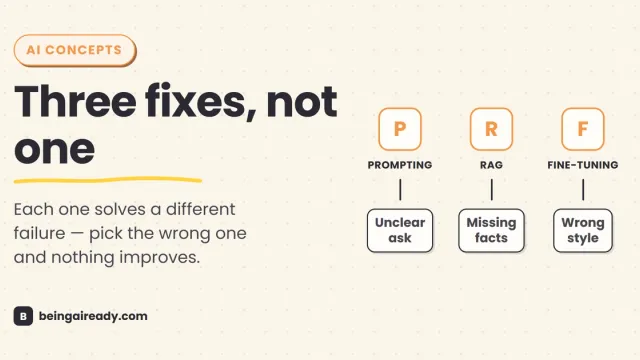
RAG vs Fine-Tuning vs Prompting: What Your Problem Needs
Prompting, RAG, and fine-tuning fix three different failures, not one. A concrete, no-hype framework for working out which one your AI problem actually needs.
How to Use AI at Work Without Getting Into Trouble
AI at work isn't risky because it's AI — it's risky because most people never learn the six specific ways it backfires. Here's the practical rulebook.