
StudyFetch
An AI study platform built around Spark.E, a tutor that answers questions, builds study plans, and quizzes students using only the materials they upload — lecture recordings, slides, and handwritten notes.
Visit website (opens in a new tab)Independent editorial listing. Features, pricing, and privacy terms can change; confirm details on the vendor site before buying or rolling out a tool.
What it does
StudyFetch is built around Spark.E, an AI tutor that answers questions using only the material a student has personally uploaded — lecture slides, recorded lectures, handwritten notes, or textbook pages — rather than drawing on general knowledge alone. On top of that chat interface, StudyFetch generates a study plan, flashcards, and practice quizzes from the same uploaded material, and even grades essays.
Distinctive features include Spark.E Visuals, which lets a student circle part of a diagram or slide to get it explained on the spot, live lecture recording and transcription, and SMS/iMessage access to Spark.E for quick questions away from a computer. StudyFetch reports more than 6 million users as of 2025 and raised an $11.5M Series A with participation from Owl Ventures and the College Board, but its privacy policy — which reportedly permits using uploaded content to train its own AI models — is worth reading closely before uploading anything sensitive.
Ideal users
- Students who want a tutor grounded specifically in their own course materials rather than general knowledge
- Learners who record lectures and want them transcribed into study material automatically
- Students who want an AI-generated study plan spanning multiple uploaded sources (slides, notes, textbooks)
Who should avoid it
- You're uncomfortable with a privacy policy that permits uploaded content to be used for AI/ML model training
- You need a tool with an explicit, documented FERPA or COPPA compliance statement
- The free tier's 10-chat, 1-study-set limit won't cover your workload and you're not ready to pay
Key features
- Spark.E, an AI tutor chat trained on a student's own uploaded materials
- Study plan builder that organizes material across multiple uploads
- Spark.E Visuals: circle part of a diagram or slide to get an explanation of just that part
- Lecture recording and transcription, including SMS/iMessage access to Spark.E
- Auto-generated flashcards, practice quizzes, and an essay grader
Pros / Cons
Pros
- Tutoring grounded in a student's actual course material rather than generic answers
- Broad feature set — flashcards, quizzes, essay grading, and lecture transcription — in one product
- Free tier exists to try core chat and study-set features before paying
- Backed by an $11.5M Series A (Owl Ventures, with College Board participating) and reports of 6M+ users in 2025
Cons
- Privacy policy reportedly permits using uploaded content and interactions to train StudyFetch's own AI/ML models
- No explicit FERPA or COPPA compliance statement found, unlike some competitors
- Free tier is quite limited (10 chats, 1 study set, 2 uploads, no video or audio)
- Published pricing has varied across sources — confirm current tiers directly before subscribing
Pricing
Free — Around $7.99/month (Base plan)
Free tier: 10 Spark.E chats, 1 study set, 2 uploads, no video/audio. Base plan (~$7.99/month): 100 chats, 100 study sets, 5 practice tests, 5 video/audio uploads. Premium (~$11.99/month, cheaper billed annually): unlimited use plus Live Lecture Assistant and handwritten-notes/photo upload. Exact current pricing has varied across sources — verify on studyfetch.com before purchasing.
Typical workflows
- A student uploads lecture slides, a recorded lecture, and handwritten notes for one class, then asks Spark.E questions grounded specifically in that material and generates a quiz to self-test before an exam.
- A student circles a diagram in Spark.E Visuals to get it explained, then texts a follow-up question to Spark.E over SMS while away from a computer.
Integrations
- SMS/iMessage access to Spark.E
- Web app with lecture recording and transcription
Privacy & security notes
StudyFetch's privacy policy reportedly permits using uploaded content, prompts, and interaction data to train and improve its AI/ML models; no explicit FERPA or COPPA compliance statement was found during research for this page. Students and parents who are cautious about this should avoid uploading material they don't want used this way and should review StudyFetch's current privacy policy directly before relying on it for sensitive coursework.
Frequently asked questions
What is Spark.E?
Spark.E is StudyFetch's AI tutor, built to answer questions using only the specific materials a student uploads rather than general knowledge, alongside study plans, flashcards, and quizzes generated from that same material.
Is StudyFetch free?
There's a free tier (10 Spark.E chats, 1 study set, 2 uploads), but video/audio uploads, the Live Lecture Assistant, and unlimited use require a paid Base or Premium plan.
Does StudyFetch use my uploaded notes to train its AI?
Its privacy policy reportedly allows uploaded content and interactions to be used to train and improve StudyFetch's AI/ML models — worth reviewing directly before uploading sensitive material.
How is StudyFetch different from Quizlet's Q-Chat?
StudyFetch is built around ingesting a wider range of a student's own material — including recorded lectures and handwritten notes — into one AI tutor and study-plan system, whereas Quizlet's AI features center more narrowly on flashcards and study sets.
Best alternatives
Quizlet
FreeThe most widely used flashcard and study-set platform, now layered with AI features — Q-Chat tutoring, Magic Notes, and image-based flashcard generation — on top of its free core study tools.
Khanmigo
PaidKhan Academy's AI tutor and teaching assistant, built to guide students toward answers with Socratic-style questioning across Khan Academy's own curriculum, plus a free companion product for teachers.
Related tutorials
33 Best AI Tools for Students in 2026 (Practical Guide)
The best AI tools for students in 2026, explained simply: research, notes, PDFs, citations, writing, math, slides, coding and focus.
12 Best AI Tools for Teachers in 2026 (That Save Time)
A plain-English guide to the best AI tools for teachers in 2026: lesson planning, grading, quizzes, and admin. No jargon, just what works and where to start.
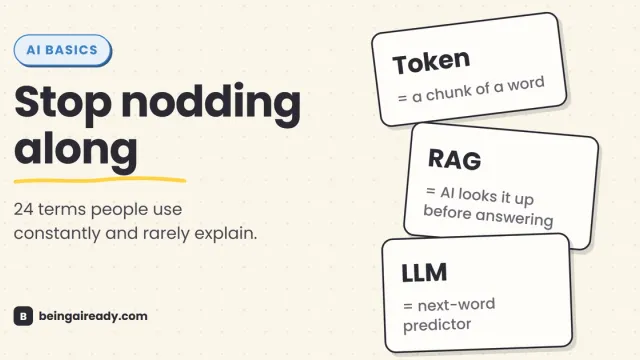
AI Terms Explained: A Plain-English Glossary of 24 Words
The 24 AI terms everyone uses but nobody defines — LLM, tokens, RAG, agents and more — explained in plain English, with analogies that actually stick.