
Photomath
A camera-based math solver, owned by Google, that scans handwritten or printed problems and returns step-by-step solutions and animated explanations rather than just a final answer.
Visit website (opens in a new tab)Independent editorial listing. Features, pricing, and privacy terms can change; confirm details on the vendor site before buying or rolling out a tool.
What it does
Photomath solves math problems from a photo: point a phone camera at a printed or handwritten problem and it returns a step-by-step solution rather than just a final number. It covers a wide range of math, from basic arithmetic through algebra, geometry, trigonometry, calculus, and statistics, and its free tier already includes unlimited solving.
The paid Photomath Plus tier removes ads, unlocks the full detailed steps behind each solution, and adds a library of more than 400 AI-powered animated tutorials that walk through problems the way a teacher might on a whiteboard. Photomath has been owned by Google since a 2023 acquisition and is increasingly tied into Google’s broader Search, Lens, and Gemini AI products, though it remains a standalone app focused specifically on math.
Ideal users
- Students who want to check their work or understand the steps behind a math answer, not just get the answer
- Learners working through arithmetic, algebra, geometry, trigonometry, calculus, or statistics problems
- Anyone who prefers pointing a camera at a handwritten problem over typing it into a chatbot
Who should avoid it
- You need help with subjects outside math
- You want the animated, in-depth tutorials without paying — those require Photomath Plus
- You're relying on it to complete graded work without understanding the steps yourself
Key features
- Camera-based scanning of printed or handwritten math problems
- Free step-by-step solutions covering arithmetic through calculus and statistics
- Photomath Plus: 400+ AI-powered animated tutorials that walk through a problem the way a teacher would on a whiteboard
- Deeper explanations and contextual hints on Plus
Pros / Cons
Pros
- Core step-by-step solving is free and works well even without a subscription
- Camera input handles handwritten work, not just typed problems
- Backed by Google's infrastructure following its 2023 acquisition of the company
- Narrow focus on math means it's often more reliable for this one subject than a general-purpose AI chatbot
Cons
- Free tier shows ads and limits how many detailed steps are shown
- Doesn't help with non-math subjects at all
- Easy to misuse for copying answers instead of learning the underlying method
- Plus is a standalone subscription on top of anything else a student already pays for
Pricing
Free — $9.99/month or $69.99/year (Photomath Plus)
The free app gives unlimited step-by-step solutions with ads and a cap on detailed steps shown. Plus removes ads and unlocks full solution steps plus 400+ animated tutorials.
Typical workflows
- A student photographs a homework problem they're stuck on, gets a step-by-step breakdown of the method used to solve it, and works through an animated tutorial on Plus for a similar problem type before a test.
Integrations
- iOS and Android apps
- Integrated with Google's broader Search, Lens, and Gemini AI ecosystem following its acquisition
Privacy & security notes
Photomath operates under Google's privacy policy following Google's 2023 acquisition of the company; no math-specific student-data terms beyond Google's standard account and privacy policies were found during research for this page.
Frequently asked questions
Is Photomath free?
The core camera-based, step-by-step solver is free, with ads and a cap on how many detailed steps are shown. Photomath Plus removes ads and adds full steps plus 400+ animated tutorials.
Does Photomath only do algebra?
No — it covers arithmetic, algebra, geometry, trigonometry, calculus, and statistics.
Who owns Photomath?
Google, which acquired Photomath in a deal announced in 2022 and completed in 2023.
Can Photomath read handwritten problems?
Yes, its camera scanning works on handwritten equations as well as printed and typed problems.
Best alternatives
Khanmigo
PaidKhan Academy's AI tutor and teaching assistant, built to guide students toward answers with Socratic-style questioning across Khan Academy's own curriculum, plus a free companion product for teachers.
Quizlet
FreeThe most widely used flashcard and study-set platform, now layered with AI features — Q-Chat tutoring, Magic Notes, and image-based flashcard generation — on top of its free core study tools.
Related tutorials
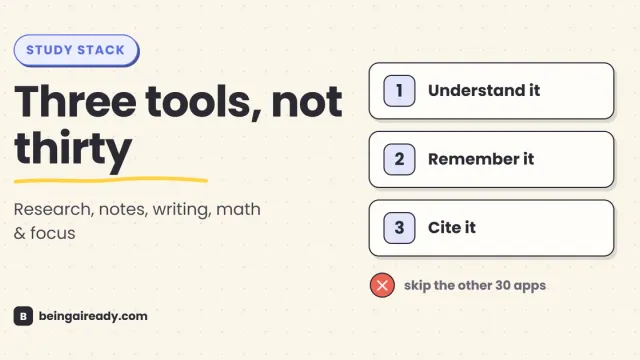
33 Best AI Tools for Students in 2026 (Practical Guide)
The best AI tools for students in 2026, explained simply: research, notes, PDFs, citations, writing, math, slides, coding and focus.
12 Best AI Tools for Teachers in 2026 (That Save Time)
A plain-English guide to the best AI tools for teachers in 2026: lesson planning, grading, quizzes, and admin. No jargon, just what works and where to start.
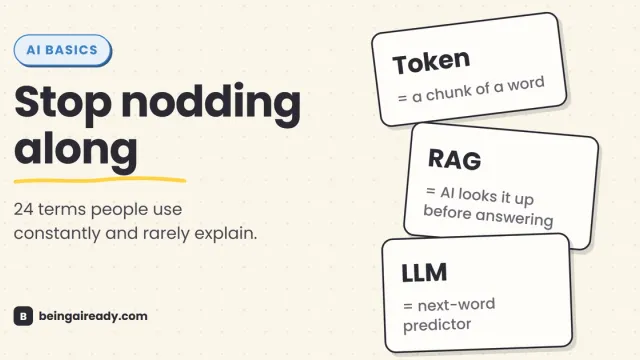
AI Terms Explained: A Plain-English Glossary of 24 Words
The 24 AI terms everyone uses but nobody defines — LLM, tokens, RAG, agents and more — explained in plain English, with analogies that actually stick.