
Google Stitch
A free, experimental Gemini-powered UI generation tool from Google Labs that turns prompts, sketches, or screenshots into UI screens and exportable code — and the direct successor to the acquired Galileo AI.
Visit website (opens in a new tab)Independent editorial listing. Features, pricing, and privacy terms can change; confirm details on the vendor site before buying or rolling out a tool.
What it does
Google Stitch is a free AI tool from Google Labs that generates user interface screens from a text prompt, a hand-drawn sketch, or a screenshot, powered by Gemini. It’s the direct successor to Galileo AI, a well-regarded text-to-UI generator that Google acquired in mid-2025 and rebuilt under its own branding — the same core idea, now backed by Google’s infrastructure and models rather than an independent startup.
Stitch can export its output as HTML/CSS code or, depending on which underlying model you use, copy a design directly into Figma with real editable layers. That combination — free access, a well-regarded design lineage, and a path into both code and Figma — makes it a reasonable option to try prompt-to-UI generation with no financial commitment. Its experimental Labs status is the tradeoff: there’s no guaranteed permanence, support, or SLA, so it’s better suited to exploration than to business-critical production work.
Ideal users
- Anyone who wants a free, no-commitment way to try prompt-to-UI generation
- Developers who want a fast visual starting point plus HTML/CSS output to hand to a coding assistant
- Teams already working inside the Google/Gemini ecosystem
- Former Galileo AI users looking for where that product went
Who should avoid it
- You need a stable, guaranteed-supported product for business-critical work — Stitch is still a Labs experiment
- You need direct React (or other framework) code export — Stitch currently exports HTML/CSS, not framework components
- You need enterprise support, an SLA, or guaranteed feature permanence
- You're using the most advanced model option, since Figma export isn't available with every underlying model
Key features
- Text, sketch, or screenshot-to-UI generation powered by Gemini models
- A 'Copy to Figma' export that preserves Auto Layout and editable layers (availability depends on which model you generate with)
- HTML/CSS code export using Tailwind classes
- Conversational, chat-based refinement of already-generated screens
- Both a faster standard mode and a more capable experimental mode with separate monthly generation limits
Pros / Cons
Pros
- Completely free as of mid-2026, with no paid tier yet
- Backed by Google and built on Gemini, with active ongoing development
- Produces both a visual design and exportable code from the same prompt
- A direct, actively maintained continuation of the well-regarded Galileo AI, rather than an abandoned product
Cons
- Still an experimental Google Labs product with no SLA or guaranteed longevity
- Monthly generation caps apply (reported around 350 standard-mode and 200 experimental-mode generations)
- Code export is HTML/CSS, not React or other production frameworks, so it needs a further conversion step
- Figma export isn't available with every model choice, including the more advanced Gemini 3 Pro option as of mid-2026
Pricing
Free — Free
No paid plan exists as of mid-2026 — Stitch is free while it remains a Google Labs experiment, subject to monthly generation caps (reported around 350 standard-mode and 200 experimental-mode generations). Google has signaled paid plans may arrive later in 2026, so treat current free access as temporary and re-check before relying on it long-term.
Typical workflows
- A developer describes a screen or feature to Stitch, refines it conversationally, then exports the HTML/CSS output as a reference for an AI coding assistant to convert into React or another framework.
- A designer generates a quick UI concept in Stitch, copies it into Figma to get real editable layers, and continues refining it there with Figma's full toolset.
Integrations
- Copy to Figma export (availability depends on the model used to generate)
- HTML/CSS export with Tailwind utility classes
- Built on Google's Gemini models (including a faster standard mode and a more advanced experimental mode)
Privacy & security notes
Stitch's own privacy notice states prompts and outputs aren't used to train models without explicit opt-in and that input data isn't retained beyond generation. That said, Google Labs experiments generally note that human reviewers may read and annotate interactions for quality purposes, with data disconnected from your Google Account first. Given the product's experimental status, avoid entering confidential or client-identifying information.
Frequently asked questions
Is Google Stitch the same as Galileo AI?
Effectively, yes. Galileo AI, a well-regarded text-to-UI generator, was acquired by Google in mid-2025 and rebuilt as Stitch inside Google Labs. Galileo AI's old domain now redirects to Stitch, and the underlying idea — generating UI screens from a prompt or sketch — carries over under Google's branding and Gemini models.
Is Google Stitch really free?
Yes, as of mid-2026 there's no paid plan — Stitch is entirely free while it's a Google Labs experiment, though it has monthly generation limits and Google has signaled paid tiers may arrive later in the year.
Can Stitch export production-ready code?
Not directly. Stitch exports HTML/CSS using Tailwind classes, which is a solid visual and structural reference, but it's not React, Vue, or another framework's components. Most teams feed that HTML output, along with a reference image, into a separate AI coding assistant to generate framework-specific code.
How is Stitch different from Figma Make?
Both turn a prompt into a UI screen, but Stitch is a free, standalone Google Labs product built on Gemini, while Figma Make is a paid feature that lives inside Figma itself and can pull from your team's existing component libraries. Stitch can export into Figma to continue there, but it isn't part of the Figma product itself.
Best alternatives
Figma
FreeThe industry-standard collaborative interface design tool, now layering AI directly onto its existing canvas through First Draft, Figma Make, and the newer Figma Agent.
Uizard
FreeA prompt-first AI UI design tool built for non-designers, turning text prompts, screenshots, or hand-drawn sketches into editable multi-screen mockups.
Related tutorials
How to Choose the Right AI Tool: A Buyer's Framework
A calm, no-hype framework for choosing the right AI tool for any task: define the job, judge the real criteria, run a cheap trial, and avoid costly switching.
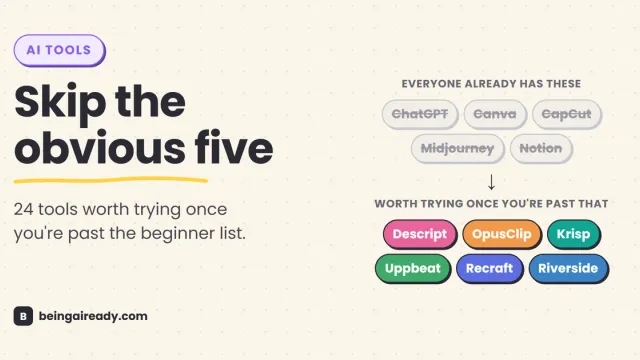
24 Underrated AI Tools for Content Creators in 2026
Skip the five AI tools every list recommends. Here are 24 lesser-known ones solo creators actually use, organized by where they fit your workflow.