
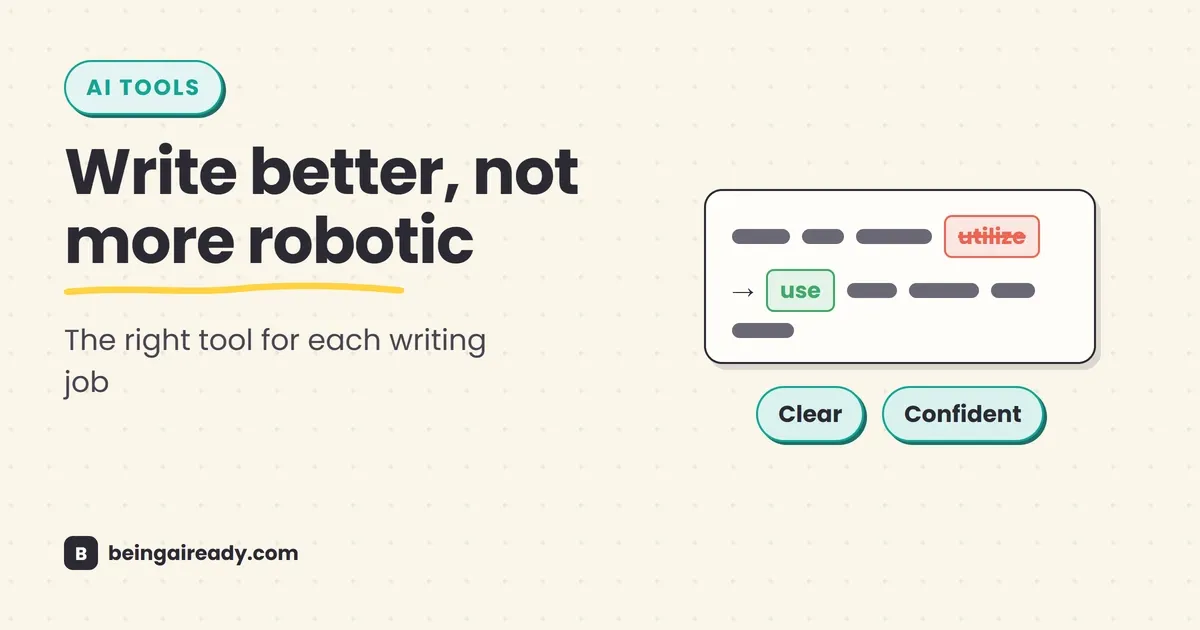
Best AI Writing & Grammar Tools in 2026: 10 Tools Compared
You add a grammar checker to your browser to catch the missing comma in a Gmail draft, and a year later the same word — tool — is being used to sell you a system that generates a 2,000-word marketing draft, a fiction assistant that develops characters, and an enterprise platform that enforces a company style guide across hundreds of employees. All of it now shelters under one label, “AI writing tools,” and that label has become almost uselessly broad.
These products all touch words, but they solve genuinely different problems, and reaching for the wrong one makes writing slower rather than faster. A novelist does not need a marketing campaign engine. A customer-support team does not need a manuscript critique. A person who mainly wants cleaner emails should not be paying for a platform built around content pipelines, brand governance, and automated workflows.
The practical question is not, “Which AI writer is the most powerful?” It is, “Where does my writing process keep getting stuck?”
For some people, the answer is grammar. For others, it is turning a rough sentence into a clear one, keeping a long document consistent, writing in a second language, formatting academic prose, or producing routine campaign assets without losing the brand voice.
This guide compares the best AI writing and grammar tools in 2026 by those actual jobs. It does not assume that generating more text is automatically better. In many cases, the most valuable tool is the one that changes the fewest words while helping the right sentence land properly.
Quick answer: Grammarly is the best all-round AI writing and grammar tool for most people. ProWritingAid is the better deep editor for books and long documents. LanguageTool is the strongest multilingual grammar-first alternative. Wordtune is excellent for fast sentence rewrites, while Hemingway Editor Plus is best for cutting clutter and improving readability. QuillBot offers a broad student-friendly toolkit. Paperpal is the specialist choice for academic writing, Sudowrite for fiction, Jasper for marketing production, and WRITER for large organizations that need brand rules and governance. Prices and plan limits were checked on August 5, 2026; regional pricing, taxes, promotions, and feature limits can change.
The best AI writing and grammar tools at a glance
| Tool | Best for | Free plan | Paid plan starts at* | Main strength | Main compromise |
|---|---|---|---|---|---|
| Grammarly | Everyday writing and proofreading | Yes | $12/month billed annually | Strong corrections across many apps | Can over-smooth deliberate style |
| ProWritingAid | Books and long-form editing | Yes | $10/month billed annually | Deep reports and manuscript tools | English only; more complex interface |
| LanguageTool | Multilingual grammar checking | Yes | About $11/month, localized | 30+ languages and broad integrations | English suggestions can feel less polished than Grammarly |
| Wordtune | Rewriting sentences quickly | Yes | $6.99/month billed annually | Clear alternative phrasing with low friction | Less useful for deep document analysis |
| Hemingway Editor Plus | Clarity and readability | Yes | $8.33/month billed annually | Makes wordy prose easier to read | Its “simpler is better” bias does not suit every style |
| QuillBot | Students and paraphrasing | Yes | Localized pricing | Wide toolkit in one place | Easy to over-paraphrase and lose precision |
| Paperpal | Academic and research writing | Yes | $12/month billed annually | Academic language, checks, and integrations | Too specialized for ordinary business writing |
| Sudowrite | Fiction brainstorming and drafting | Trial | $10/month | Story-aware creative assistance | Not a conventional grammar checker |
| Jasper | Marketing teams and repeatable campaigns | Trial | $59/month billed annually | Brand voice plus marketing workflows | Expensive for individual writers |
| WRITER | Enterprise brand control and governed writing | Trial | Not publicly displayed | Style rules, grounding, permissions, governance | Considerably more platform than most writers need |
*USD pricing shown where the vendor publishes a clear US price. “Billed annually” means the effective monthly cost requires a one-year commitment.
How we compared these tools
There is no honest single benchmark for this category. A tool can be excellent at correcting punctuation and mediocre at developing an argument. Another can generate fluent campaign copy but be awkward as an always-on proofreader.
The comparison therefore uses six practical criteria:
- Correction quality: Does the tool catch grammar, spelling, punctuation, agreement, and usage problems without creating new ones?
- Rewrite control: Can you shorten, clarify, change tone, or improve fluency without surrendering the meaning of the sentence?
- Workflow fit: Does it work where people already write, including browsers, email, Microsoft Word, Google Docs, desktop apps, Scrivener, or Overleaf?
- Specialization: Does it understand the conventions of a particular job, such as academic writing, fiction, marketing, or enterprise communications?
- Value: Is the paid plan meaningfully better than the free one, and is the subscription justified by repeated use rather than an impressive demo?
- Control and trust: Can the writer understand, reject, and govern suggestions? For teams, are style guides, permissions, data controls, and auditability available?
This is a use-case ranking, not a claim that one model produced the prettiest paragraph in a one-off prompt. Writing quality is contextual. A good suggestion preserves the writer’s intention; a bad one can be grammatically correct and still make the sentence worse.
1. Grammarly: best overall for everyday writing
Best for: Professionals, students, freelancers, and teams that write across email, browsers, documents, and desktop apps.
Grammarly remains the easiest default recommendation because it solves the most common problem with the least disruption: it sits where you already write and points out issues as they appear.
The free plan covers spelling, grammar, and tone signals, with a limited allowance for AI prompts. Grammarly Pro adds full-sentence rewrites, tone adjustment, fluency support, personalized suggestions, plagiarism checking, AI-text detection, and a larger monthly generative-AI allowance. The current US price is $12 per month when billed annually or $30 month to month.
Its real advantage is not that it can generate a blog post. General AI assistants can do that. The advantage is distribution. Grammarly works across browsers, desktop applications, Microsoft Office, Google Docs, mobile devices, email, and many common web forms. A tool used on every message often saves more time than a theoretically more capable tool that requires copying text into another tab.
Where Grammarly is strongest
- Fast, low-friction correction during ordinary work
- Good explanations for many grammar and punctuation changes
- Useful tone and clarity signals for email and workplace communication
- Sentence rewrites that are easy to compare with the original
- Broad platform support
- A free tier that is sufficient for light proofreading
Where Grammarly falls short
Grammarly has a recognizable editorial preference: direct, concise, standard professional English. That is useful for a sales email and less obviously useful for fiction, opinion writing, dialogue, or a personal essay built around rhythm and voice.
It can also encourage unnecessary intervention. A sentence may be correct but still receive a clarity or tone suggestion. Accepting every green, yellow, or purple underline is not editing; it is outsourcing taste to a system with a house style.
The AI-detection feature should also be treated as a signal, not a verdict. AI detectors can produce false positives and should not be used as proof of misconduct without other evidence.
Who should choose it
Choose Grammarly when your writing happens in many places and your main goal is to make everyday communication cleaner with minimal setup. It is the best single subscription for someone who writes emails, reports, proposals, messages, and web content but does not need a specialist authoring environment.
Verdict: The best overall choice, not because it is the most ambitious tool, but because it is the one most likely to be useful several times a day.
2. ProWritingAid: best for long-form editing and authors
Best for: Novelists, book authors, editors, and anyone revising long documents.
ProWritingAid is closer to an analytical editor than a conventional spellchecker. It offers more than 25 writing reports covering areas such as readability, pacing, repetition, transitions, sentence structure, passive voice, overused words, sensory language, dialogue, and style.
That depth makes it especially valuable once a draft already exists. Grammarly is usually better for cleaning a sentence while it is being typed. ProWritingAid is better when you have a chapter and want to understand the patterns across it.
The product has also moved further into story development. Its current feature set includes chapter critique, manuscript analysis, a virtual beta reader, story-focused AI features, author comparisons, and tools for planning and revising fiction. It integrates with Word, Google Docs, Scrivener, browser extensions, and desktop writing environments.
The free plan checks up to 500 words at a time and limits report runs and rewrites. Premium currently costs $10 per month billed annually or $30 monthly. Premium Pro raises the AI and critique allowances and costs $12 per month billed annually or $36 monthly. Lifetime licences remain available, although the high upfront cost only makes sense for people who expect to use the software for years.
Where ProWritingAid is strongest
- Detailed analysis of recurring habits across long work
- Strong support for fiction and manuscript revision
- Scrivener integration, which matters to many authors
- Reports that teach rather than simply replace
- Custom style guidance and terminology controls
- Lifetime payment option for committed long-term users
Where ProWritingAid falls short
The interface asks more of the writer. Dozens of reports can be illuminating, but they can also become another way to avoid making the hard editorial decision. A score is not the same as a better chapter.
ProWritingAid is also English-only, although it supports several regional varieties of English. Writers working across multiple languages should look at LanguageTool instead.
Its most advanced story-analysis features may require separate credits or higher plans. That makes the product harder to evaluate from the headline subscription price alone.
Who should choose it
Choose ProWritingAid when you regularly revise chapters, books, long reports, or substantial articles and want to find patterns that a sentence-level checker misses. It is particularly well matched to fiction writers who use Scrivener.
It is the strongest deep editor in this list, and it rewards writers who want to understand their own habits rather than just clear the underlines.
3. LanguageTool: best multilingual grammar checker
Best for: Multilingual writers, international teams, and people who want a grammar-first Grammarly alternative.
LanguageTool’s clearest advantage is language coverage. It supports more than 30 languages and offers browser extensions, desktop apps, email add-ons, and plugins for tools including Google Docs, Microsoft Word, Apple Pages, LibreOffice, and Thunderbird.
The free version covers basic grammar, spelling, punctuation, and a limited number of sentence rewrites. Premium adds a much larger set of style and grammar checks in its best-supported languages, longer text fields, unlimited AI paraphrasing, and a personal style guide. Team plans add shared dictionaries, style rules, and user administration.
LanguageTool’s official pricing is localized and can include taxes. When checked for this guide, the individual plan was displayed at roughly $11 per month, but buyers should treat that as an indication rather than a universal price.
Where LanguageTool is strongest
- Genuine multilingual support rather than translation bolted onto an English editor
- Good coverage across browsers, documents, email, and desktop tools
- Personal and team style guides
- Large text allowance on Premium
- A capable free plan for ordinary correction
- A more language-neutral choice for international organizations
Where LanguageTool falls short
Language support is not equally deep in every language. The vendor itself highlights more extensive Premium checks for English, German, French, Spanish, Dutch, Polish, and Portuguese. Someone who sees “30+ languages” should not assume identical correction depth across all of them.
Its English rewriting and tone guidance can also feel less polished than Grammarly’s in some business contexts. LanguageTool is at its best when the priority is broad correction and multilingual consistency, not a highly guided English writing experience.
Who should choose it
Choose LanguageTool when you write in more than one language, work with an international team, use LibreOffice or Thunderbird, or simply want a less English-centric proofreading tool. It is the best multilingual grammar checker of the ten, and the most sensible Grammarly alternative for anyone whose work does not happen entirely in English.
4. Wordtune: best for quick sentence rewrites
Best for: People who know what they want to say but dislike the sentence they have written.
Wordtune is built around a small, common moment: the sentence is technically fine, but it is not quite landing. You want it shorter, clearer, more fluent, or phrased in a way you would not have reached on the first attempt.
The free plan includes unlimited spelling and grammar checks, plus limited daily rewrites and AI suggestions. The Advanced plan currently costs $6.99 per month billed annually and raises the daily allowances. The Unlimited plan costs $9.99 per month billed annually and removes limits on rewrites and summarization while adding vocabulary, clarity, and fluency improvements.
The appeal is speed. Wordtune presents alternatives without burying the writer in a full analytical dashboard. It is particularly useful for email, support replies, social posts, short explanations, and second-language English.
Where Wordtune is strongest
- Fast alternative phrasing
- Low learning curve
- Useful controls for clarity, fluency, and vocabulary
- A relatively affordable annual plan
- Strong fit for short-form professional communication
- Unlimited basic grammar and spelling checks on the free plan
Where Wordtune falls short
It is not a deep editor. It will not diagnose a 40-page report with the same granularity as ProWritingAid, enforce a sophisticated company language system like WRITER, or manage a marketing production pipeline like Jasper.
Its value also drops if you already use a general AI assistant well. A carefully instructed chatbot can generate ten alternatives to a sentence. Wordtune’s case is convenience: it is faster and more integrated for this narrow task.
Who should choose it
Choose Wordtune when rewriting is the bottleneck. It is especially good for people who frequently pause over a sentence and think, “There must be a cleaner way to say this.” As a focused rewriting assistant it has little competition here, and it is one of the better-value paid options for an individual professional.
5. Hemingway Editor Plus: best for clarity and readability
Best for: Bloggers, business writers, educators, and anyone whose drafts tend to become dense or wordy.
Hemingway has always had a simple editorial opinion: readable writing is usually direct writing. The classic editor highlights hard-to-read sentences, passive voice, adverbs, and phrases with simpler alternatives. It also gives the document a reading-grade score.
Hemingway Editor Plus adds AI rewrites, advanced grammar fixes, tone and length controls, document review, and synonym suggestions. The Individual 5K plan currently costs $8.33 per month billed annually, or $10 on a monthly plan, with 5,000 AI sentence rewrites per month. The 10K plan doubles the rewrite allowance. The free web editor still provides the familiar readability highlights without requiring the AI subscription, and a separate one-time desktop version is available without the newer AI features.
This is the tool to use when the problem is not correctness but friction. A long sentence may be grammatical and still force the reader to work too hard. Hemingway is good at making that visible.
Where Hemingway is strongest
- Immediate readability feedback
- Excellent at revealing long, tangled sentences
- Clear emphasis on active, concrete prose
- A useful free editor even without AI
- Simple annual pricing
- Markdown and document workflows in the desktop product
Where Hemingway falls short
Readability is not the only goal in writing. Legal analysis, academic argument, literary prose, technical documentation, and carefully paced narrative may legitimately use longer sentences and specialized terms. A lower grade level is not automatically a higher-quality piece of writing.
Hemingway also tends to frame complexity as a local sentence problem. Sometimes the real issue is that the argument is poorly organized, an example is missing, or the writer has not decided what the paragraph is trying to do.
Who should choose it
Choose Hemingway when you routinely overwrite, use too much jargon, or need content that a general audience can scan quickly. It works particularly well as a second pass after the ideas are settled, and nothing else here is as good at making dense prose easier to read — provided you treat its rules as prompts rather than commandments.
6. QuillBot: best all-in-one toolkit for students
Best for: Students and occasional writers who want paraphrasing, grammar checking, summarization, citations, and related tools in one account.
QuillBot has expanded far beyond its original paraphraser. Its current product menu includes a grammar checker, paraphraser, summarizer, citation generator, translator, plagiarism checker, AI detector, AI chat, and project workspace.
That bundle is the point. A student moving between lecture notes, an essay draft, a citation list, and a summary may prefer one broad toolkit to four separate subscriptions.
QuillBot offers a free tier and Premium subscriptions on monthly and longer billing cycles. Pricing is localized by region, so the company directs users to the current upgrade page rather than publishing one universal figure in its help documentation.
Where QuillBot is strongest
- Broad set of writing utilities in one place
- Strong paraphrasing workflow
- Useful summarization and citation helpers
- Accessible to students and occasional users
- Browser and document integrations
- Easy to try before paying
Where QuillBot falls short
Paraphrasing is deceptively risky. A sentence can become smoother while becoming less precise. Technical terms can be replaced with near-synonyms that are not actually equivalent. A cautious academic sentence can become more certain than the evidence allows.
There is also an integrity issue. Rewriting copied material does not make the underlying idea original. Students should not use paraphrasing software to disguise plagiarism, evade course rules, or create citations they have not opened and verified.
QuillBot’s breadth also means it is not always the deepest tool in each category. Grammarly is the smoother everyday checker; Paperpal is more academically specialized; Wordtune offers a cleaner rewrite-focused experience.
Who should choose it
Choose QuillBot when you need a general writing utility belt, especially for study and coursework, and are willing to check every paraphrase against the original meaning. It is the most convenient all-in-one student toolkit of the group, though its easiest feature to misuse — paraphrasing — is also its signature one.
7. Paperpal: best for academic and research writing
Best for: Researchers, postgraduate students, academics, and people preparing journal manuscripts or technical papers.
Academic writing is not ordinary business writing with longer words. It has its own conventions around caution, evidence, terminology, consistency, citations, structure, and submission requirements. Paperpal is designed around that context.
Its tools cover academic language correction, rewriting, translation, research and citation support, plagiarism checks, consistency checks, and submission-readiness reviews. It works through a web editor, Microsoft Word add-in, browser extensions, Google Docs, and Overleaf support.
Paperpal Prime currently costs $12 per month billed annually or $25 monthly. The higher Pro plan costs $29 per month billed annually or $59 monthly and is positioned for higher-stakes research and clinical documents.
Where Paperpal is strongest
- Suggestions oriented toward academic English
- Useful for researchers writing in a second language
- Word, Google Docs, browser, and Overleaf workflows
- Citation and research-oriented features
- Submission checks that ordinary grammar tools do not provide
- A clearer fit for theses and manuscripts than general-purpose editors
Where Paperpal falls short
Most people do not need it. Its specialist checks and academic tone can make ordinary writing stiff. A product description, customer email, newsletter, or opinion essay is usually better served by a less formal tool.
Citation assistance also requires human verification. No AI system should be trusted to establish that a paper exists, that a quotation is accurate, or that a source supports the claim attached to it. Open the source, read the relevant passage, and check the metadata yourself.
Who should choose it
Choose Paperpal when the conventions of academic publishing are central to the work rather than an occasional requirement. For researchers and academic authors it is the best specialist writing assistant here; for almost everyone else it is unnecessary.
8. Sudowrite: best for fiction generation and story development
Best for: Fiction writers who want help brainstorming, extending scenes, exploring alternatives, or developing a story world.
Sudowrite is not primarily a grammar checker. It belongs in this comparison because “AI writing” increasingly includes systems that work with narrative context rather than individual sentences.
Its features are designed around fiction: story planning, character and world information, scene generation, description, brainstorming, rewriting, and story-aware chat. The system can use the project’s story information to retrieve relevant details before generating a passage, reducing the amount of context the writer must repeat.
Current displayed plans start at $10 per month for Hobby & Student, $22 for Professional, and $44 for Max, with different AI credit allowances. A free trial is available, and the checkout may vary with the selected billing cycle.
Where Sudowrite is strongest
- Fiction-specific interface and vocabulary
- Story-aware assistance rather than generic prompting
- Useful for alternatives, description, and scene development
- Can help writers move past a stalled passage
- Better creative workflow than a blank chatbot window
Where Sudowrite falls short
Generated prose can still be generic, over-explained, or tonally inconsistent. The system may produce a serviceable continuation that solves the immediate blank-page problem while moving the story in a less interesting direction.
There is also a difference between helping a writer discover a scene and writing the scene for them. The more prose the system generates, the more editorial work is required to make the result belong to the book.
Writers should also check publisher, contest, client, and platform rules around AI-assisted work. Policies differ, and they can change.
Who should choose it
Choose Sudowrite when fiction is the job and ideation is the bottleneck. Do not buy it merely because you occasionally write a short story; a general assistant may be enough for that. It is the best purpose-built creative partner for fiction in this list, but no substitute for the choices that make a story worth reading.
9. Jasper: best for marketing teams and repeatable content production
Best for: Marketing teams that need repeatable, on-brand assets across campaigns and channels.
Jasper has moved beyond the old “type a prompt, receive copy” model. Its 2026 product is a marketing platform built around brand voice, company knowledge, audiences, workflows, content production, and specialized agents.
The Pro plan currently costs $59 per seat per month when billed annually or $69 monthly. It includes the Canvas content environment, agents for core marketing workflows, two brand voices, five knowledge assets, and three audience profiles. Business pricing is custom and adds broader governance, customization, APIs, and scaled content operations.
This makes Jasper difficult to compare with Wordtune or Grammarly. It is not mainly trying to fix your sentence. It is trying to help a marketing function produce a family of related assets with shared context and fewer repeated instructions.
Where Jasper is strongest
- Structured marketing workflows
- Brand voice and audience context
- Reusable company knowledge
- Campaign and content production at team scale
- More purpose-built for marketing than a general chatbot
- Business controls for larger organizations
Where Jasper falls short
The price is hard to justify for an individual writer who wants occasional drafting help. General assistants can write emails, outlines, landing-page variants, and social posts for much less, although they may require more prompting and manual brand control.
Jasper can also make it easy to produce content before the underlying idea is strong enough. A polished content pipeline does not create original research, customer insight, a defensible point of view, or a useful product.
Who should choose it
Choose Jasper when multiple people repeatedly create related marketing assets and brand consistency is a real operational problem. It is the best marketing-focused writing platform in this list, and comfortably the most overbuilt and overpriced for ordinary proofreading or solo drafting — so skip it when you are one person looking for a better sentence.
10. WRITER: best for enterprise brand governance
Best for: Large organizations that need controlled, compliant, on-brand writing across teams and systems.
WRITER is now an enterprise agent platform rather than a simple writing assistant. Its relevance here is governance: personality profiles, style guides, approved terminology, data grounding, connectors, roles, permissions, workflows, and organizational controls.
The Starter plan supports up to five users, a limited number of playbooks, a team personality profile, and basic connectors. WRITER offers monthly or annual per-seat pricing with fixed credit limits, but the current public page does not display a simple price. Enterprise plans are quoted and add wider deployment, governance, connectors, permissions, and support.
The platform says customer data remains customer-owned, follows a zero-data-retention approach, and is not used to train or improve its models by default. For a regulated or brand-sensitive organization, those controls may matter more than whether one generated paragraph sounds marginally better.
Where WRITER is strongest
- Company-wide style and terminology rules
- Grounding in approved organizational knowledge
- Roles, permissions, workflows, and auditability
- Enterprise security and governance options
- Brand controls that can be applied across generated output
- A better fit for operational consistency than consumer writing apps
Where WRITER falls short
It is too much platform for most readers of this guide. A freelancer, student, novelist, or ten-person company may spend more effort configuring governance than they would save in editing.
The lack of a straightforward public price also makes casual evaluation difficult. This is a product to buy through a defined organizational use case, not because someone liked its text generator in a demo.
Who should choose it
Choose WRITER when inconsistent terminology, compliance risk, permissions, and brand governance are expensive problems across a large organization.
It is the strongest enterprise governance option of the ten — and, for an individual writer, the least relevant choice on the page.
What about ChatGPT, Claude, and Gemini?
General AI assistants are very capable writing partners. They can outline, draft, critique, restructure, translate, explain edits, create alternatives, and work through several rounds of revision in conversation.
They are often better than dedicated tools for tasks such as:
- turning rough notes into a structured first draft;
- testing several possible arguments;
- reorganizing a long section;
- interviewing you to uncover missing detail;
- adapting one piece for several audiences;
- explaining why a paragraph feels weak;
- creating a custom editing checklist;
- comparing two versions and describing the trade-offs.
They are usually worse at the quiet, continuous work of proofreading everything you type across many applications. You have to provide the text, explain the task, inspect the rewrite, and move the result back into your document. A dedicated checker reduces that friction.
The sensible division of labour is often:
- Use a general assistant for thinking, structure, and substantial revision.
- Use a dedicated grammar or style tool for the final sentence-level pass.
You do not necessarily need both as paid subscriptions. Start with the free version of a grammar tool and the general assistant you already use. Pay only when a repeated limit interrupts real work.
Which tool should you choose?
For emails, reports, and everyday professional writing
Choose Grammarly. It has the best balance of correction, rewriting, tone support, and availability across apps.
Choose LanguageTool instead when multilingual writing is central or your preferred apps are better covered by its integrations.
For novels, books, and long documents
Choose ProWritingAid for analysis and editing.
Add Sudowrite only when you also want fiction generation, scene development, and story-aware brainstorming. The two tools overlap at the edges but solve different core problems.
For students
Choose QuillBot for a broad set of everyday study tools.
Choose Paperpal for a thesis, research manuscript, or serious academic publishing workflow.
Use neither to disguise copied work or manufacture sources.
For people writing in English as a second language
Choose LanguageTool when you write in several languages.
Choose Wordtune when the main issue is making English phrasing sound more natural.
Choose Paperpal when the context is academic English.
For bloggers and clear business writing
Choose Hemingway Editor Plus when wordiness is the recurring problem.
A strong low-cost workflow is to draft in your normal editor, run Grammarly or LanguageTool for correctness, and use the free Hemingway editor for a final clarity pass.
For marketing teams
Choose Jasper when repeatable campaign production, brand voice, audiences, and shared company knowledge justify a dedicated platform.
A small team that mainly needs proofreading should stay with Grammarly or LanguageTool. Do not buy a production system to solve a punctuation problem.
For large organizations
Choose WRITER when the actual requirements include approved terminology, compliance, governance, data grounding, permissions, and scalable workflows.
This is a procurement and operating-model decision, not an individual productivity purchase.
The three tool stacks that make sense
Most people do not need a “writing stack.” They need one tool they remember to use. Still, three combinations are defensible when the work is frequent enough.
The everyday professional stack
- A general assistant for outlines and substantial rewrites
- Grammarly Free or Pro for live correction
- Hemingway’s free editor for important public-facing pieces
This covers thinking, correctness, and clarity without paying for three full subscriptions.
The author stack
- Scrivener or another long-form writing environment
- ProWritingAid for line editing and pattern analysis
- Sudowrite only when creative generation is genuinely useful
The important word is “only.” Many authors need an editor, not another source of prose.
The academic stack
- Paperpal for academic language and submission checks
- A primary research database for source discovery
- A reference manager for citations
- A general assistant for explanations and structural critique, used within institutional rules
No AI citation generator should replace opening the source and verifying that it says what you claim.
How to use AI writing tools without losing your voice
The most common failure is not an obvious factual error. It is gradual sameness. The writing becomes smoother, more balanced, more explicit, and less recognizably yours.
A few habits prevent that.
1. Ask for diagnosis before replacement
Instead of selecting “rewrite paragraph,” ask what is unclear, repetitive, unsupported, or poorly ordered. A diagnosis leaves the decision with the writer.
A useful instruction is:
Identify the three places where a reader may hesitate. Explain the problem and offer two local fixes for each. Do not rewrite the full passage.
2. Edit in small sections
A whole-document rewrite encourages the system to normalize everything at once. Work paragraph by paragraph or sentence by sentence when voice matters.
3. Keep a short voice sheet
Write down five to ten specific rules, such as:
- Prefer concrete examples to abstract claims.
- Keep occasional sentence fragments.
- Avoid corporate transitions such as “Moreover” and “In today’s landscape.”
- Do not remove dry humor.
- Use contractions.
- Do not turn cautious claims into certainty.
- Preserve regional spelling and terminology.
Specific constraints work better than “make it sound human.”
4. Compare every rewrite with the original meaning
Check names, numbers, qualifications, causes, and degree of certainty. A rewrite can improve flow while quietly changing the claim.
Watch especially for shifts from:
- “may” to “will”;
- “is associated with” to “causes”;
- “some customers” to “customers”;
- “one reason” to “the reason”;
- “we observed” to “we proved.”
5. Reject technically correct suggestions
A tool cannot know that the repetition is deliberate, the fragment is rhythmic, the unusual word is a term of art, or the passive voice is appropriate because the actor is unknown — which is why the right acceptance rate is not 100%.
6. Read the final version aloud
This remains one of the fastest quality checks. Awkward rhythm, inflated transitions, repeated sentence shapes, and unnatural formality become easier to hear than to see.
What AI writing tools still get wrong
They can change facts while “improving” prose
Generative rewrites are not neutral transformations. They may add specificity, remove a qualification, invent an example, or make a sentence more confident than the evidence supports.
They reward conventional writing
Most systems are better at producing clear standard prose than preserving unusual voice. That is not a flaw when you are writing instructions. It is a problem when the unusual voice is the point.
They confuse readability with quality
Shorter sentences and simpler words often help, but a complex idea sometimes needs a complex sentence. A reading-grade score cannot judge whether the argument is true, original, fair, or worth reading.
They cannot verify their own citations reliably
A polished citation can be fabricated, incomplete, or attached to a claim the source does not support. Citation generators are formatting aids, not evidence engines.
They cannot take responsibility
The writer remains accountable for accuracy, confidentiality, attribution, legal risk, and the effect of the message. “The tool suggested it” is not a defence that matters to a client, reader, editor, teacher, or regulator.
Privacy: what not to paste into a writing tool
Writing tools often see material before it is public: customer complaints, contracts, medical information, financial results, product plans, unpublished manuscripts, legal correspondence, employee reviews, and private messages.
Before pasting sensitive text, check:
- whether the plan uses customer content for model training;
- whether training is on or off by default;
- how long the provider retains prompts and documents;
- whether administrators can control retention and sharing;
- where data is processed;
- whether the product offers enterprise agreements or a data-processing addendum;
- whether your employer or client has approved the tool.
For confidential work, a business or enterprise plan with explicit data terms is usually more appropriate than a free consumer account. When the sensitivity is high and the policy is unclear, do not paste the text.
Are AI writing tools worth paying for?
A paid writing tool is worth it when it removes repeated friction from real work.
A simple test is to track one month:
- Note how often you open the tool or accept a useful suggestion.
- Estimate the time saved on a recurring task.
- Identify whether the tool improved an outcome that matters: fewer review cycles, faster client replies, clearer documentation, fewer corrections from an editor, or more consistent team language.
- Cancel it if the value is mainly the feeling that you could use it.
For many people, the free plans are enough. Grammarly Free, LanguageTool Basic, Wordtune Basic, QuillBot Free, and the free Hemingway editor cover a surprising amount of everyday work.
The paid upgrade becomes reasonable when limits repeatedly interrupt a workflow, not when the pricing page presents a long list of features.
The bottom line
There is no single “best AI writer” because writing is not one task.
Grammarly is the best default for most people. It improves everyday writing where the writing already happens.
ProWritingAid is the stronger choice for authors and long-form editors who want to understand patterns across a manuscript.
LanguageTool is the best multilingual option. Wordtune is the cleanest sentence rewriter. Hemingway Editor Plus is the most useful tool for cutting clutter. QuillBot gives students the broadest utility bundle, while Paperpal is the academic specialist. Sudowrite is purpose-built for fiction. Jasper and WRITER make sense only when writing has become a team system involving campaigns, brand context, governance, and repeatable workflows.
The grounded way to choose is to start with the bottleneck, not the feature list. Use a free plan on real work for two weeks. Notice what it changes, what it gets wrong, and whether you keep reaching for it. Then pay for the smallest tool that solves the recurring problem.
Good writing software should make the writer more capable and the writing more precise. It should not make every writer sound like the software.
Source notes
Product features and prices in this article were checked against official vendor pages on August 5, 2026, including:
- Grammarly Plans and Grammarly Pro
- ProWritingAid Features, Pricing, Integrations, and Help Centre
- LanguageTool Premium
- Wordtune Plans
- Hemingway Editor Plus and Hemingway billing documentation
- QuillBot Premium and Help Center
- Paperpal Pricing and Help Center
- Sudowrite product documentation and 2026 pricing materials
- Jasper Plans & Pricing
- WRITER Plans, product updates, and support documentation
Pricing may vary by country, tax treatment, promotion, billing cycle, and currency. Product limits can change without notice.
Frequently asked questions
What is the best AI writing tool in 2026?
Grammarly is the best all-round choice for most people because it combines dependable everyday corrections, rewrites, tone guidance, and broad app support. It is not the best at every specialist job, however. ProWritingAid is stronger for deep long-form editing, Paperpal is better suited to academic writing, Sudowrite is built for fiction, and Jasper or WRITER make more sense for organized marketing teams.
What is the best free AI grammar checker?
Grammarly, LanguageTool, Wordtune, QuillBot, and ProWritingAid all offer useful free plans, but they impose different limits. Grammarly is the simplest free option for everyday English corrections. LanguageTool is especially useful for multilingual writing. ProWritingAid's free plan is more analytical but checks only 500 words at a time. The best free choice depends on whether you need correction, rewriting, or detailed feedback.
Is Grammarly better than ChatGPT for grammar?
For live proofreading while you type, usually yes. Grammarly is designed to flag individual issues inside browsers, email, documents, and desktop apps, so it is faster and more consistent for routine correction. ChatGPT is more flexible when you want to discuss a passage, restructure an argument, generate alternatives, or explain why a change works. Many writers use a dedicated checker for the final pass and a general assistant for larger revisions.
Which AI writing tool is best for students?
QuillBot is a practical general choice for paraphrasing, summarizing, citations, and grammar support. Paperpal is the stronger specialist for research papers, theses, and journal-style academic English. Students should still follow their institution's AI policy, disclose assistance when required, and verify every citation rather than assuming a generated reference is genuine.
Which AI writing tool is best for authors?
ProWritingAid is the best editing-focused option for novelists and other long-form authors because of its detailed reports, Scrivener support, chapter critique, and manuscript-oriented features. Sudowrite is the stronger choice when the need is creative generation, scene development, brainstorming, and story-aware drafting rather than line editing alone.
Can AI writing tools preserve my writing style?
They can help, but only when you give them constraints and reject suggestions that flatten your voice. Use AI for diagnosis and alternatives rather than automatic replacement. Keep a short voice guide, edit in small sections, compare changes against the original, and preserve intentional fragments, rhythm, humor, terminology, and regional language.
Related articles
Best AI Coding Assistants for Beginners in 2026
A practical comparison of the best AI coding assistants for beginners, including GitHub Copilot, Replit, Cursor, Antigravity, Amazon Q, and JetBrains AI.
Best AI Meeting Assistants in 2026 (Ranked & Compared)
The best AI meeting assistants in 2026, ranked by notes, integrations, workflow automation, value, privacy controls, and fit for real teams.
Best AI Resume Builders in 2026: 8 Tools Ranked and Compared
The best AI resume builders in 2026, ranked for writing quality, ATS-friendly formatting, job-specific tailoring, free plans, pricing, and ease of use.